Mastodon The Writing Desk

4 July 2016

The Tudors' Road to Bosworth Part 1: The Tudors Escape to Brittany


As part of the research for my Tudor trilogy, I decided to follow the journey of Jasper Tudor and his young nephew Henry from Tenby in Wales to their fourteen-year exile in Brittany - and ultimately their return to victory at the pivotal Battle of Bosworth. There are many stories but the documented historical record raises questions and inspired by the travels of Nathen Amin, author of Tudor Wales, I wanted to see for myself what primary evidence I could discover.

Wales had become a dangerous place for the Tudors by 1471. The Lancastrian cause was lost with the news that King Henry had been found dead in his chapel in the Tower of London. The Lancastrian heir to the throne, Edward, Prince of Wales, had been slaughtered in the massacre of Queen Margaret’s forces at Tewkesbury and many Lancastrian nobles were executed by York’s army.

Jasper and Henry found themselves trapped in their stronghold of Pembroke Castle. Their position must have seemed hopeless, particularly when they learned that the men besieging them were fellow Welshmen, loyal to King Edward IV. Then, at the eleventh hour, the siege was broken by a band of Welsh rebels led by Dafydd ap Thomas. It would only be a matter of time before York’s men returned in force, so Jasper and Henry took what might be their only chance to flee to France.

Their problem was that Tenby, the nearest town where they could hope to find a ship, was already taken by the Yorkists. The story which has been handed down over the centuries is that they hid in a cellar belonging to a wine merchant named Thomas White, then escaped to the harbour at night through a secret tunnel.

It was easy enough to find the location of Thomas White’s house in Tenby, as there is a small bronze plaque on the wall outside what is now Boots the Chemists in Tenby High Street. Under a Tudor rose the plaque reads:  By tradition Henry Tudor with his uncle Jasper Tudor Earl of Pembroke was hidden in the cellar on this site before escaping to Brittany in 1471. In 1485 he landed at Dale and defeated Richard III at Bosworth to take the throne as the first Tudor monarch.


In Crackwell Street to the rear of Boots the Tenby Civic Society have also mounted a blue plaque on the wall which reads: It is said that Henry Tudor (Later King Henry VII) escaped through a tunnel here in 1471 when he fled to France.
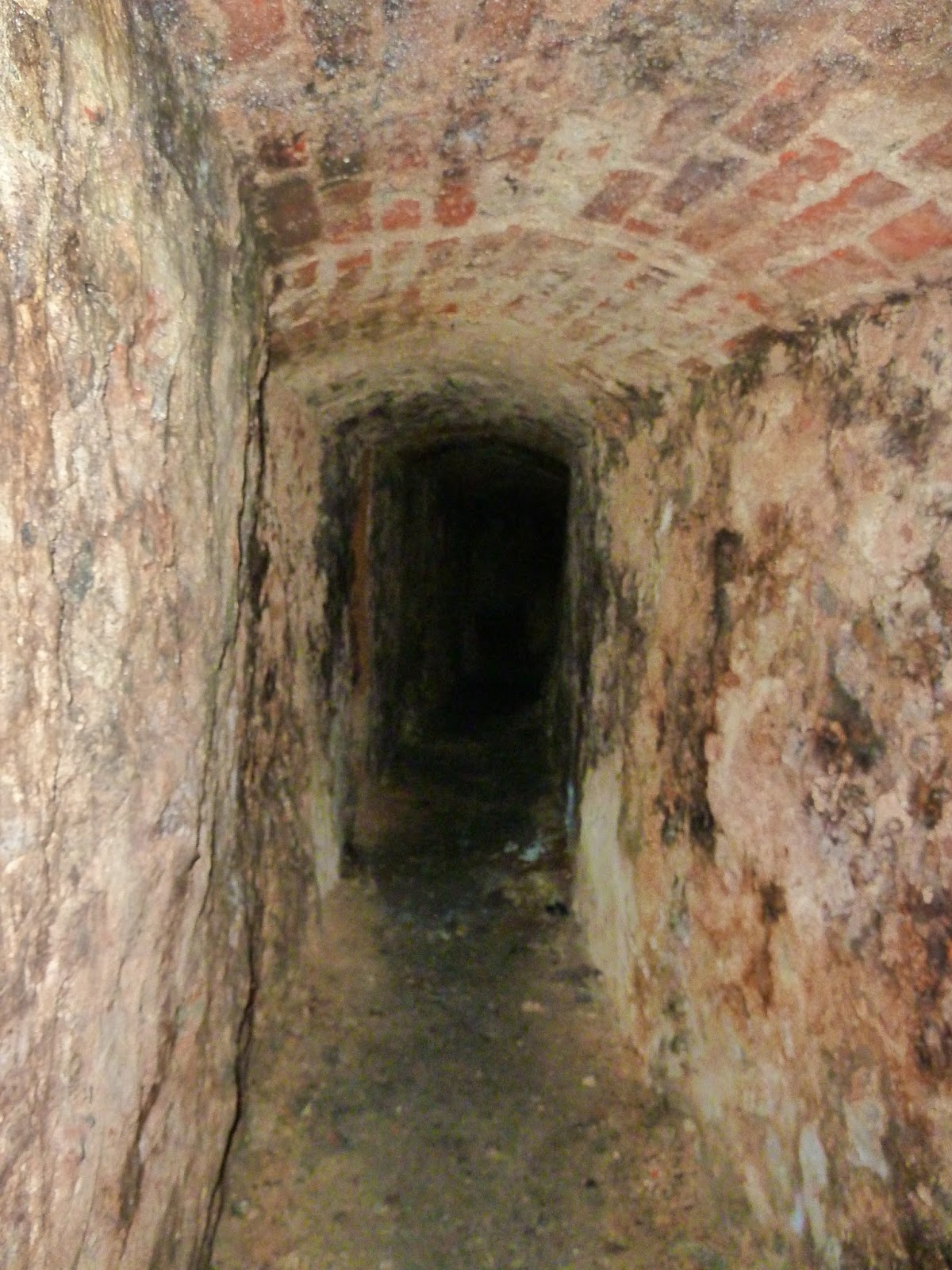
The manager of Boots kindly agreed to show me the tunnels and we started in the extensive basement cellars, now used as store-rooms. As we entered the tunnels, deep under the street, we were plunged into darkness and had to rely on torches. I saw the roof of the tunnel closest to the entrance had been rebuilt with bricks, and the remains of an ancient fireplace, complete with chimney. This seemed an odd luxury to have in a tunnel and could be further evidence for its use in the past to hide people who might need a fire for warmth. 

Further down the tunnel the roof was roughly hewn through bedrock. This looked to have been done centuries ago, as there was calcification of the surface, which must have taken a long time to form. Unfortunately the tunnel had several exits which were bricked up, but although it wasn’t possible to follow the trail to the harbour, I could see the stories of how the Tudor’s escaped from Tenby could be true.

After emerging back into the bright sunshine I went to pay my respects to the good friend of the Tudors, Thomas White. Visiting the church and looking into his sculpted face reminds me he was a real person, who left his mark on the town and helped change the history of Britain.

The day of the Tudor’s escape doesn’t seem more than five centuries away as I walk from the church in the high street, down the narrow lane with uneven stone steps. I pass the timber-framed Tudor merchant’s house, now a Tudor museum, and see men preparing their boats in the sheltered harbour. It was from here that Jasper and Henry sailed into their long exile, to return to claim the English throne.

I have sailed from this harbour many times, including in complete darkness to catch the tide, just as the Tudors would have done.  There are perilous rocks just below the surface as you head out into the Bristol Channel bound for the equally hazardous Land’s End, which their ship had to navigate before they could even begin heading for the uncertain welcome they might receive in Brittany.

There is a great sense of freedom as you leave the confines of the little town with its narrow streets and pass the monastic island of Caldey before heading out into open water. I can imagine Jasper and Henry Tudor would have stood at the ship’s rail and watched as the last pinpricks of light disappeared from view. They must have felt relieved to escape but also sadness to be leaving their troubled country as refugees, owning only what they could carry and with no idea of when, if ever, they would be able to return.  

In the second part of this journey I chose instead to sail for Brittany from the shorter route of the safe harbour of Portsmouth, passing on the way the bright yellow buoy marking the site of the tragic sinking of a warship belonging to Henry Tudor’s son – the Mary Rose.


0

3 July 2016

Guest Post ~ A Pitchfork Rebellion in Dark Age Cornwall, by Mary Anne Yarde


Novella Available on Amazon UK and Amazon US

When the devil wanted to destroy the world he would do so with fire. Alden du Lac knew this for a fact, because the devil had come to Cerniw. Alden may have driven the man who tortured him from his lands, but he can do nothing to drive him from his dreams.

Despite is's obscurity, the Dark Ages is one of the most significant periods in British History. So much happened. The Roman's who had ruled this province from AD 43 until c. 410, up and left. The Anglo-Saxons invaded and they drove the Celtic inhabitants to Scotland, Wales and Cornwall. England, as we know it today, was born during this period. And, of course, this was the time of one of the greatest heroes in English history. Arthur.

Was ever there a myth that captured the imagination quite like the stories of King Arthur and his knights?  I grew up near Glastonbury. There used to be a sign if you entered Glastonbury on the Wells Road that said:


It was magical. It is a magical place where such stories can be believed. Of course, Glastonbury is just one of many places associated with Arthur. Today, I want to take a look at Cornwall. Cornwall has embraced the Arthurian legend and made it her own.

Cornwall was the home of King Mark – the cuckolded king in the legend of Tristan and Isolde. Cornwall is also where you will find Tintagel Castle, which thanks to Geoffrey Monmouth and his great work The History of the Kings Britain, is now associated with King Arthur.

My novella, The Pitchfork Rebellion, is set in the year 496 AD in Cerniw (Cornwall) and part of a series called The Du Lac Chronicles, which is a post-King Arthur, historical fantasy. I spent many hours researching not only the legends of Arthur but also the land that he is associated with. Arthur's story can take you on quite a journey. England, Scotland, Wales and Brittany all claim him as their own. But as I wanted to centre my story around the Saxon King, Cerdic of Wessex, I decided to keep to the South of England - In particular Wessex and Cornwall, with a quick trip across the Channel to Brittany. 

Cornwall has a very interesting past and in the Dark Ages, she is very much her own kingdom, separated from the rest of Britain, not only by her language, Cornish, but by an independent spirit that refused to bow down to imposed authority. Regardless of where the threat was coming from, she wasn't going down without a fight. For an example let’s look what happened when the Roman’s came. The Roman occupation of Cornwall is very intriguing. It has been suggested that the Roman's stopped at Devon. There are a few milestone and evidence of Roman occupation in Cornwall, but not on the scale of the rest of the county. But it doesn't stop there. Cornwall was the last kingdom in the South to hold out against the Saxon's as well. 

Why? What made Cornwall different?

There are many reasons, but I think trade had a lot to do with it. The Cornish could be independent because they knew what they were doing when it came to commerce. They had trade agreements with Brittany, Wales and Ireland. Cornwall had something everyone wanted. Tin. The history of mining for tin goes way back, and one thing they were good at was mining for it. Silver has also been found in Cornwall. The land is rich with treasure for those who know where to look. And trade means money, and money means they could afford the arms to defend their kingdom.

Cornwall did eventually fall under the control of Dumnonii (Devon), possibly due to a plague that hit during this time. But Dumnonii had an ambitious neighbour, and it was only a matter of time before they too bowed down to the Saxon aggressor.

I am fascinated by the Saxon invasion, in particular, Cerdic of Wessex and his journey to being crowned High King. While other kingdoms fell by the wayside and became incorporated into the Wessex realm, Cornwell held her ground. Cerdic landed in Hampshire in c.495. By 419, Cerdic had conquered the south of England, with the exception of Cornwall. It wasn't until the Battle of Hingston Down, in 838, when Cornwall lost her independence to Wessex – they repelled the Saxons for over 400 years. Now, that is impressive.

What bravery, what spirit this little kingdom had. The stories of Hadrian's Wall and Scottish rebellion is renowned, but we forget about Cornwall. I wanted to incorporate this spirit of independence into my story. They would not be ruled.

In The Pitchfork Rebellion, Alden du Lac, son of Lancelot, has just won his kingdom, Cerniw, back from Cerdic of Wessex and now he has to take stock, bring his country back together under his leadership, and rebuild a stronger and greater kingdom that could stand against another invasion. But things are never easy, and Alden faces many challenges from both home and abroad before he can settle back into leadership. I hope I have brought to the attention this great nation, which wasn't afraid to take a stand against what it believed in. Cornwall is the epitome of the word – Freedom!

The next book in the series, The Du Lac Devil, is due out later this year. I will be taking my readers across the sea and back to Brittany, where things are never what they seem.

Mary Anne Yarde
# # #


About the Author

Mary Anne Yarde grew up in the southwest of England, surrounded and influenced by centuries of history and mythology. Glastonbury—the fabled Isle of Avalon—was a mere fifteen-minute drive from her home, and tales of King Arthur and his knights were part of her childhood. At nineteen, she married her childhood sweetheart and began a bachelor of arts in history at Cardiff University, only to have her studies interrupted by the arrival of her first child. She would later return to higher education, studying equine science at Warwickshire College. Horses and history remain two of her major passions. Mary Anne Yarde keeps busy raising four children and helping run a successful family business. She has many skills but has never mastered cooking—so if you ever drop by, she (and her family) would appreciate some tasty treats or a meal out! Find our more at http://www.maryanneyarde.blogspot.co.uk/ and find her on Twitter @maryanneyarde.

2 July 2016

Book Launch ~ Kingmaker: Divided Souls, by Toby Clements


New on Amazon UK and Amazon US

Lent, 1469:  The recent wars between the House of York and the House of Lancaster seem over. The Yorkist King Edward sits on his throne in Westminster, while the Lancastrian claimants are in exile or under lock and key in the Tower.

But within the family of York there is discord. The Earl of Warwick conspires against his King, and while to one another's faces they are all smiles, their household men speak in lies and whispers.

No man comes to court unarmed.  Thomas and Katherine have returned to Marton Hall, the only home they know.

But what lies buried in the past cannot remain so for long, and soon they are forced to take up arms once more in one of the most savage wars in history.  The Wars of the Roses .

An enthralling adventure story, honest and powerful. The Wars of the Roses are imagined here with energy, with ferocity, with hunger to engage the reader.' Hilary Mantel

# # #

About the Author

Toby Clements has had a lifelong interest in the period of history we now call the Wars of the Roses. Early influences include the Ladybird classic Warwick the Kingmaker, but since then he has moved on, reading everything he can get get his hands on, and spending long days at various reenactment events around the country. 


1 July 2016

Book Launch ~ Insurrection: Henry VIII, Thomas Cromwell and the Pilgrimage of Grace, by Susan Loughlin


New on Amazon UK and Amazon US

Autumn 1536. Both Katherine of Aragon and Anne Boleyn are dead. Henry VIII has married Jane Seymour, and still awaits his longed-for male heir. Disaffected conservatives in England may have seen an opportunity for a return to Rome and an end to religious experimentation. 

However, Thomas Cromwell has other ideas. In August, the Lutheran influenced Ten Articles of the Anglican Church was published and the dissolution of the monasteries had started. The obstinate monarch, enticed by monastic wealth, is determined not to change course. Fear and resentment has been unleashed in northern England in the largest, spontaneous uprising against a Tudor monarch. 

That rebellion is the Pilgrimage of Grace, in which 30,000 men have taken up arms against the king. This book reviews the evidence for that opposition and examines the abundant examples of religiously motivated dissent. It also highlights the rhetoric, reward and retribution used by the Crown to enforce its policy.
# # #

About the Author

Susan Loughlin is a historian and author from London and currently lives in Ireland. She has a First Class Honours B.A degree in History & Political Science from the National University of Ireland, Galway and was awarded the titles of University Scholar and Galway Doctoral Research Fellow, and completed her PhD (NUIG) in 2013. Her book 'Insurrection' is based on her Doctoral thesis. 

30 June 2016

Book Launch Guest Post ~ For The Most Beautiful, by Emily Hauser @ehauserwrites


New on Amazon UK and Amazon US

Women of the Trojan War

It was a war that gave birth to legends — to Achilles, the greatest of the Greeks, and Hector, prince of Troy. Three thousand years later, it’s time for the women of Troy to tell their story…  The daughter of a prince should never defy her father and an imprisoned princess should never fall in love with her captor. However, in turbulent times, rules can be broken. And as war raged, the lives of two women collide. Captives of the Greeks, Briseis, princess of Pedasus, and Krisayis, daughter of the high priest of Troy, are pawns in a battle fought by men. But choices they make will determine their fate and that of the city and its people they hold dear, in an epic tale that has waited millennia to be told…


My debut novel For The Most Beautiful is a re-telling of the tale of the Trojan War, one of the greatest legends of all time, from the point of view of two women, Briseis and Krisayis. These women are mentioned in Homer’s Iliad, the archaic Greek epic which tells the story of the battle for Troy. But, as many of us know, Homer’s version of the Trojan War is anything but a woman’s story: it’s filled with overweening heroes (Achilles, Hector, Odysseus, to name but a few), male gods, and blood-and-guts battles between the Greeks and the Trojans.

When I set about writing For the Most Beautiful, one of the things I wanted to do most was to recover and re-tell the experiences of the women of Troy. The question is often asked, why does history matter? And why re-write it? To me, the fact that the legend of the Trojan War has been passed down for thousands of years suggests that there has to be something in it that appeals to us; something about it that allows us to reflect on who we are as humans, why we’re here, and who we want to be. So what is it? Perhaps it’s the very human wrath of Achilles that draws us in, or the tragedy of the death of Hector as we watch his wife, Andromache, cope with her grief at his loss. These are very real human tales, and they are ones that are enduringly relevant.

But I began to wonder if there wasn’t also another way in which we might be able to connect to the story of the Trojan War, another way of seeing it that might allow us to understand it – and ourselves – a little bit better. When I looked more closely at the stories of Briseis and Krisayis (spelled Chryseis in the Iliad), I discovered a completely new tale lying hidden within the text of Homer’s epic. The story tells how Briseis, a princess of Pedasus (a city nearby Troy), saw her husband and three brothers killed by Achilles – and then was captured by him as a sex slave. Krisayis, my second protagonist, even opens the Iliad with a debate over her release when her father, a Trojan priest, wants to ransom her from the Greek camp. These women lie at the very heart of the action, and by looking at their stories, we discover not only a breathtaking tale full of courage, betrayal and sacrifice – but also a new way of looking at the Trojan War.

But why focus on the women? I’ve studied the classical world for many years, first at Cambridge and now at Yale, and one of the enduring fascinations for me has been the women of ancient Greece and Rome. As the textual record – one of the most reliable sources we have for antiquity – is heavily biased towards men (written both by, about and for men), it’s always been a challenge to uncover the lives and stories of the women of the ancient world. To me, fiction provides a unique way in which to imagine ourselves back into the past, and, grounded in the archaeological and textual details we do know, to bring back the lost voices of the women of the Trojan War.

Emily Hauser

 # # #

About the Author

Born in Brighton and brought up in Suffolk, Emily Hauser studied Classics at Cambridge, where she was taught by Mary Beard. She then went to Harvard on a Fulbright Scholarship, and now studies and teaches at Yale, where she is completing her PhD. For the Most Beautiful – the first book in a trilogy based on the myths of the Golden Apples – is her debut novel. Find out more on Emily’s website, and follow her on Twitter @ehauserwrites. 

Blog Tour: The Lord of Ireland (The Fifth Knight Series Book 3) by E.M. Powell #HFVBT


Available on Amazon UK and Amazon US

England, 1185. John is a prince without prospect of a crown. As the youngest son of Henry II, he has long borne the hated nickname ‘Lackland’. When warring tribes and an ambitious Anglo-Norman lord threaten Henry’s reign in Ireland, John believes his time has finally come. Henry is dispatching him there with a mighty force to impose order. Yet it is a thwarted young man who arrives on the troubled isle. John has not been granted its kingship—he is merely the Lord of Ireland, destined never to escape his father’s shadow. Unknown to John, Henry has also sent his right-hand man, Sir Benedict Palmer, to root out the traitors he fears are working to steal the land from him.

How to Write a Historical Thriller

It’s a real privilege to be able to write a guest post here on The Writing Desk. This is one of the blogs I come to when I am seeking writerly wisdom and advice and I hope I can add to that! Today I’m sharing what I know about writing a very popular sub-genre: the historical thriller. This is the category into which my medieval Fifth Knight series belongs. As the sales for the series are now into six figures, I must be doing something right.

For those of you for whom the historical thriller is an entirely new concept, I also suggest you read Robert Harris’s hugely enjoyable Pompeii or any of C.J. Sansom’s magnificent Tudor Shardlake series. Ken Follett is a marvellous read, too.

In discussing this topic, I’m including the related mystery and crime sub-genres, as thriller, crime and mystery have huge crossovers. Note that the historical thriller is also a sub-genre of the giant of a genre that is the thriller, as well as historical fiction. You may be wondering why I’m so hung up on genre definition. But this brings me to my first point.

Define your genre- and thus your market

By being clear about what your genre is, you are already starting to define the market for your novel. You may be a writer who likes to write for the sheer pleasure of it. Nothing wrong with that. But if writing to make money (as in ‘Pay Electric Bill’ rather than ‘Buy Island’) is your aim, then defining your market one of the things you need to consider from the outset. Like it or not, readers mostly make choices on whether a book will appeal to their existing taste.

‘But I don’t know what my market is!’ I hear you cry. ‘I haven’t written/sold the thing yet!’ Think of it in terms of a bookshop. If you have a historical thriller that has a young woman on the cover in a big dress, beautiful though it may be, it is highly unlikely that a reader who favours a cover with a broken sword and a dented helmet lying in the mud is going to pick it up. You need to decide not only on your story, but the tone and the level of violence and what its themes are going to be. If your dented sword cover has a plot that centres on embroidery or vice versa, be prepared for the 1* reviews and indifferent sales.

Do your research- but it’s still a thriller

Part of what draws us all to writing historical fiction is that we all love history. We especially love our own specialist areas of history. Any novelist has to do some research, but the commitment is huge in writing historical fiction. We all want to make our novels as representative of our time and place as we can. We want to get the facts right. We want our readers to be immersed in our worlds. And of course, that’s all well and good. It’s what our readers, people who love historical fiction demand.

In your hard, hard work to get the type of grain in the field correct or the right baron on the right horse, do not neglect the other important element: you are writing a thriller. Your readers will expect action. They will expect pace. They will expect intrigue. They will expect danger. They will expect violence, betrayal. Murder. Mayhem. They will expect to be surprised.

If these elements are missing, then you may not be writing a historical thriller- you may be writing something different. Nothing at all wrong with that. But ask yourself the question. It might also be that you’re not writing a thriller, but these elements are creeping in and you’re enjoying them the most. Then maybe you’re a thriller writer at heart, and you need to ramp up all those elements and really, really go for it.

It’s not serious historical fiction- is it?

Anyone who writes genre fiction faces criticism. Genre fiction is commercial fiction. It’s not literary or serious fiction. Those of us who write commercial fiction know perfectly well that our work can be sneered at. But ask yourself this: what do you read? If the answer is that you like to read commercial fiction, then why not write it? You enjoy it hugely. That’s what you want your readers to do.

You know how much hard work you’ve put into making your book the best it can be. The hours and hours that you’ve put into creating worlds and characters your readers can get lost in and will keep them hooked until the last page. In my book, that’s serious. Go forth and thrill!

E. M. Powell
# # #

About the Author

E.M. Powell is the author of medieval thriller The Fifth Knight, which was a #1 Amazon best seller. Born and raised in the Republic of Ireland into the family of Michael Collins (the legendary revolutionary and founder of the Irish Free State), she now lives in the northwest of England with her husband and daughter and a Facebook-friendly dog. She is a regular blogger on English Historical Fiction Authors and a reviewer for the Historical Novel Society. Learn more about E.M. Powell on her website www.empowell.com and find her on Twitter @empowellauthor.


Blog Tour Schedule

Thursday, June 9 Review at Impressions In Ink Friday, June 10 Excerpt & Giveaway at Passages to the Past Monday, June 20 Review at Oh, for the Hook of a Book! Tuesday, June 21 Interview at Layered Pages Friday, June 24 Review at Dianne Ascroft's Blog Monday, June 27 Interview at Oh, for the Hook of a Book! Tuesday, June 28 Review at CelticLady's Reviews Wednesday, June 29 Review at Book Nerd Thursday, June 30 Guest Post at The Writing Desk Tuesday, July 5 Excerpt at What Is That Book About Thursday, July 7 Guest Post & Giveaway at Let Them Read BooksMonday, July 11 Review at A Book Geek Saturday, July 16 Review at Bookramblings Monday, July 18 Review at Just One More Chapter Friday, July 22 Review at Broken Teepee


04_The Lord of Ireland_Blog Tour Banner_FINAL

28 June 2016

Guest Post - The Shadow of a King, by C. M. Gray @cgray129


Available on Amazon UK and Amazon US

In his fifteenth year of rule, King Uther Pendragon - High King of all the Celtic Tribes - is set on a quest by Merlyn and the druids of Mona, to brave the winter seas and set sail for the Isle of Erin. The quest placed upon the king, despite the tribal lands being at war with Saxon invaders, is to take a war party and return with a prize that will lay to rest the ghosts of the past and allow the Celts to reclaim their lands. But none of those who set sail realize what this quest will release within their king, and what events will unfold. 

I started writing because I was bored, brutally honest but true! I always loved to read, but I had never ever thought about writing anything myself, but then, back in 2010 I got bored… television was my undoing. I realised that I was returning home from work every night and allowing my brain to be entertained in front of the ‘idiot box’  - I couldn’t even remember what I had been watching most of the time!

So I sat at my laptop and stared at a blank screen for a while until a line came to me… - ‘The floorboard creaked under the sole of his felt boot – a calculated risk when entering a sleeping man’s room uninvited.’ – I was hooked by the writing bug! That first line became my first book, The Flight of the Griffin, a fantasy that was ‘longlisted’ for the 2013 Times/ChickenHouse Children’s literary awards. I have since written a sequel to this called Chaos Storm and both have a good following of readers, young and old, who enjoy fantasy adventure.

It wasn’t until I got to my third book that I discovered my real love, which is for the Dark ages and medieval times. Especially legends surrounding the main Arthurian legend.  Much has been written about King Arthur, Merlin the Druid and the Lady of the Lake. There are some wonderful characters within this legend that we can really relate to and we all love the story, the romance and the clash of steel.

However, when I started writing the Shadowland books I decided that the story of Arthur and his Knights had been too well told by some amazing authors and it had almost all been said. I could have invented a story around the legends and given a slightly different take  which would have been entertaining and fun to do, but I decided to look for a lesser told story within the Arthurian theme.

My tale from the Dark Ages starts with an old storyteller who gathers an audience of villagers around him, by a village Inn’s log fire, one midwinter’s eve. He is persuaded to tell a story from his own youth rather than a tale of fancy, and it becomes a retelling of the rise of Uther Pendragon.

Uther was the father of Arthur. He was the man who rose from a humble beginning within the Isceni tribe to unite all the tribes of Britain against a common foe - the Saxon invaders. Under Roman rule, the tribes had lived a simple, relatively untroubled life, but around AD 410 the Romans realised their empire was in peril and departed, packing everything of value they headed to their ships and sailed away. This happened relatively quickly and left a power vacuum in Britain that the Saxon’s, Jutes and Angles immediately took advantage of – the tribes of Britain needed to unite if they were ever going to claim Britain as their own, they needed a strong leader.

In my first book, Shadowland, I tell of the rise of Uther. How as a boy he met Merlyn and how he discovered he was destined to lead the Britons against the Saxon invaders after his brother Ambrosius died. As much as possible I have kept faith with all the old legends and stories told of Uther and the early years of Merlyn, but because this was the dark ages and so little is factually known, I’ve thrown a bunch of fantasy and a little Druid madness into the mix to make it more interesting.

Shadowland has been really well received with over 250 Amazon reviews and although I intended it to be a stand-alone story, I have been getting so many requests to follow up with another Uther story that almost two years ago I began to write a sequel.

The Shadow of a King was published in May 2016. It tells a very different tale from the first, but still taken from the legends of Uther. Persuaded on his deathbed to tell the story of how he accepted a Druid’s quest to journey to the Isle of Erin and there to bring back the ring of stones known as the 
Giant’s Dance and then upon his return how he met his love, Igraine.

If you enjoy Arthurian Legend, I hope you will try Shadowland and The Shadow of a King. Neither are written to be factual books of history, very little fact remains from those times leaving the interpretation of legend open to an author’s imagination. These are merely accounts of how it might have been…

C. M. Gray
# # #

About the Author

Born in Essex England, C.M.Gray has travelled and lived in many different places in our world, from Hong Kong and India, to a farm in Burgundy France and now a house in the hills outside of Barcelona, Spain. He has been a carpenter, a stockbroker and grower of wines, life is an ongoing adventure! Writing is a passion that has so far produced four books, all of which have been Amazon bestsellers, The Flight of the Griffin, Chaos Storm, Shadowland and The Shadow of a King. Learn more about C.M.Gray and his books on his website www.author-cmgray.com and find him on Twitter @cgray129.