9 February 2022
My publishing history - a nostalgic look back following news of Smashwords and Draft2Digital Merger
6 October 2021
How to convert your eBook to paperback or hardback in six simple steps
Some people will never read an ebook, and I like to offer readers the choice of paperback, hardback or audio editions, all of which can be produced at no cost other than your time. I know the advice is to use professional designers, both for the cover and the interior, but I wanted complete control over the process, and interested to see what you can do using Vellum, Photoshop, and the KDP cover design tools:
Step 1. Make sure your manuscript is as good as it can possibly be before uploading to Vellum. Your starting point needs to be the edited version of your book, ideally in Word, with all the front matter, copyright wording, dedications, foreword etc. sorted. (I looked at a range of printed books by my favourite authors and copied the layout). It's easy to make any changes in Vellum - and the advantage of doing it yourself is you can make future changes in minutes (such as adding your new book at the back) at no cost. All you need to do then is produce the files from Vellum by clicking 'Generate':
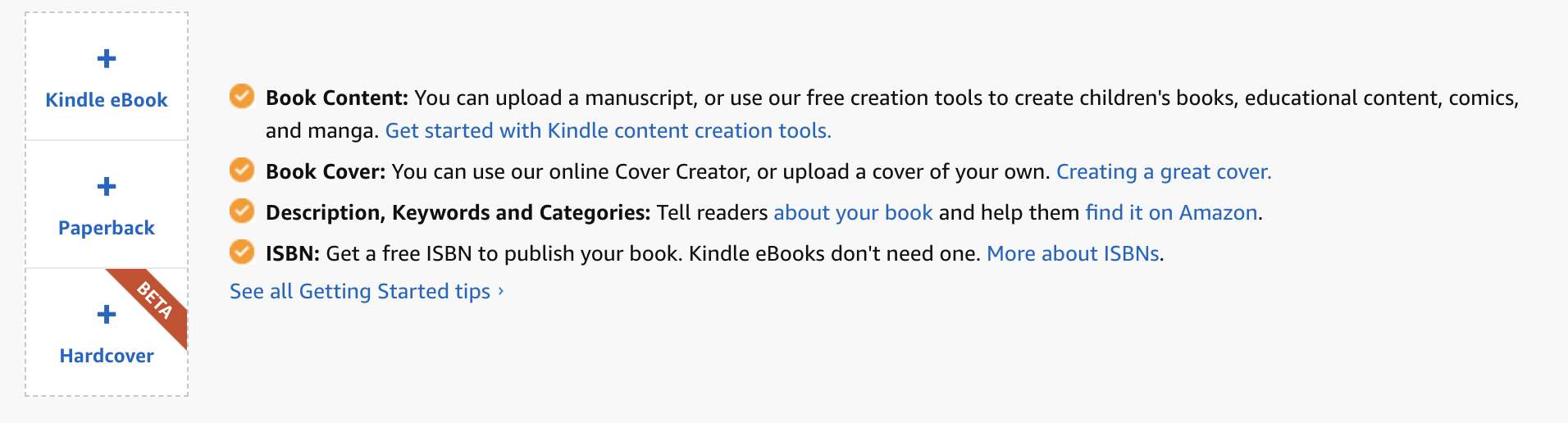
Step 2. If you have an eBook in KDP, go to Bookshelf and click on Create Paperback or Create Hardcover (which is in Beta but works well and is easy to use). If not, you can set up a free publishing account on Amazon KDP. The process is quick and easy, as the setup screen uses all the information from your eBook. There is plenty of help and guidance if you need it, including links to articles on how to write an effective book description and some advice on titles and keywords. KDP cal also assign a free ISBN for your book.
Step 3. Upload the Interior content. I use the PDF created by Vellum (which is a single click process). Choose white or cream paper and matt or glossy cover,
Step 4. Use the online cover creator, and upload a jpg if you already have a great cover, or you can use an editing tool such as Photoshop to make any changes or fine adjustments. The ‘cover creator’ automatically formats the cover based on your book's size and page count. (You need to make sure nothing important touches the dotted guidelines, or your cover will be rejected.)
Step 5. Review the Proof of your book and update. (If you want any changes, you can go back to steps one or two before you invest in a published proof copy.)
Step 6. Decide your pricing and distribution. There is plenty of advice on book pricing strategies, much of it contradictory. I decided to set my paperback price at the market average. Then click 'Publish your book'.
This is well within the skills of anyone who has already created an eBook, and doesn’t cost anything other than the cost of your one copy, unless you pay for graphics or design. Happy publishing!
Tony Riches
See also: Using Vellum as a publishing tool
16 March 2021
Special Guest Post by Sharon Woodhouse, Author of Pitch What's True: A Publisher's Tools for Navigating Your Best Path to a Published Nonfiction Book
Cheat Sheet: Find the Right Publisher for Your Non-Fiction Book
- Spend a few hours on Amazon researching existing books on your topic and any topic, really, that is aimed at your book’s likely audience. Take in all you can about these titles—such things as sales rankings, reviews (what do readers like about the books? dislike? want more or less of? what do they care about? what are their hot buttons?), their packaging and marketing (what can you infer about how they’re titled, designed, and promoted?), what books customers also purchased. Finally, you want to know…who is publishing books such as yours?
- Visit the biggest bookseller near you and see which companies are publishing books on your topic and closely-related topics. Note those publishers whose approach, style, design, vibe, etc. you like and are a good fit for your book and its intended audience. Where Amazon can give you breadth, depth, and near-instant information, there is also much to be gleaned from holding physical books and assessing their properties and the decision-making that went into them.
- As you go about the above two activities, create a list of desirable and suitable publishers. Aim for a list of 50 to at least 100 publishers—seriously. Consider any press that might be a match: micro, small, independent, niche, regional, academic, nonprofit, organizational, religious.
- Consult the Literary Marketplace guide found in the reference section of most libraries to see which publishers are looking for books on your topic. This hefty annual contains detailed entries on publishers that include such information at publishing specialties, submission policies, acquisitions practices, etc., along with useful articles for aspiring authors. Add the most interesting and relevant publishers to the list you’ve started. (LMP is available online for subscribers—the annual fee is $459.50 US if you’re feeling spendy, but the $24.95 US for a week’s access serves just as well for the diligent and organized.)
- There are various other directories and listings of publishers online, but in my experience, they are mostly redundant (if you’ve done the above steps) and/or heavy on teeny-tiny, out-of-business, scamming, or self-publishing (pay-to-play) operations.
- Visit the websites of companies on your list and spend time getting a sense of who they are.
- While on those websites, read the company’s submission guidelines (nearly 100% of publishers’ websites now contain this information and you usually don’t have to dig around too much for it either). If you learn your book is not a good fit for them, remove them from your list and move on.
- As you go, prioritize your list of potential publishers based on a combination of your book’s right fit for them and their desirability for you.
- Next, submit your book proposal package per the instructions (to a tee) on their websites to the publishers on your list, starting at the top and working down. (Think big from the start…don’t “work up” to them!) Simultaneous submissions are okay unless stated otherwise. Divide up the work as makes sense to you, but I’d advise sending them out in batches of 2 to 10 each day in a steady stream until you either reach the end or have a contract. Commit to the project and concentrate your efforts. Don’t drag it out. Publishing takes a long time! You either want to find a publisher in a reasonable amount of time or move on to considering self-publishing or hybrid options.
- If a publisher’s submission guidelines aren’t specific, think of a book proposal as a “business plan” for your book, and a publishing contract as a “business agreement” between you and the publisher, and it will be hard to go wrong.
- Keeping in mind the restrictions the publisher lets you know about in advance and the publishing process from the publisher’s perspective, give them your best, savviest shot, knowing that you are essentially competing—even at the smallest presses—against hundreds or thousands of others for only a few coveted spots. Use your passion and imagination to catch their attention, pique their interest, impress them, persuade them…whatever won’t cause them to immediately know your proposal’s a “no.”
- Unless the submission guidelines prohibit it (or politely request not to do it), plan to check in with every publisher you’ve contacted and not heard back from 30 to 45 days after your initial contact.
- Use every aspect of your initial contact(s) with a publisher to show your professionalism, your attention to detail, your work ethic, your understanding of their business and their point of view. All other things being equal, they’ll almost always choose the author who’s more professional and easier to work with.
- If anyone takes the time to jot you a few notes about your book (with their rejection), see what you can learn from the experience and take steps to use that knowledge to your benefit. Tweak future submissions as necessary.
- Don’t give up. Periodically review your proposal with fresh eyes and upgrade it as necessary. Get advice from others (preferably those with some knowledge of the process). Keep sending it out. Keep your brain trained on new ways to pitch your book, on new opportunities to get it published, and on ways to improve your book in the meantime.
- Create and know your contingency plan. Create a schedule around it. How long will you devote to finding a publisher? If you don’t find a publisher in that amount of time, will or won’t you pursue self-publishing? What self-publishing options are out there, how and when will you learn about them, and how will you assess them?
10 February 2021
Guest Post: Writing a Novel, by Saga Hillbom ~ Part Two: The Publishing Process
"Traditionally published books are of a higher quality. Self-publishing is for those who failed."
An acquaintance of mine said these exact words to me when I was fifteen and considering which way I would want to publish my debut novel. Now, the novel was, to put it bluntly, shit. That is why I later removed it from the market and am currently rewriting it—but I did receive a couple of offers from literary agents.
Recalling what my acquaintance had told me and what I knew was a common view of traditional versus self-published books, it felt like a no-brainer to accept one of the offers. However, I did not. Creative control has always been extremely important to me; I write because I love it, and I want to have full power over what happens to my finished product. Moreover, I was eager to get my book out there, as I imagine most writers are. To wait a couple of years before seeing it in print, to have others influence my cover design and tell me what I had to edit out from the manuscript—all this felt harrowing.
When I first began self-publishing, I was a complete novice and made more mistakes than correct choices. I have still not mastered the process, but a lot has improved. For example, I have learnt how to professionally format a book, how to market myself, and which cover designers to hire. Although I far from enjoy the publishing process, I do not feel quite as lost, and I am glad that I chose creative control over supposed higher status. There are terrible traditionally published books just as there are fantastic ones; the same stands true for the self-publishing market. No matter which way suits you best, there will always be both good and bad reviews.
I use Ingramspark to print my paperbacks and Kindle for my ebooks. This combination works best for me. Ingramspark has given me various issues over the years, such as making my book available to retailers before either of my ‘publishing’ and ‘on sale’ dates, but I stick with it. If you are planning to self-publish your book, be sure to check whether there are any promo codes available. Around November, you can usually find a code for NaNoWriMo, saving you the fee for uploading files on Ingramspark.
In August 2020, I ordered the cover for my historical novel Princess of Thorns from my favourite freelance graphic designer, who has made the covers for my previous books as well. There are not many stock images out there depicting accurate 15th century fashion, so I had to settle for the best I could find.
The girl on my cover is therefore a compromise between historical accuracy, visual appeal, and the protagonist's appearance. The crown encircling her legs is obviously symbolic of the literary themes. To tell the truth, I sometimes feel that all my books look more ‘girly’ than they are once you actually read them. While there is absolutely nothing wrong with chick lit, I hope my designer and I have managed to convey the right mood for Princess of Thorns. Overall, I was very pleased with how the cover turned out.
As part of my publishing and marketing process, I have started a series of Instagram posts about medieval and early modern England. This is partly to attract my target audience, partly to keep me busy while I go through the periods of waiting associated with releasing a book. The series of posts centers around the Wars of the Roses, including everything from battles to major and minor personages, but also covers 15th century food and clothes. In my experience, the publishing process can be quite frustrating at times, so I really recommend having another little project on the side.
This has been a shorter post than the one I wrote about my writing process, but perhaps that is because publishing is simply not what I feel the most passionate about. I would say that I publish because I write rather than the other way around, if you see what I mean. Someday, I might sacrifice a bit of creative control and give traditional publishing a proper go, but not with Princess of Thorns. As for now, I am about to bundle myself up in a blanket, make a cup of tea, and flick through my proof copy.
Saga Hillbom
26 September 2020
Special Guest Post by Publishing Consultant Natalie Audley
My name is Natalie Audley, and I am a Publishing Consultant who has spent the last six years working across the industry. I have worked with hundreds of authors, from debuts to household names, and I know what makes them sell.
In my work I have managed and marketed a variety of genres and learnt a great deal about how and why something sells. I have a great passion for literature, as well as respect for those who love to write. My abilities at selling books, from being a bookseller to pitching thousands of copies to Amazon, means I know how to communicate great ideas with personable flare.
The aim of my publishing consultancy is to support new writers in developing their fiction or plays, with a view to what sells. Having worked for some of the major and bestselling independent publishers in London, I have an excellent radar for what will sell, and how to make the most of your writing. In terms of playwriting I have been a reader for the last three years at one of the premier new writing venues in London and have managed my own theatre company, producing eight shows since 2013 and performing at Edinburgh, Camden and Brighton Fringes.
With my insight to the market I can help you establish your ideas, restructure and develop your work, and give you advice on how to approach agents. I can help you to understand the markets you would sell into, and how this would work for you as an author.
I am happy to assist you from initial idea to final pitch, with the aim of having a novel which could be sold into Waterstones, Amazon and wholesalers as well as independent bookshops. My expertise can help tailor your manuscript into a piece that’s ready for success.
As a Publishing Consultant I am not an editor, but my in-depth experience as a publisher will talk you through the process of building up your story, with a focus on where you need to develop each section of your writing as if it were a business model:
- Initial idea
- Planning
- Drafting
- Editing
- Synopsis/Pitch
My advice will be predicated on advising you how to make your writing as commercially viable as possible. Of course, I am happy to see a range of fiction pitches whether these be literary, genre or YA. My experience in both print and digital publishing will give insight to authors seeking an agent, or those looking to self-publish off their own bat.
Natalie Audley
# # #
About the Author
Natalie Audley has worked in publishing for the last six years, beginning as a Waterstones Bookseller before working in several independent publishing houses in London. Natalie has a BA and Masters in English and Creative Writing, and completed a playwriting course at Brighton Theatre Royal Young Writers Scheme. Her playwriting has been shortlisted by The Bruntwood and the Papatango Prizes, and she has been awarded several grants to stage her plays. For more information visit her website and follow her on Twitter @NatalieAudley1615 August 2020
Book Review - Six Tudor Queens: Katheryn Howard, The Tainted Queen, by Alison Weir

Alison Weir is the New York Times bestselling author of the novels Innocent Traitor and The Lady Elizabeth and several historical biographies, including Mistress of the Monarchy, Queen Isabella, Henry VIII, Eleanor of Aquitaine, The Life of Elizabeth I, and The Six Wives of Henry VIII. She lives in Surrey, England with her husband and two children. Find our more at Alison's website http://www.alisonweir.org.uk/ and fin her on Facebook and Twitter @AlisonWeirBooks
Disclosure: I am grateful to Alison Weir's publishers, Headline Books, for providing a review copy.
22 December 2019
10 Publishing Myths: Insights Every Author Needs to Succeed, by W. Terry Whalin
10 Publishing Myths offers authors the chance to succeed in the publishing world by giving them practical tools they can use to succeed and dodge the myths of the industry.
The publishing world is filled with misconceptions and myths. Therefore, it is terrific for authors to have big ambitions as their book is being published, but, it is also important to be realistic and understand the world of publishing.
“Terry Whalin’s new book, 10 Publishing Myths, Insights Every Author Needs to Succeed. gives authors solid action steps to take to be successful while increasing their understanding about the business of publishing. He breaks the myths that hinder authors in their journey.” — Susan Reichert, Editor-in-Chief, Southern Writers Magazine.
“10 Publishing Myths, Insights Every Author Needs to Succeed is not merely a collection of “tips and tricks” for writers. Based on years of inside experience, author Terry Whalin offers straight-talk advice to anyone willing to do the hard work necessary for publishing success.” — David Horton, Vice President Editorial, Bethany House Publishers
“For years, so-called truths have floated around in the publishing world, and naïve writers have believed them. In 10 Publishing Myths, Terry reveals the truth and shares important principles that affect a writer’s success. Using examples and stories, he shows what works and then provides plenty of help—including action steps—to encourage writers on the right path. Terry’s vast experience in the industry makes this an excellent resource.” — Cecil Murphey, bestselling author of 140 books, including 90 Minutes in Heaven (with Don Piper) and Gifted Hands: The Ben Carson Story
Terry Whalin has loved books since his mother read And to Think That I Saw It on Mulberry Street (the first Dr. Seuss book). He has worked both sides of the editorial desk—as an editor and a writer. He worked as a magazine editor and his magazine work has appeared in more than 50 publications. A former literary agent, Terry is an Acquisitions Editor at Morgan James Publishing. He has written more than 60 books through traditional publishers in a wide range of topics from children’s books to biographies to co-authored books. Several of Terry’s books have sold over 100,000 copies. Terry is a popular speaker and teacher at numerous writers’ conferences and an active member of the American Society of Journalists and Authors . He lives near Denver, Colorado. Finds out more at https://www.10publishingmyths.com/ and find Terry on Twitter @terrywhalin.7 February 2019
How to Create Large Print Editions of Your Books With Vellum
I've been using Vellum to format my books for eBooks and print editions for several years now and am happy with the ease of use and excellent results. In particular, it is easy to make updates to your text and produce new editions with one click.
The latest version, Vellum 2.5 includes support for production of Large Print editions, which can help you reach the wide readership who may not be able to read a typical paperback. You can use the latest version of Vellum to create a Large Print edition in just a few steps.
- Open Print Settings from Vellum’s File menu. Press More Options to find presets for large print
- Find large print presets by pressing More Options
- When you select one of the Large Print options shown, Vellum will use the indicated trim size and configure everything in your book for Large Print.
- With a Large Print option selected, your text will use a significantly increased font size, equivalent in size to 16-point Adobe Garamond Pro.
A larger font size will result in fewer words per line and fewer lines per page. To counter this, Vellum uses an outside margin that is smaller than what might be used for an equivalent trade paperback. Line spacing will also be slightly tighter than what is typical for such a large font size.
Because of the increased size of text, a Large Print version of your book will require more pages, making it more expensive to print.
As a Large Print edition will be bigger than a standard paperback, you’ll also need to adapt your existing cover layout to the new size.
Large Print on Amazon
Large Print editions require a new ISBN, which means you have to set up a new edition on your Amazon Bookshelf. (Amazon will provide a free ISBN.) When setting up your large print edition, check the Large Print box and your book's Amazon detail page will be marked 'Large Print' and linked to any matching editions. Your book will also be included in, but not limited to, large-print book browse results.
Tony Riches
31 March 2018
The 2018 Guide to Manuscript Publishers, by Emily Harstone
14 October 2017
Using Vellum as a publishing tool
26 January 2017
How to Successfully Market your eBook: A Beginner's Guide by Jo Harrison
This extensive eBook has been created using Jo Harrison's popular, four-part eBook Marketing Mini-eCourse for Authors. The advice you’ll find within is guaranteed to be easy to follow and help bring you those all-important sales.
This short eBook will show you how to:
- Keep energising and promoting your work
- Achieve eBook marketing success
- Become a successful self-published author
Also include marketing tips from previous authors Jo Harrison has worked with, which will provide some extra food for thought
Jo Harrison is a British Virtual Assistant who lives in South West France with two dogs and cat. Over the past 5 years, Jo has worked with both self-published and bestselling authors alike helping them format their books for print and eBook publication. As a virtual assistant, Jo's experience covers designing websites and marketing, including social media and email campaigns, for her clients. For more information see http://joharrison.rocks/ and follow Jo on Twitter @JoHarris0n 4 December 2014
Tracking Amazon Ranking with AuthorRise
It all started with a brainstorm between myself, Co-Founder/CEO, David Goldenberg, and CTO/technical Co-founder Keith Woody. David was a long-time journalist and I was a literature major in college. Our mutual love of books led to us talking to dozens of authors - and we found the problem of growing a readership and putting books into their hands was universal and deeply felt.
Out of that need came AuthorRise. There are lots of promotion sites that offer authors a quick burst of marketing but we wanted to build something that supports sustainable, everyday actions that any author can take and go from zero readers to a successful business. If someone is serious about becoming a full-time author, it takes time, patience and perseverance.
![]() |
| Chris Weber |
19 September 2014
How to get started with Kindle Kids’ Book Creator
Kindle Kids’ Book Creator supports multiple layouts for children’s books, including facing page spreads and accepts the most popular graphic file types, so authors are free to create art in their preferred design tools. You can even import a book from a multi-page PDF, making it easier to take a book originally created for print and turn it into a Kindle book. When you are ready to publish your book, simply go to Kindle Direct Publishing (KDP) to upload your book.
Here's how to get started:
- Download the tool, and you can convert individual illustrations into interactive books for both Kindle devices and free reading apps.
- Once your book is ready, export the file and upload it to KDP.
- Set the book category, age range, and grade range to help customers find the right books for their kids.
24 August 2014
Guest Post ~ Hybrid publishing, by Ben Coles at Promontory Press
It’s always been tough to get picked up as a new author, but these days the publishing world has become so risk-averse that an unknown author has almost zero chance of convincing a publisher to take a big financial risk on them, no matter how good their book is. In the hybrid model, the author and publisher both make an investment in the book, sharing the financial risk and splitting the revenues much more evenly. The hybrid publisher only makes money if the book sells, and therefore the goals of author and publisher are completely aligned.
This is the critical difference between a hybrid publisher and a vanity press. A vanity press (or self-publisher) makes all its money on the fees the author pays up front – selling the book is irrelevant to their business model. The money an author pays a hybrid publisher, however, is only a portion of the costs that the hybrid publisher takes on to produce, sell and market the book. The hybrid publisher MUST sell a lot of copies of the book in order to turn a profit. The author’s investment reduces that initial risk, but doesn’t eliminate it. In the hybrid model, both publisher and author make money only by selling books.
At Promontory Press, we’re always looking for new authors who have something significant to say. We meet authors at every stage of their writing, but the earlier in the process we meet the better. If the author comes to us with an idea or an early draft, we as a team can assess both the quality of writing and the market potential of the book, giving the author a clear sense of what will be required to get the book ready both for publication and for the essential marketing support that every author has to give their book.
- The market potential of the book – do we think that the audience for this particular book is large enough and accessible enough to earn a big enough return for both Promontory and the author?
- The quality of writing – what skill level does the author bring and how much work will be required to get the manuscript ready?
- The mindset of the author – does the author want to maintain 100% control, is the author willing to get involved in marketing, will the author commit financial resources to supporting their book?
Every book is printed to the highest quality, on recycled paper wherever possible, and while we rarely used POD, we still keep our inventories lean. Every book is personally pitched by our sales team to the national buyers at all the major American and Canadian bookstores and wholesalers (Barnes & Noble, Chapters-Indigo, Baker & Taylor, etc.) as well as to the independent bookstores. And finally, every book has a custom marketing plan that is implemented by our marketing team with the author as a trained member.
- Am I willing to have my book changed if the professionals advise it?
- Am I willing to get actively involved in marketing if I’m trained on how to do so?
- Am I willing to make a financial investment in my book if I know what the potential returns and timelines are?
1 August 2014
Guest Post ~ Two Roads, Self Publishing Or Traditional - The Choice Is Yours, by Jill Paterson
- Send off a query letter along with a Book Proposal, three sample chapters and synopsis to a literary agent or publisher who accepts unsolicited manuscripts. Being accepted is easier said than done so you might have to repeat this process many times.
- If you are successful in being accepted for publication, you will sign a contract and the publication process will begin. (In all, the process can take between 1-2 years before your book appears in bookstores.)
- Your manuscript will be scrutinised by a content editor, line editor and copy editor.
- A cover will be designed with the editorial board and marketing team’s input (the author may or may not be included in the decision making).
- At the same time, a description (blurb) of your story will be written for the cover.
- ISBNs will be assigned to each format your book is to be published in.
- For a new author there will probably be a print run of 5000 books which will be stored in a warehouse.
- Your book will remain in bookstores for up to 1 year (depending on shelf space) whereupon any unsold copies will be returned to the publisher.
- You will receive royalty cheques twice per year.
- Although your publisher will market your book, you are expected to contribute to this process.
- Make sure that your manuscript is polished for publication. Employing a freelance editor can help you achieve this.
- If you plan to publish in both eBook and paperback formats, you will need to have your manuscript formatted for each. The eBook file will be a word.doc file and the paperback has to be a PDF file.
- Find a cover designer to create a dynamic cover. If you plan on publishing in both eBook and paperback formats, you will need two covers. One front cover for the eBook and a full cover - back/front/spine - for your paperback.
- Write a catchy blurb that will capture potential readers interest.
- Obtain ISBNs for both your eBook and your paperback.
- Decide who you will publish with.
- If, for example, you plan to publish using Amazon, you will need to go through Kindle Direct Publishing (KDP) for your eBook, and CreateSpace for the paperback. In both instances, these sites will walk you through the publishing process. (You may be given the option of a free ISBN from Amazon.).
- Once you have uploaded your files to KDP and CreateSpace, your book will appear on the Amazon site within days.
- There is no warehousing of your printed edition because paperbacks will be printed as they are sold. This is called Printed On Demand POD.
- You are able to monitor your sales on the KDP and Createspace sites and royalties for each month of sales are paid 60 days on.
- Build an author platform. This can be done with social media through sites such as Twitter, Facebook, Goodreads and perhaps a blog.
- If you have published on Amazon create an Author Central page.
- If you are with KDP, you can join KDP Select and take advantage of their Countdown Deals.
- Advertise through web sites such as The Kindle Book Review, eReader News Today, Bargain Booksy and Book Goodies.
17 June 2014
Increase your readership with oAuthor
8 May 2014
2014 Global eBook Market Trends and Developments
There are several thought-provoking ideas in the report, including that the potential of eBooks has yet to be fully realised, as development is still in its early stages. The result could be the emergence of something completely different from marketing printed books through digital channels.