Mastodon The Writing Desk

29 November 2021

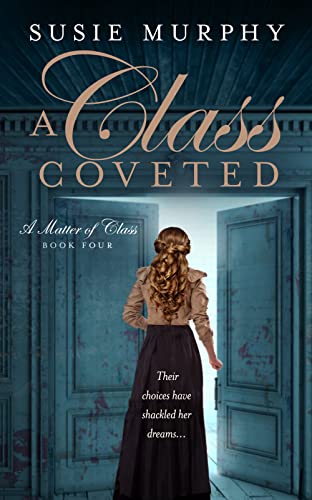
Historical Fiction Spotlight: A Class Coveted: A sweeping Irish historical romance saga (A Matter of Class Book 4) by Susie Murphy


Available from Amazon UK and Amazon US

Their choices have shackled her dreams…

It’s 1836, and Bridget and Cormac have arrived, full of hope, to the city of Boston with their growing family. However, as they adjust to domestic life together for the first time, they face anti-Irish sentiment from the local Americans, as well as a threat to their happiness from a much closer source.

Cormac undertakes the challenging search for his missing sister, Bronagh. He is determined to do all he can to put the broken pieces of his family back together, but the appalling truth he uncovers will shake him to his core.

Meanwhile, as Emily grows up in this new country, she realises how her parents’ past actions will affect her entire future and she begins to covet that which is no longer within her reach. When she receives an unexpected proposition, will she be able to resist its temptation, despite the untrustworthy nature of the person behind it?

A Class Coveted is the fourth book in Susie Murphy's historical fiction series A Matter of Class. The story will continue in the fifth book, A Class Reunited.

# # #

About the Author

Susie Murphy is an Irish historical fiction author. She loves historical fiction so much that she often wishes she had been born two hundred years ago. Still, she remains grateful for many aspects of the modern age, including women’s suffrage, electric showers and pizza.
You can find out more at www.susiemurphywrites.com, and you can connect with Susie on Facebook, and Twitter @susiemwrites

27 November 2021

Special Guest Interview with David Pilling, Author of The Champion (III): Blood and Faith


Available for pre-order

from Amazon UK and Amazon US


1297 AD: the kings of England and France have struck a truce, but elsewhere conflict still rages. In Scotland, the armies of Edward Longshanks have been driven out by a mysterious champion named William Wallace. Meanwhile, on the continent, the the Holy Roman Empire is torn apart by civil war.


I'm pleased to welcome author David Pilling to The Writing Desk:

Tell us about your latest book 

My latest is the third in The Champion series, a series of tales loosely based on a real-life 13th century Spanish knight called En Pascal de Valencia. We know the real Pascal was a mercenary who fought for Edward I in Scotland and probably elsewhere. He was called the 'Adalid', which translates as 'the champion', hence the title of the series. This was a traditional military rank awarded to especially skilled fighters in the kingdoms of Aragon and Navarre.

I have used the bare details of the historical Pascal's career as the basis for a series of fictional stories, in which the character is transported all over Christendom. In this, his latest adventure, he is dispatched on a secret diplomatic mission to Rome, where he encounters a certain famous Scottish hero. He also meets the Pope, and has several close shaves in Scotland and France. It's quite a packed story!

What is your preferred writing routine? 

I am at my best in the morning, when I am fresh and full of energy and ideas (and caffeine). In the afternoons I prefer to concentrate on my blog and social media.

What advice do you have for aspiring writers? 

The main thing – unless one is exceptionally lucky – is to be prolific. Unless you are fortunate enough to write a hit bestseller, or get snapped up by one of the handful of major publishers, the only realistic path is to churn out material on a regular basis. It also has to be of high quality, of course. Work hard, do your research, and employ decent graphic designers and editors/proofreaders!

What have you found to be the best way to raise awareness of your books? 

I started writing full-time in 2013 and throughout have discovered that the most efficient way is to keep producing quality, well-presented content. Everything else – social media, blogging, online promotion etc – is helpful, though I do sometimes wonder how necessary it is. There are so many authors competing for attention now, there is a danger of creating a 'white noise' effect, whereby we all cancel each other out. On the other hand, readers are now spoiled for choice and the market is not restricted to a handful of publishing houses. These trends can only be a good thing, since they allow more opportunity and freedom of expression.

Tell us something unexpected you discovered during your research 

I am constantly surprised by the sheer volume of surviving source material for this era. The details of Pascal's own career are quite bare – which enables me to fill in the gaps – but in general there are stacks of surviving documentation, so one can pluck out all kinds of juicy details to add colour and conviction to the story.

What was the hardest scene you remember writing? 

For this book, it was the death of a particular supporting character. I was in two minds about the scene at first, but it definitely added an edge to the narrative. Obviously I won't reveal the details...

What are you planning to write next? 

I have several projects in the pipeline. These include a short 'novelette'  that fleshes out some of the background and context to the Champion series, and a nonfiction book on Edward I and the Anglo-French war of 1298-1303. I am also engaged to write the second and third parts of a series for Sharpe Books, based on the English condottiere in Italy in the time of Sir John Hawkwood. Busy, busy!

David Pilling 

# # #

About the Author

David Pilling is a writer and researcher, addicted to history for as long as he can remember. The medieval era has always held a fascination for him, perhaps because he spent much of his childhood exploring the misted ruins of castles in Wales. David also has a keen interest in the Byzantine Empire, the post-Roman period in Britain and the British & Irish Civil Wars. Find out more at David's website https://davidpillingauthor.weebly.com/ and follow him on Facebook and Twitter @RobeH2


26 November 2021

Historical Fiction Spotlight: The Castilian Pomegranate (The Castilian Saga Book 2) by Anna Belfrage


Available on Amazon UK and Amazon US


An enraged and grieving queen commands them to retrieve her exquisite jewel and abandon their foundling brat overseas—or never return.

Robert FitzStephan and his wife, Noor, have been temporarily exiled. Officially, they are to travel to the courts of Aragon and Castile as emissaries of Queen Eleanor of England. Unofficially, the queen demands two things: that they abandon Lionel, their foster son, in foreign lands and that they bring back a precious jewel – the Castilian Pomegranate.

Noor would rather chop off a foot than leave Lionel in a foreign land—especially as he’s been entrusted to her by his dead father, the last true prince of Wales. And as to the jewel, stealing it would mean immediate execution. . . 

Spain in 1285 is a complicated place. France has launched a crusade against Aragon and soon enough Robert is embroiled in the conflict, standing side by side with their Aragonese hosts. 

Once in Castile, it is the fearsome Moors that must be fought, with Robert facing weeks separated from his young wife, a wife who is enthralled by the Castilian court—and a particular Castilian gallant. 

Jealousy, betrayal and a thirst for revenge plunge Noor and Robert into life-threatening danger. 

Will they emerge unscathed or will savage but beautiful Castile leave them permanently scarred and damaged?  


# # #

About the author

Had Anna been allowed to choose, she’d have become a time-traveller. As this was impossible, she became a financial professional with two absorbing interests: history and writing. Anna has authored the acclaimed time travelling series The Graham Saga, set in 17th century Scotland and Maryland, as well as the equally acclaimed medieval series The King’s Greatest Enemy which is set in 14th century England. Anna has also published The Wanderer, a fast-paced contemporary romantic suspense trilogy with paranormal and time-slip ingredients. Her September 2020 release, His Castilian Hawk, has her returning to medieval times. Set against the complications of Edward I’s invasion of Wales, His Castilian Hawk is a story of loyalty, integrity—and love. Her most recent release, The Whirlpools of Time, is a time travel romance set against the backdrop of brewing rebellion in the Scottish highlands. All of Anna’s books have been awarded the IndieBRAG Medallion, she has several Historical Novel Society Editor’s Choices, and one of her books won the HNS Indie Award in 2015. She is also the proud recipient of various Reader’s Favorite medals as well as having won various Gold, Silver and Bronze Coffee Pot Book Club awards Find out more about Anna, her books and her eclectic historical blog on her website, www.annabelfrage.com and follow her on Facebook and Twitter @abelfrageauthor


18 November 2021

Crown & Sceptre: A New History of the British Monarchy from William the Conqueror to Elizabeth II, by Tracy Borman


Available from Amazon UK and Amazon US

The British monarchy is the one of the most iconic and enduring institutions in the world. It has weathered the storms of rebellion, revolution and war that brought many of Europe's royal families to an abrupt and bloody end. 

Its unique survival owes much to the fact that, for all its ancient traditions and protocol, the royal family has proved remarkably responsive to change, evolving to reflect the times. But for much of its history, it also spearheaded seismic change, shaping our religious, political and cultural identity and establishing the British monarchy as the envy of the world.

There has never been a more apposite moment to consider the history of this extraordinary survivor. Within the next decade, there is likely to be a change of monarch, sparking renewed global interest on a scale not seen since Elizabeth II's coronation in 1953. 

Even the media and popular frenzy evoked by recent royal events such as royal weddings and births will not compare to that generated by the accession of a new king. In the lead up to this pivotal moment in Britain's history, Crown & Sceptre explores the history and evolution of the monarchy from 1066 to the present day, feeding the renewed interest not just in the modern royals but in the predecessors who helped shape the institution into what it is today.

"Crown and Sceptre shows an astonishing command of a thousand years of the British monarchy, its traditions, roles and realities beyond the pageantry and romance. Beautifully crafted, insightful, and a genuine pleasure to read, it underscores the royal heritage at the heart of a nation." - Lauren Mackay

"Crown and Sceptre" combines an eminently accessible narrative with a lucid scholarly lens. Tracy Borman skilfully unravels the trials and triumphs of this ever-shifting institution. By charting both the majesty and mechanics of monarchy, we get a vivid understanding of why its glittering gears shifted over time, and by whom the levers of change were pulled. A triumph.' - Owen Emmerson, Curator at Hever Castle

'Tracy Borman's passion for the British monarch and the crown is infectious and compelling!' - Estelle Paranque

Enlightening, gripping and skilfully composed, Tracy Borman navigates the twists and turns of the British monarchy with an expert hand. A pacy narrative that's simply bursting with colour and intrigue, Crown and Sceptre is both powerful and compulsively readable. A masterpiece. - Nicola Tallis

# # #

About the Author

Tracy Borman is joint Chief Curator of Historic Royal Palaces and Chief Executive of the Heritage Education Trust. She studied and taught history at the University of Hull and was awarded a PhD in 1997.  Tracy is the author of a number of highly acclaimed books, including Thomas Cromwell: The Untold Story of Henry VIII's Most Faithful Servant, Matilda: Wife of the Conqueror, First Queen of England, Elizabeth's Women: The Hidden Story of the Virgin Queen and Witches: A Tale of Sorcery, Scandal and Seduction. Tracy is also a regular broadcaster and public speaker, giving talks on her books across the UK and abroad. She lives in Surrey with her daughter. Find out more at tracyborman.co.uk and follow Tracy on Twitter @TracyBorman

12 November 2021

Description of England, by William Harrison (1535-1593), an Essex clergyman, in Holinshed’s Chronicles (1577)


Of Palaces belonging to the Prince

What shall I need to take upon me to repeat all and tell what houses the Queen’s Majesty hath? since all is hers, and when it pleaseth her in the summer season to recreate herself abroad and view the estate of the country and hear the complaints of her poor commons injured by her unjust officers or their substitutes, every nobleman’s house is her palace, where she continueth during pleasure and till she return again to some of her own, in which she remaineth so long as it pleaseth her.

The court of England, which necessarily is held always where the prince lieth, is in these days one of the most renowned and magnificent courts that are to be found in Europe. 

I might here make a large discourse of such...grave councillors and noble personages as give their daily attendance upon the Queen’s Majesty there. I could in like sort set forth a singular commendation of the virtuous beauty or beautiful virtues of such ladies and gentlewomen as wait upon her person.

It is a rare thing with us now to hear of a courtier which hath but his own language. And...how many gentlewomen and ladies there are that, beside sound knowledge of the Greek and Latin tongues, are thereto no less skilful in the Spanish, Italian, and French, or in some one of them.

Our ancient ladies of the court do shun and avoid idleness, some of them exercising their fingers with the needle...divers in spinning of silk, some in continual reading either of the Holy Scriptures or histories of our own or foreign nations about us, and divers in writing volumes of their own or translating of other men’s into our English and Latin tongue, whilst the youngest sort in the meantime apply their lutes, citterns...and all kinds of music, which they use only for recreation sake when they have leisure and are free from attendance upon the Queen’s Majesty or such as they belong unto.

Many of the eldest sort also are skilful in surgery and distillation of waters. As each of them are cunning in something whereby they keep themselves occupied in the court, so there is in manner none of them but when they be at home can help to supply the ordinary want of the kitchen with a number of delicate dishes of their own devising.

In some great princes’ courts beyond the seas...it is a world to see what lewd behaviour is used among divers of those that resort unto the same, and what whoredom, swearing, ribaldry, atheism, dicing, carding, carousing, drunkenness, gluttony, quarrelling, and such-like inconveniences do daily take hold...all which enormities are either utterly expelled out of the court of England or else so qualified by the diligent endeavour of the chief officers of her Grace’s household that seldom are any of these things apparently seen there without due reprehension and such severe correction as belongeth to those trespasses.

Finally, to avoid idleness and prevent sundry transgressions...such order is taken that every office [of the household] hath either a Bible or the books of the Acts and Monuments of the Church of England [by John Foxe] or both, beside some histories and chronicles lying therein for the exercise of such as come into the same, whereby the stranger that entereth into the court of England upon the sudden shall rather imagine himself to come into some public school of the universities, where many give ear to one that readeth, than into a prince’s palace.

I might speak here of the great trains and troops of serving men also, which attend upon the nobility of England in their several liveries and with differences of cognizances [badges] on their sleeves whereby it is known to whom they appertain. I could also set down what a goodly sight it is to see them muster in the court...much like to the show of the peacock’s tail in the full beauty or of some meadow garnished with infinite kinds and diversity of pleasant flowers.

William Harrison, 1577 

11 November 2021

Elizabethan Ladies: Katheryn of Berain


Katheryn of Berain, sometimes called Mam Cymru ("mother of Wales"), or Katheryn Tudor, (her father being Tudor ap Robert Vychan). Katheryn, was a ward of Queen Elizabeth, and heiress to the Berain and Penymynydd estates in Denbighshire and Anglesey.

Her maternal grandfather Sir Roland de Velville (1474 – 25 June 1535), is said to have been a natural son of King Henry VII of England by a Breton lady, during his long exile in Brittany.

In her portrait, Katheryn of Berain clutches a prayer-book and caresses a human skull. The skull often occurs in sixteenth-century portraits; the contrast between flesh and bone reminds us of the frailty of life. She appears to be in mourning, but in fact had recently married the royal agent Richard Clough.

She is presented as a fitting wife for a wealthy merchant. Her elaborate costume, pale skin and plucked brows were highly fashionable, and the prayer-book confirms her piety.

It is thought this portrait was painted in the Northern Netherlands by the Friesian artist van Cronenburgh.

Tony Riches

9 November 2021

Historical Fiction Spotlight: Rebel's Knot (Quest for the Three Kingdoms) by Cryssa Bazos


Available from Amazon UK and Amazon US

Ireland 1652: In the desperate, final days of the English invasion . . .

A fey young woman, Áine Callaghan, is the sole survivor of an attack by English marauders. When Irish soldier Niall O'Coneill discovers his own kin slaughtered in the same massacre, he vows to hunt down the men responsible. He takes Áine under his protection and together they reach the safety of an encampment held by the Irish forces in Tipperary.

Hardly a safe haven, the camp is rife with danger and intrigue. Áine is a stranger with the old stories stirring on her tongue and rumours follow her everywhere. The English cut off support to the brigade, and a traitor undermines the Irish cause, turning Niall from hunter to hunted.

When someone from Áine's past arrives, her secrets boil to the surface—and she must slay her demons once and for all.

As the web of violence and treachery grows, Áine and Niall find solace in each other's arms—but can their love survive long-buried secrets and the darkness of vengeance?

# # #

About the Author

Cryssa Bazos is an award-winning historical fiction author and a seventeenth century enthusi-ast. Her debut novel, Traitor's Knot is the Medalist winner of the 2017 New Apple Award for Historical Fiction, a finalist for the 2018 EPIC eBook Awards for Historical Romance. Her second novel, Severed Knot, is a B.R.A.G Medallion Honoree and a finalist for the 2019 Chau-cer Award. For more information visit Cryssa's website. You can also connect with her on Facebook and Twitter @CryssaBazos