
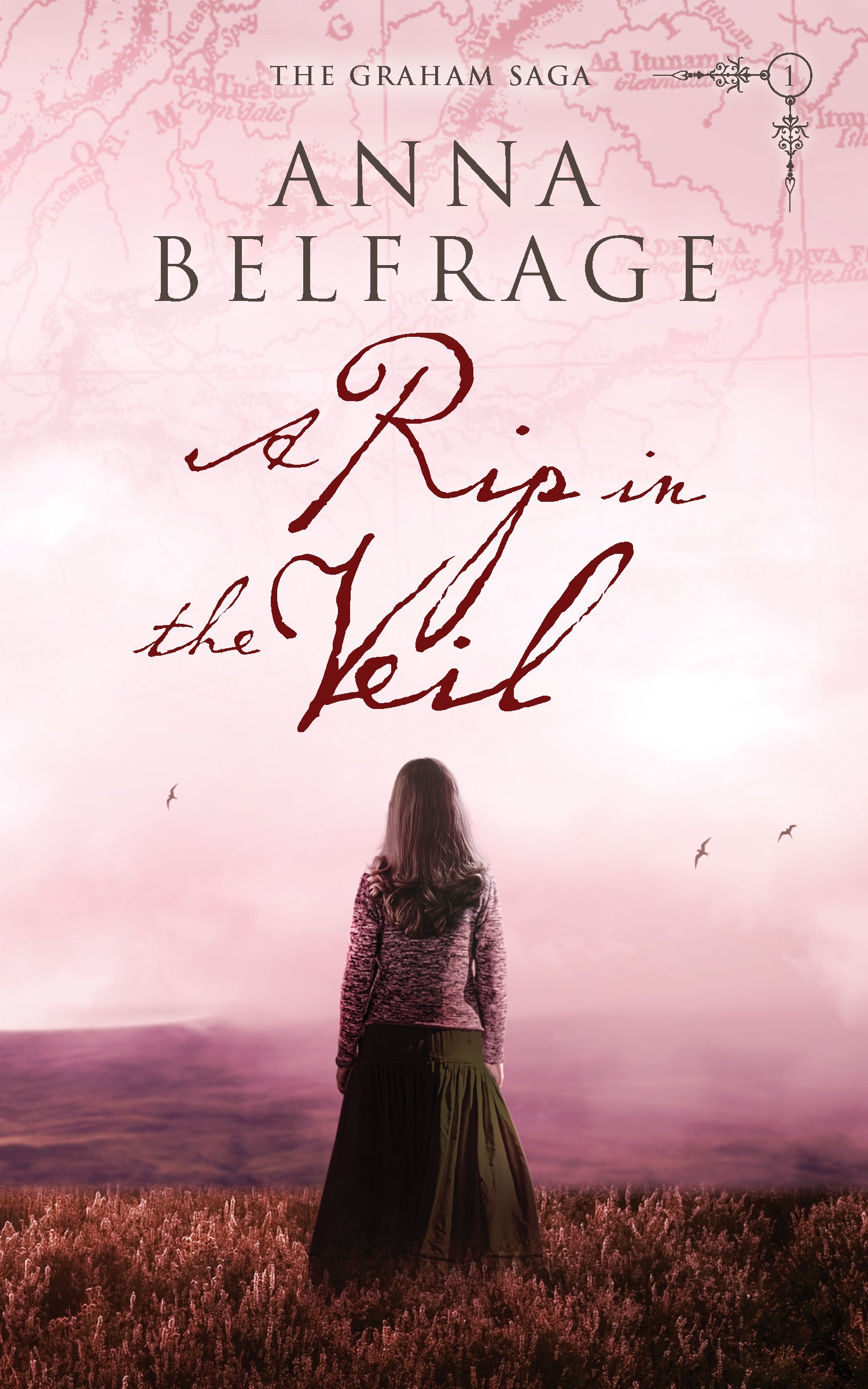
On a muggy August day in 2002 Alex Lind disappears. On an equally stifling August day in 1658, Matthew Graham finds her on a Scottish moor. Life will never be the same for Alex – or for Matthew.
Dressing for success in the seventeenth century
In a A Rip in the Veil—the first book in The Graham Saga—the unfortunate (or not, depending how one sees it) Alex Lind has the misfortune of falling three centuries backwards in time to land at the feet of Matthew Graham. Matthew Graham is a devout Presbyterian who has fought in the Commonwealth armies in the Civil War. To Alex, he is initially very strange. Heck, the entire situation is strange: no, wait—it’s impossible!
Matthew is as taken aback as Alex is—perhaps even more, as the only explanation to her sudden appearance in his life must be magic. Or? Besides, what is the woman wearing? Those tight, tight breeches she calls ‘djeens” showcase her every curve, as do her other garments.
No, had she been his woman, he’d never have allowed her to set a foot outside dressed like that, all of her exposed, like.
Alex quickly realises that in this new time she has to adapt. ASAP. And one of the first things she must embrace is an entire new wardrobe.
“Yay me,” she mutters as she shakes out shift and petticoats and heavy skirts and bodice and. . .
This period dress thing is difficult—and not only for my reluctant time traveller Alex. As a writer of historical fiction it is important to understand what people wore, who wore what and how it was worn. In some cases it's straightforward: stockings cover your feet and the nether part of your legs no matter if you live in the twentieth century or the fifteenth.
But take that rather ugly male adornment that Henry VIII was so proud of flaunting - the codpiece - and I am somewhat stumped. How did it work? ( Okay, so I've looked this up; strings, buttons or hooks kept this decorative little (hmm) flap of fabric in place.)
There must also be a familiarity with how people dress and undress. “He told her to turn around and zipped up her gown,” is not a good description of the intimacy between man and wife in the fourteenth century. (BTW, the modern zipper owes a lot to Swedish inventor Gideon Sundback. It's nice to know us Swedes have contributed to human development: dynamite, zippers, gauge blocks, the AGA cooker)
To avoid such gaffes, I’ve spent a lot of time researching my period and have accordingly done my fair share of staring at what few clothes survive from the seventeenth century—like James II’s elegant attire exhibited in the Victoria & Albert museum. Okay, so that is later in the century, but all that lace, all those embroideries, and that gigantic wig! Plus, the high heels on the shoes. . . Nope, not at all my cup of tea.
Earlier in the 1600s, men wore wide breeches, sashes, lace, ribbons—like these young and elegant Stuart brothers in Van Dyke’s portrait:

To the seventeenth century young girl, they were likely delectable. To Alex, not so much. She’d be hard put not to laugh her head off. So it is fortunate that Matthew would no more adorn himself with ribbons than he would dance attendance on the king—he is a man of Parliamentarian convictions. No, Matthew wears plain and well-made clothes, now and then adorned with a ruffled cuff or an elegant collar.
Obviously, Matthew expects this new, alluring female companion of his to dress sedately, which is how Alex finds herself obliged to re-learn just how to dress.
In the seventeenth century, there were no bras, no panties. Instead, the undergarment is a shapeless elongated linen shirt that comes to just below the knees. This shift is worn over stockings that come to just above the knee and are fastened by garters.
“I can help you with those,” Matthew suggests, and there is a twinkle in his eyes as he helps Alex fasten the stockings with pink ribbons. Just because he doesn’t wear ribbons, it doesn’t mean she can’t, he says. In fact, he rather likes the fact that she is wearing them—and that he tied them into place.
Over the shift—which also doubles as nightgown—Alex dons a corset.
“Ugh!” she groans as she tightens into place. The corset she has ties in front—only people who can afford a lady’s maid have corsets that tie in the back. Then there are the petticoats, tied into place at her waist and falling to mid-calf. Only the very, very rich have garments that fall all the way to the floor. Most women have skirts high enough to allow them to work and walk without dragging the hem in the dirt.
“Here.” Matthew hands her the heavy skirts. And yes, they are heavy, making it hard to, for example, run. Or jump a fence.
A bodice, a shawl to cover what may remain exposed of her chest and then Matthew holds out a cap.
“No way!” She backs away, staring at the embroidered linen coif.
“You must cover your hair,” he says.
She refuses.
There is a slight. . . er . . . argument. Things end in a compromise: she will not cover her hair indoors, but otherwise she will either wear a coif or a hat. Matthew would prefer both, but he is pragmatic enough to realise this isn’t a battle he will win. Besides, Alex is having to handle a lot of change as it is.
“Tell me about it,” she mutters. She isn’t overly impressed with the food. Or the lack of chocolate. Or of tea. “I thought they had tea in the seventeenth century,” she groans.
“They do,” I tell her, “but it is very, very expensive.”
“Oh.” She gnaws her lip, her shoulders slumping. Which is probably why Matthew expends a ridiculous amount on a ridiculous small quantity of tea next time he goes to Edinburgh, pleased by the way she lights up from within when he hands the precious package over.
Over time, Alex will become accustomed to her new clothes, even if she will quite often think longingly of jeans and sweatshirts, of Converse and shop-bought socks. (She hates to knit)
But while she adapts to her new life on the outside, she remains a woman of modern convictions, which will now and then cause her quite some problems in her new time.
It is fortunate that she has Matthew to guide her. On the other hand, there will be countless of occasions when Matthew will owe his life and sanity to her, the strange lass he found concussed and burned on an empty Scottish moor. Two halves made whole are my Alex and Matthew, no matter such details as sartorial arguments!
Anna Belfrage
# # #
About the Author


Tony, thank you so much for your generosity. I am delighted to visit your blog. Again :)
ReplyDelete