Showing posts with label Tudor Trilogy. Show all posts

5 August 2018

Special giveaway of three copies of Owen - Book One of the Tudor Trilogy on the New Bookery App


Bookery is a new app for readers looking for the best book, featuring deals and novel news.  Instead of searching through your over-loaded email box for book deals, the Bookery App  brings them straight to your phone in one convenient place. 

The team at Bookery have also gathered great reading from authors and bloggers for your entertainment. And they are always running contests. There are plenty of prizes: from books to gift cards and much more.

The new contest is to win one of three free paperback copy of the best-selling historical fiction novel, Owen - Book One of the Tudor Trilogy


England 1422: Owen, a Welsh servant, waits in Windsor Castle to meet his new mistress, the beautiful and lonely Queen Catherine of Valois, widow of the warrior king, Henry V. Her infant son is crowned King of England and France, and while the country simmers on the brink of civil war, Owen becomes her protector.

They fall in love, risking Owen’s life and Queen Catherine’s reputation—but how do they found the dynasty which changes British history – the Tudors?

This is the first historical novel to fully explore the amazing life of Owen Tudor, grandfather of King Henry VII and the great-grandfather of King Henry VIII. Set against a background of the conflict between the Houses of Lancaster and York, which develops into what have become known as the Wars of the Roses, Owen’s story deserves to be told.


Enter now and check out Bookery on the Apple App Store  and on Google Play - and follow the Bookery team on Twitter @TBookery


14 January 2018

Why You Should Consider Writing a Trilogy #AuthorToolboxBlogHop


Available on Amazon UK and Amazon US

For most writers, completing one book would seem more than enough of an achievement, so why would anyone make a commitment to writing three?  

There are real benefits of tackling any story as a trilogy and now I’ve written one I’m convinced it’s something any novelist should consider. The scope of a trilogy offers writers a liberating sense of space and freedom, as ideas hinted at in the first book can be developed and explored over the rest. This means the writer has space to explore the complexity of relationships that evolve over time, as well as the shifting social, political and economic context over years – or even generations, offering readers a more ‘immersive’ experience.

There are also practical and commercial considerations. If you follow the fashion for longer books, you have one opportunity to sell it and the promotion can only begin once it’s available for pre-order. I was able to promote book one of my Tudor trilogy while writing book two (and it became a best-seller in the UK, US and Australia.)  Readers began contacting me to ask when the next book would be available and I soon built an international reader base for the trilogy.

Similarly, although each book works as a ‘stand-alone’, I’ve seen evidence in my sales that even people who read them in the wrong order tend to buy the others. I also hadn’t realised Amazon (and other retailers) are happy to promote and market a trilogy (or any series) as a discounted single purchase, which is good value for readers and means your books are more likely to be ‘discovered’.
Finally, a trilogy offers a framework for developing work on an ‘epic’ scale. 

I realised there were countless novels about the court of King Henry VIII and his six wives, yet I could find almost nothing about the early Tudors who founded the dynasty. The idea for The Tudor Trilogy was that King Henry VIII’s father could be born in book one, ‘come of age’ in book two, and rule England in book three, so there would be plenty of scope to explore his life and times.

The first book of the trilogy was my fourth novel, so I had a good idea about the structure. In book one, OWEN, a Welsh servant of Queen Catherine of Valois, the lonely widow of King Henry V, falls in love with her and they marry in secret. Their eldest son Edmund Tudor marries the thirteen year-old heiress Lady Margaret Beaufort, and fathers a child with her to secure her inheritance. The birth of her son, Henry, nearly kills her, and when her husband dies mysteriously, his younger brother Jasper Tudor swears to protect them.

In book two, JASPER, they flee to exile in Brittany and plan to one day return and make Henry King of England. King Richard III has taken the throne and has a powerful army of thousands – while Jasper and Henry have nothing. Even the clothes they wear are paid for by the Duke of Brittany. So how can they possibly invade England and defeat King Richard at the Battle of Bosworth?

In the final book of the trilogy, HENRY, I explore how he brought peace to England by marrying Elizabeth of York, the beautiful daughter of his enemy, King Edward IV. The Tudor trilogy offers me the scope and depth to help readers understand how Henry’s second son became King Henry VIII, the tyrant who transformed the history of England forever. 

Tony Riches

Do you have some great writing tips you would like to share?
Please feel free to comment


The #AuthorToolboxBlogHop is a monthly event on the topic of resources and learning for authors. Feel free to hop around to the various blogs and see what you learn! The rules and sign-up form are below the list of hop participants. All authors at all stages of their careers are welcome to join in.

18 March 2017

New Book Launch – HENRY Book Three of the Tudor Trilogy


(Audiobook coming soon)

Bosworth 1485: After victory against King Richard III, Henry Tudor becomes King of England. Rebels and pretenders plot to seize his throne. The barons resent his plans to curb their power and he wonders who he can trust. He hopes to unite Lancaster and York through marriage to the beautiful Elizabeth of York. With help from his mother, Lady Margaret Beaufort, he learns to keep a fragile peace. He chooses a Spanish Princess, Catherine of Aragon, as a wife for his son Prince Arthur. His daughters will marry the King of Scotland and the son of the Emperor of Rome. It seems his prayers are answered, then disaster strikes and Henry must ensure the future of the Tudors.

I began the Tudor Trilogy with a challenge. The known facts of Owen Tudor’s life are so sparse it’s little wonder so few writers have tackled his story. There are no images of him and historians even debate his name. Undaunted, I persevered and uncovered an amazing life of adventure which ended in tragedy when Owen was about the same age I am now.

The records were far more detailed for the second book, the story of Owen’s second son Jasper Tudor, and although he spent many years in exile I had no shortage of material. As my research progressed I began to wonder how the story would end. Henry was born in the first book, comes of age in the second and becomes King of England in the final book of the trilogy.

The problem now was too much information. Henry left a wealth of detailed records, often initialling every line in his ledgers, which still survive. At the same time, I had to deal with the contradictions, myths and legends that cloud interpretation of the facts. It troubled me to realise how, even in my own history lessons, we skipped over Henry’s contribution to learn about his son (and his six wives).

How could I begin to do justice to the life of such a complex and little understood man? Why did his son turn out as he did? I decided the only way was to immerse myself in Henry’s world and explore events as they might have appeared from his point of view. I stood in the small room in Pembroke Castle where Henry Tudor is thought to have been born, (within sight of where I was born) and began three years of intensive research about this enigmatic king.

I bought every book I could find about Henry and his times. I travelled to remote Brittany to visit the cobweb-festooned chateau in theforest where he lived in exile. I stood on the pebble beach at Mill Bay wherehe landed with his invasion fleet. I walked across Bosworth field and watched hundreds of re-enactors recreate the battle, complete with cavalry and cannon fire. I saw the Torrigiano bust of Henry at the V&A Museum, his portraits at the National Portrait Gallery and finally visited his tomb at Westminster Abbey.

My hope is that I can offer readers an insight into Henry’s life and make them want to learn more about one of our least understood kings. I’d like to take this opportunity to thank all the readers around the world who have been on this journey with me. Although this is the end of the Tudor trilogy, I am now researching the lives of Henry's daughter Mary and her husband Charles Brandon, so the story of the Tudors is far from over.

Tony Riches

26 October 2016

New Audiobook: Jasper - Book Two of the Tudor Trilogy


New on Amazon UK and Amazon US
Also Free with 30 Day Audible Trial

“Jasper Tudor was a rebel and a warrior, the man who created the greatest dynasty England has ever known... The Tudors.” Dr Sara Elin Roberts, author of Jasper – The Tudor Kingmaker

Following the best-selling historical fiction novel OWEN – Book One of The Tudor Trilogy, this is the story, based on actual events, of Owen’s son Jasper Tudor, who changes the history of England forever. 

England 1461: The young King Edward of York has taken the country by force from King Henry VI of Lancaster. Sir Jasper Tudor, Earl of Pembroke, flees the massacre of his Welsh army at the Battle of Mortimer’s Cross and plans a rebellion to return his half-brother King Henry to the throne.
When King Henry is imprisoned by Edward in the Tower of London and murdered, Jasper escapes to Brittany with his young nephew, Henry Tudor. Then after the sudden death of King Edward and the mysterious disappearance of his sons, a new king, Edward’s brother Richard III takes the English Throne. With nothing but his wits and charm, Jasper sees his chance to make young Henry Tudor king with a daring and reckless invasion of England.

Set in the often brutal world of fifteenth century England, Wales, Scotland, France, Burgundy and Brittany, during the Wars of the Roses, this fast-paced story is one of courage and adventure, love and belief in the destiny of the Tudors.

15 August 2016

New Audiobook - OWEN Book One of The Tudor Trilogy


New on Amazon UK and Amazon US

England 1422: Owen Tudor, a Welsh servant, waits in Windsor Castle to meet his new mistress, the beautiful and lonely Queen Catherine of Valois, widow of the warrior king, Henry V. Her infant son is crowned King of England and France, and while the country simmers on the brink of civil war, Owen becomes her protector.
They fall in love, risking Owen’s life and Queen Catherine’s reputation—but how do they found the dynasty which changes British history – the Tudors?
This is the first historical novel to fully explore the amazing life of Owen Tudor, grandfather of King Henry VII and the great-grandfather of King Henry VIII. Set against a background of the conflict between the Houses of Lancaster and York, which develops into what have become known as the Wars of the Roses, Owen’s story deserves to be told.

24 July 2016

The Tudors' Road to Bosworth Part 4: Henry Tudor at Forteresse de Largoët, Brittany


In this series I followed Jasper Tudor and his young nephew Henry’s escape from Tenby in Wales and their arrival in Brittany. The Tudors enjoyed relative freedom together in Vannes as guests of Duke Francis of Brittany, then at the Château de Suscinio. Then Duke Francis decided to reduce the risk of their abduction to England by moving them to different locations inland.

Young Henry Tudor found himself deep in the forest at the remote Forteresse de Largoët, outside of the Breton town of Elven. In the safe custody of the twenty-seven year old Marshall of Brittany, Jean IV, Lord of Rieux and Rochefort, Henry was able to continue his education. The isolation meant he would have had few visitors and it seems he was prevented from communicating with his mother in England or with his uncle, Jasper Tudor.

There are, however, intriguing details uncovered at the National Library of Wales which indicate Henry Tudor may have enjoyed more freedom at this time than is generally thought. The papers claim that, ‘by a Breton lady’, Henry Tudor fathered a son, Roland Velville, whom he knighted after coming to the throne. Sir Roland is recorded as being Henry’s ‘companion’ and a champion jouster. (After Henry’s death he became Constable of Beaumaris Castle, and is buried in the Church of St Mary's and St Nicholas, adjacent to Beaumaris Castle. In an elegy by the sixteenth century Welsh poet Daffyd Alaw, Sir Roland Velville is described as 'A man of kingly line and of earl's blood'.)

The poorly signposted Forteresse de Largoët was a little difficult to find up an unlikely looking track leading deep into the woodlands outside Elven. There was an admission charge at the small gatehouse, and I was given a useful leaflet in English which confirmed that: ‘On the second floor of the Dungeon Tower and to the left is found a small vaulted room where the Count of Richemont was imprisoned for 18 months (1474-1475).

The 'Dungeon' Tower
I was impressed by the scale of the building, which sits in a wooded valley by a small lake. It was built unusually high, at fifty-seven meters, to provide a view out to the Gulf of Morbihan. The tower originally had a moat crossed by a raising drawbridge on a pier and still has a spiral stone staircase with 177 steps to the top. There are deep cracks in the crumbling walls and notices warning of falling masonry and that visitors climb the stairs at their own risk and will ‘arrive at numerous gaping openings which makes this a dangerous venture.’

Entering the tower through a dark corridor, the open interior reveals there were once at least seven floors. This space was once used as a kitchen and leads to the main stairway and a guardroom. I regretted not bringing a torch, as the high stairway is lit only by the small window openings. Interestingly, the lower level is octagonal, with the second hexagonal and the rest square. Worryingly, the leaflet notes that ‘This imposing ruin has defied the centuries, in spite of an absence of relieving arches above the large windows. This is what produced the large crevices.’

Cautiously feeling my way up the staircase I had a real awareness that I was now most certainly walking in the footsteps of the young Henry Tudor, who would also have steadied himself by placing his hand against the cold stone walls, nearly five and a half centuries before. 

Further evidence that this tower was not really a ‘dungeon’ is suggested by the fact that the second floor was once used by Lady Françoise Raguenel of Malestroit, who married Marshall Jean IV in 1463. The third floor was used by the Marshall and the fourth by their young daughter, also named Françoise. The Marshall’s brother François occupied the fifth floor of the tower, which also had a chapel, so a picture emerges not of a prison but of a series of rooms decorated and furnished to provide some comfort to the occupants.


The guide states that Henry Tudor was held in a small vaulted room on the second floor, to the left of the apartments of Lady Françoise. After some exploration I found the room, which must be rarely visited as it was full of cobwebs. My own observation is the room seemed too small and cramped to have been a residence, and I wondered if in fact Henry lived higher up at the top of the tower as suggested in other accounts.

All the same, there is a chance the Marshall might have taken his responsibility for Henry so seriously that he did keep him in a room small enough to be described as a ‘prison cell.’ I would like to imagine instead that, as at Suscinio, Henry, now turning eighteen, would have been able to hunt in the forest and fish in the well-stocked lake – and meet and fall in love with the mysterious ‘Breton Lady.’


Henry would no doubt have missed the company and advice of his uncle, Jasper Tudor, who had been taken to a far grander place, the Château de Josselin, home of the de Rohan family and the next destination on my search for evidence of the Tudors in exile.  
  
Tony Riches

See also: 


16 July 2016

The Tudors' Road to Bosworth Part 3: Exiled at Château de Suscinio, Brittany


In the first two parts of this series I followed Jasper Tudor and his fourteen-year-old nephew Henry’s escape from Tenby in Wales and their arrival in Brittany. The Tudors are recorded as spending a year in Vannes as guests of Duke Francis of Brittany, but in October, 1472, the duke became concerned they might be abducted by York’s agents.

They were moved to his remote ‘hunting lodge’ by the sea, south of Vannes, the Château de Suscinio. Their new home had been fortified in the fourteenth century and now resembled a castle of grand proportions, surrounded by forests stocked with game. 


A wide moat with a drawbridge meant few soldiers were needed to guard the Tudors. In my novel Jasper - Book Two of The Tudor Trilogy I decided they were not prisoners at Suscinio but still guests of the duke, under his protection. In this short extract, Jasper Tudor accompanies Duke Francis on a wild boar hunt:

  The woods came alive to the excited baying and barking of the duke’s hounds as they raced through the undergrowth in pursuit of the unseen boar. Jasper rode at the duke’s side as his guest, with Henry following behind with a dozen minor nobles. These ambitious young men, eager to win the duke’s approval, formed teams of flanking riders, ready to head off the boar if it tried to escape.
Riding dangerously fast, Jasper ducked, narrowly avoiding a low branch, his heart pounding with the thrill of the chase. He glanced back to check Henry had seen the branch and noticed he was falling well behind. Although Henry rode well, he had never hunted anything as challenging as a wild boar.
  They were deep in the forest and Jasper lost all sense of direction, as the sun was directly overhead and the trees grew so thickly it was impossible to see. His horse nearly stumbled on uneven ground and he struggled to stay in the saddle when he leapt a fallen tree, galloping onwards to catch up with the duke.
  As he drew alongside, Duke Francis glanced across at him as if reading his mind. He looked more like a soldier again, dressed in his hunting clothes, and had a glint in his eyes as he urged his horse even faster through the undergrowth.
  The baying of the dogs sounded closer and changed to the frantic yelping that told Jasper their quarry was close at hand. Spurring his horse in pursuit he found himself in an open clearing where the duke’s trained catch dogs had taken the loudly protesting boar by its ears and held it down. The animal was a fully grown male, with powerful curved white tusks and angry red eyes. He stayed in the saddle, aware the dangerous boar could break free at any moment.

There were no wild boar in the forest when I visited the Château de Suscinio on a gloriously hot afternoon. Instead, I found a car park full of coaches and soon discovered why. The Département of Morbihan has spent a fortune over the last fifty years restoring the once ruined castle to how it might have looked when Jasper and Henry stayed there in the fifteenth century. (There is a collection of photographs of the château before reconstruction here.)

Château de Suscinio before reconstruction
Most of the visitors were French school children, excitedly learning about their own history, and I wondered if any of them knew the significance of the Tudors. Crossing the green moat over the long drawbridge, I was handed a useful audio guide by the staff, which had explanations in English for each of the numbered rooms. 

There are no records of where in the château Henry and Jasper were accommodated but one candidate is the first floor, which was used by the captain of the guard, as the second floor contained the duke’s private apartments and third floor those of the duchess.


Another intriguing possibility is the West range, on the opposite side of the spacious walled courtyard. I couldn’t explore the rooms in this building as it is still being restored, although the extensive accommodation was claimed to have once been used as a prison, which seems unusual for a château used as a hunting lodge. If the Tudors had been housed there, the men guarding them would have been likely to think of them as ‘prisoners’.

The West range of Château de Suscinio
I also visited the nearby beach a short walk from the château, where a wide sweeping bay of the Atlantic stretched far into the distance. I could imagine how Jasper and Henry would have made the same walk, followed by their ever-present guards. The long expanse of sand, with small boats moored offshore, must have reminded them of their home in Tenby far away across the Atlantic.


It was easy to see how York could land a flotilla of ships there if he wished. It is thought this is why Duke Francis soon decided to reduce the risk of their abduction to England by moving them to different locations inland. These would be the next stops on my own journey, although I couldn’t resist a last look at the magnificent château and wonder if the Tudors realised they would not be able to see each other again for almost nine years.

Tony Riches

See also:


# # #
About the Author

Tony Riches is a full time author of best-selling fiction and non-fiction books. He lives in Pembrokeshire, West Wales and is a specialist in the fifteenth century, with a particular interest in the Wars of the Roses and the lives of the early Tudors. For more information about Tony’s other books please visit his website and find him on Facebook and Twitter @tonyriches.

4 July 2016

The Tudors' Road to Bosworth Part 1: The Tudors Escape to Brittany


As part of the research for my Tudor trilogy, I decided to follow the journey of Jasper Tudor and his young nephew Henry from Tenby in Wales to their fourteen-year exile in Brittany - and ultimately their return to victory at the pivotal Battle of Bosworth. There are many stories but the documented historical record raises questions and inspired by the travels of Nathen Amin, author of Tudor Wales, I wanted to see for myself what primary evidence I could discover.

Wales had become a dangerous place for the Tudors by 1471. The Lancastrian cause was lost with the news that King Henry had been found dead in his chapel in the Tower of London. The Lancastrian heir to the throne, Edward, Prince of Wales, had been slaughtered in the massacre of Queen Margaret’s forces at Tewkesbury and many Lancastrian nobles were executed by York’s army.

Jasper and Henry found themselves trapped in their stronghold of Pembroke Castle. Their position must have seemed hopeless, particularly when they learned that the men besieging them were fellow Welshmen, loyal to King Edward IV. Then, at the eleventh hour, the siege was broken by a band of Welsh rebels led by Dafydd ap Thomas. It would only be a matter of time before York’s men returned in force, so Jasper and Henry took what might be their only chance to flee to France.

Their problem was that Tenby, the nearest town where they could hope to find a ship, was already taken by the Yorkists. The story which has been handed down over the centuries is that they hid in a cellar belonging to a wine merchant named Thomas White, then escaped to the harbour at night through a secret tunnel.

It was easy enough to find the location of Thomas White’s house in Tenby, as there is a small bronze plaque on the wall outside what is now Boots the Chemists in Tenby High Street. Under a Tudor rose the plaque reads:  By tradition Henry Tudor with his uncle Jasper Tudor Earl of Pembroke was hidden in the cellar on this site before escaping to Brittany in 1471. In 1485 he landed at Dale and defeated Richard III at Bosworth to take the throne as the first Tudor monarch.


In Crackwell Street to the rear of Boots the Tenby Civic Society have also mounted a blue plaque on the wall which reads: It is said that Henry Tudor (Later King Henry VII) escaped through a tunnel here in 1471 when he fled to France.

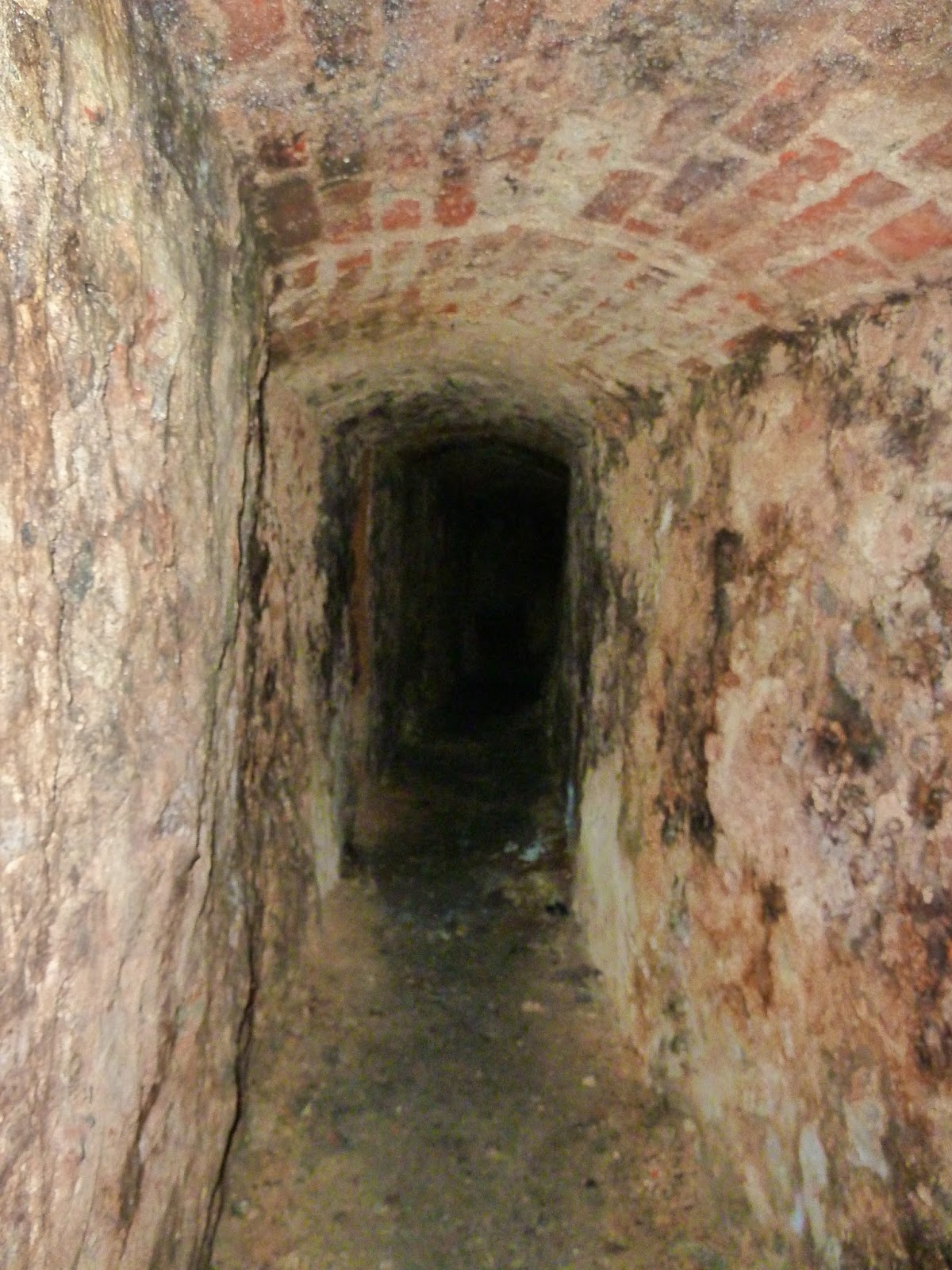
The manager of Boots kindly agreed to show me the tunnels and we started in the extensive basement cellars, now used as store-rooms. As we entered the tunnels, deep under the street, we were plunged into darkness and had to rely on torches. I saw the roof of the tunnel closest to the entrance had been rebuilt with bricks, and the remains of an ancient fireplace, complete with chimney. This seemed an odd luxury to have in a tunnel and could be further evidence for its use in the past to hide people who might need a fire for warmth. 

Further down the tunnel the roof was roughly hewn through bedrock. This looked to have been done centuries ago, as there was calcification of the surface, which must have taken a long time to form. Unfortunately the tunnel had several exits which were bricked up, but although it wasn’t possible to follow the trail to the harbour, I could see the stories of how the Tudor’s escaped from Tenby could be true.

After emerging back into the bright sunshine I went to pay my respects to the good friend of the Tudors, Thomas White. Visiting the church and looking into his sculpted face reminds me he was a real person, who left his mark on the town and helped change the history of Britain.

The day of the Tudor’s escape doesn’t seem more than five centuries away as I walk from the church in the high street, down the narrow lane with uneven stone steps. I pass the timber-framed Tudor merchant’s house, now a Tudor museum, and see men preparing their boats in the sheltered harbour. It was from here that Jasper and Henry sailed into their long exile, to return to claim the English throne.

I have sailed from this harbour many times, including in complete darkness to catch the tide, just as the Tudors would have done.  There are perilous rocks just below the surface as you head out into the Bristol Channel bound for the equally hazardous Land’s End, which their ship had to navigate before they could even begin heading for the uncertain welcome they might receive in Brittany.

There is a great sense of freedom as you leave the confines of the little town with its narrow streets and pass the monastic island of Caldey before heading out into open water. I can imagine Jasper and Henry Tudor would have stood at the ship’s rail and watched as the last pinpricks of light disappeared from view. They must have felt relieved to escape but also sadness to be leaving their troubled country as refugees, owning only what they could carry and with no idea of when, if ever, they would be able to return.  

In the second part of this journey I chose instead to sail for Brittany from the shorter route of the safe harbour of Portsmouth, passing on the way the bright yellow buoy marking the site of the tragic sinking of a warship belonging to Henry Tudor’s son – the Mary Rose.


0

25 March 2016

Historical Fiction Book Launch: JASPER - Book Two of The Tudor Trilogy


New on Amazon UK  Amazon US and Amazon AU

Following the best-selling historical fiction novel OWEN – Book One of The Tudor Trilogy, this is the story, based on actual events, of Owen’s son Jasper Tudor, who changes the history of England forever.

England 1461: The young King Edward of York takes the country by force from King Henry VI of Lancaster. Sir Jasper Tudor, Earl of Pembroke, flees the massacre of his Welsh army at the Battle of Mortimer’s Cross and plans a rebellion to return his half-brother King Henry to the throne.

When King Henry is imprisoned by Edward in the Tower of London and murdered, Jasper escapes to Brittany with his young nephew, Henry Tudor. After the sudden death of King Edward and the mysterious disappearance of his sons, a new king, Edward’s brother Richard III takes the English Throne. With nothing but his wits and charm, Jasper sees his chance to make young Henry Tudor king with a daring and reckless invasion of England.

Set in the often brutal world of fifteenth century England, Wales, Scotland, France, Burgundy and Brittany, during the Wars of the Roses, this fast-paced story is one of courage and adventure, love and belief in the destiny of the Tudors.

"Without the heroic Jasper Tudor there could have been no Tudor dynasty."  Terry Breverton, author, historian and Television Presenter.

"Jasper Tudor was the greatest survivor of the Wars of the Roses. Whilst almost all his contemporaries suffered often brutal and bloody deaths, Jasper persevered against all the odds. That's not to say it was easy, as you will discover..".  Nathen Amin, Author of Tudor Wales

29 December 2015

Inspiration for writing The Tudor Trilogy


Available on Amazon UK and Amazon US

England 1422: Owen Tudor, a Welsh servant, waits in Windsor Castle to meet his new mistress, the beautiful and lonely Queen Catherine of Valois, widow of the warrior king, Henry V. Her infant son is crowned King of England and France, and while the country simmers on the brink of civil war, Owen becomes her protector.  They fall in love, risking Owen’s life and Queen Catherine’s reputation—but how do they found the dynasty which changes British history – the Tudors? 


I was born within sight of Pembroke Castle and often visit the small room where the thirteen-year-old Lady Margaret Beaufort gave birth to the future king, Henry Tudor. I also recently stood on the remote beach at Mill Bay near Milford Haven, imagining how Jasper Tudor would have felt as he approached with Henry and his mercenary army to ride to Bosworth - and change the history of Britain.

All I knew about Owen Tudor was that he was a Welsh servant who somehow married the beautiful young widow of King Henry V, Queen Catherine of Valois, and began this fascinating dynasty. Inspired to write a historical fiction trilogy about them, I was amazed to discover that, although there are plenty of references to Owen, Jasper and Henry in novels, there were none that fully explored their lives.

I wanted to research their stories in as much detail as possible and to sort out the many myths from the facts. There are, of course, huge gaps in the historical records, which only historical fiction can help to fill. For example, there is no record of the marriage between Owen and the Dowager Queen Catherine, although I have also not been able to find evidence of the legitimacy of his decedents, particularly Henry VII, ever being challenged.

Another advantage I have is that my previous two historical fiction novels, The Secret Diary of Eleanor Cobham, and WARWICK ~ The Man Behind The Wars of The Roses are also set in the fifteenth century, so my considerable library of books and papers on the period are invaluable in cross checking dates and events.

I would like to take this opportunity to thank my many readers around the world for helping to make the first book of The Tudor Trilogy, OWEN, an Amazon best-seller in the UK and US, and my best-selling book in Australia, where I have a rapidly growing readership.

Owen was an adventurer, a risk-taker, a man who lived his life to the full and made his mark on the world through his descendants. Jasper Tudor made it possible for his nephew Henry to become King of England and bring a lasting peace to the country. I am now helping to campaign for a statue of Henry Tudor to be erected outside Pembroke Castle so that their legacy is not forgotten.

Tony Riches


24 November 2015

How to murder a king – the mysterious death of King Henry VI


I would like to sincerely thank all the readers around the world who have made Owen – Book One of The Tudor Trilogy an Amazon best seller. I am now close to completing the first draft of Jasper – Book Two of the Tudor Trilogy and have been taking a closer look at the untimely death of Owen’s stepson, Jasper Tudor’s half-brother, King Henry VI.

Imagine, for a moment, you are Edward of York, returned to the throne of England for the second time – and determined to learn from mistakes which nearly cost your own life. Having placed the devout but confused King Henry in the Tower of London (and captured and imprisoned his troublesome wife, Queen Margaret) you must worry just a little that he will become at best a martyr to Lancaster, at worst the focus for a new rebellion.

Here’s what you need to do:
  1. Place your ambitious younger brother (Richard of York) in charge of the Tower where the king is held – and make sure nobody sees you wink when you tell him to make sure he takes care of him.
  2. Make sure you have a good alibi for the night of the 21st May 1471, and avoid the Tower of London or any discussion of the former king’s health or lack of it.
  3. Profess great sadness when you learn the king had died of grief and melancholy in the night and issue a proclamation (press release) to make sure everyone knows the official story.
  4. Put the late king’s body on public display in St Paul’s cathedral to stop any rumours that he is actually alive and well and just waiting to be rescued.
  5. Arrange to be crowned the next day, as if nothing has happened.

I think it would be trickier these days. When King Henry’s body was put on display, only his face was visible, instead of his whole body, the normal custom. People turning up to pay their respects were also alarmed to see a pool of blood on the pavement but were reassured when told this was simply proof the king had died of his grief.

Sir William St John Hope
Assistant Secretary of the
Society of Antiquaries
When Henry’s tomb was opened by curious (but unqualified) investigator Sir William St John Hope in 1910, the back of his skull was found to be shattered, as could be caused by a blow from a heavy object such as a sword or poleaxe. They also noted that some hair remained, which seemed to be matted with a dark substance that looked like dried blood.

There are still arguments about who might have inflicted the horrific wound, although the list of suspects is rather short. 

Tony Riches


24 October 2015

The Mystery of a Queen, Two Bishops and a Secret Tudor Wedding


One of the big questions I had to answer in my latest novel OWEN (Book One of the Tudor Trilogy), was did Owen Tudor, a Welsh servant, really marry Catherine of Valois, Dowager Queen of England?  

Historians have so far failed to track down any irrefutable evidence of Owen’s marriage to the young widow of King Henry V, so I had to do some real historical detective work.

To set the scene, it is useful to know that King Henry VI is a minor, so the Regency of England is shared between two great political rivals, Duke Humphrey of Gloucester, younger brother of the late king, and Cardinal Henry Beaufort, Bishop of Winchester.

It is documented that Owen and Catherine's first son, Edmund Tudor, was born in 1430 at Much Hadam in Hertfordshire – and is sometimes referred to as ‘Edmund of Hadam.’ Much Hadham was best known for the Bishop's Palace, the country home of the Bishops of London. In 1430 it was the residence of Bishop William Grey, a close friend of Queen Catherine’s trusted spiritual advisor Philip Morgan, Bishop of Ely.

I have Owen say in the book:
    ‘Bishop Philip Morgan of Ely is a Welshman, wealthy enough not to need Cardinal Beaufort’s support—and influential enough not to worry about upsetting Duke Humphrey. I could ask Catherine to write to him, requesting his help.’
Bishop Morgan agrees to meet in secret with Queen Catherine and Owen. He enjoys taking about his past as Rector of Aberedowy in Wales with Owen and agrees to officiate at their secret wedding, saying:
    ‘I will ask my good friend William Grey, the Bishop of London, to act as our second witness. It may be helpful if the validity of the marriage is ever challenged. You must understand that it is consummation which truly seals a legally binding marriage. Let us imagine you were to have another child, soon after you are married.’
    He pauses to allow us to think about what he is saying. ‘There would be little point in their challenging that, would there?’ There is a twinkle in his eye when he sees our reaction.
    Catherine brightens as she understands his point. ‘Any children of my marriage will be members of the royal family.’
The bishop continues:
    ‘You will find William Grey is both discreet and sympathetic. He has little time for Cardinal Beaufort’s politics or the way he conducts himself as Bishop of Winchester. William may even agree that you can stay at his palace until all this blows over. He lives in London now and his country residence would be the perfect place to escape the attention of those in Westminster.’
    Catherine is interested. ‘Where is his country palace, Bishop?’
    ‘It’s a manor house in a village called Much Hadam, in Hertfordshire.’ He gives me a knowing look. ‘Out of sight is out of mind, Tudor, remember that. They will have their hands full with this coronation in France and will be too busy to go searching for the mother of the king.’ 
Their second son, Jasper Tudor (subject of the second book in the Tudor Trilogy) was not born at the Much Hadham but instead at the Bishop of Ely's manor at Hatfield in Hertfordshire nearby in 1431. After trawling through all the possible reasons for the move I discovered Bishop Grey was replaced at this time by Robert Fitzhugh as Bishop of London by Cardinal Henry Beaufort.

Owen Tudor is understandably concerned and raises the question at a supper with Bishop Morgan:
    ‘You said that Bishop Grey’s tenure is coming to an end?’
    The bishop finishes his mouthful of ham before replying. ‘Robert Fitzhugh is to become the new Bishop of London. I knew his father, Baron Fitzhugh. A good man, I worked with him on the Treaty of Troyes.’
    Catherine remembers him. ‘I travelled with Baron Fitzhugh from France. He helped escort the late king’s body back to Westminster Abbey—and now he too is dead.’
    ‘Does this mean that we need to move from here, if Bishop Grey’s tenure is ending?’ I have mixed feelings at the thought, as I am comfortable at Much Hadham and it is where my son was born.
    The bishop lays down his knife and looks at us both. ‘That depends. Robert Fitzhugh’s appointment is supported by Cardinal Henry Beaufort.’
    ‘So we cannot rely on him to keep silent?’
    Bishop Morgan shrugs his shoulders. ‘All I am saying is... we can’t be certain. William Grey is a trusted friend, while Robert Fitzhugh is young and ambitious.’
    Catherine looks around the great hall which has become their home. ‘I don’t want to be too far from Windsor. Now we have taken Sir Richard into our confidence it should be easier to visit Harry.’
    Bishop Morgan drains his goblet of mead. ‘I am to join the king in France for his coronation visit—and expect it could be some time before I am able to return, so you are welcome to stay at the manor of the Bishops of Ely in Hatfield. My house is not as grand as this,’ he waves at the high ceiling self-deprecatingly, ‘although it has the advantage that no one will expect to find you there.’
So there you have it – two of the leading Bishops of England, both known to be opposed to Cardinal Beaufort’s politics and loyal to the young King Henry VI, allowing Owen and Catherine to live in their palaces.  I find it impossible to believe they would have been happy for this to happen out of wedlock, or that they were not party to a secret marriage.

Owen and Catherine’s grandson was, of course, Henry Tudor, King Henry VII (subject of book three of the Tudor Trilogy) and I have never found any evidence of his legitimacy being challenged.

Tony Riches

26 July 2015

Book Launch: Owen - Book One of The Tudor Trilogy #Tudors #Histfic


New on Amazon UK and Amazon US
and all formats on Smashwords

England 1422: Owen Tudor, a Welsh servant, waits in Windsor Castle to meet his new mistress, the beautiful and lonely Queen Catherine of Valois, widow of the warrior king, Henry V. Her infant son is crowned King of England and France, and while the country simmers on the brink of civil war, Owen becomes her protector.
They fall in love, risking Owen’s life and Queen Catherine’s reputation—but how do they found the dynasty which changes British history – the Tudors?
This is the first historical novel to fully explore the amazing life of Owen Tudor, grandfather of King Henry VII and the great-grandfather of King Henry VIII. Set against a background of the conflict between the Houses of Lancaster and York, which develops into what have become known as the Wars of the Roses, Owen’s story deserves to be told.

AddToAny