Showing posts with label Guest Blog. Show all posts

20 August 2019

Guest Post by Sarah Kennedy: City of ladies (The Cross and The Crown Book 2)


Available from Amazon UK and Amazon US

Henry VIII’s England has not been kind to many of the evicted members of religious houses, and Catherine has gathered about her a group of former nuns in hopes of providing them a chance to serve in the village of Havenston, her City of Ladies

When I began my novel series, The Cross and the Crown, I wanted to present Tudor England from the perspective of a woman who was not noble, not royal, not famous—but who is intelligent and resourceful. Staying away from the famous characters, whose stories we all already know, gave me some wiggle room to create Catherine Havens, my heroine. 

I wanted to explore what might happen to a “regular” woman who is confronted with the upheavals of Tudor England under Henry VIII. In the second book, City of Ladies, Catherine moves away from the convent but not away from her struggles with belief

Historical fiction is an important way of seeing the past in new ways, and since I’ve always had an interest in “real” history, I have mixed feelings about how rigorous historical novelists must be in recreating their periods. It does allow, I think, for imaginative re-creation of a distant place and time, and it can, in doing that, provide a fresh perspective on the present—how we got here from there. (I believe good science fiction does this as well—just in the opposite direction in time!)

I do blend fiction with the facts of my Tudor series, though I wouldn’t change the well-known details of the monarch or well-researched historical figures. I’m more interested, generally, in the development of character than in plot, so I have chosen to create Catherine as a character who has only passing (though significant) interaction with the famous people.

Of course, I love the famous people. My interest in Tudor England comes from an inherent fascination with turbulent times in the past and in charismatic leaders, and how they affected the people “under” them. My doctoral work focused on the late Renaissance, so I have a long personal background in reading and teaching Tudor literature, and that’s probably why I set my story in the 1500s.

But when I turned to fiction after seven books of poems, I wanted to “flesh out” the culture, and so I created Catherine Havens. She’s entirely a fiction, a novice who, by this second book, has been thrown out of her home, the convent, during the English Reformation. She is given permission to marry. 

Did this happen? Not that I’m factually aware of, in any particular instance. Could it have happened? It certainly could have. The laws of England were firm, including the stricture against marriage by former nuns (of course, mine is a novice—more wiggle room) but those laws were also subject to interpretation—and to twisting by clever lawyers and people with access to money and influence.

I wanted to dramatize about how the centralization of power in the English court after the seizure of the religious houses might have changed people who struggled to understand how and why the new religion and the court could control their everyday lives. People revolted. They challenged authority. They went on with their lives, sometimes in spite of the king (or queen).

Half of these ordinary people were women. We have many more records about men, but women worked and prayed alongside their brothers, husbands, and fathers, and I wanted to re-imagine these invisible foremothers into flesh-and-blood life. They raised families, healed wounds, treated the sick, and washed the dead. They oversaw households and undermined expectations.

I travel frequently, and I love to be in the spaces where people lived, because I can feel their lives when I can see where they lived. Even ruins seem to talk to me, and though I rarely take photographs (I prefer my own faulty memory) experiencing these places alters the way I perceive the lives women lived. I particularly like looking at kitchens (Hampton Court and Sutton House are favorites), because I can see the women (and men) who sweated and labored in them to feed the people above, who might not even know their names.

Catherine is not unknown to her “betters,” but she still wants the sisterhood that she lost when she lost the convent. The title of the book alludes to Christine de Pizan’s City of Ladies, a sort of catalogue of good women. Catherine is given a copy and she treasures it. Like me, my Catherine hungers for answers to the past. She is on a journey to understand herself, and what she believes and what she will do about it if her opinions conflict with the powers that be. She, like many of us, wants understand her history. And don’t we all wonder about the people who came before us and want, in finding out some answers, to better understand how we have come to be who we are today?

Sarah Kennedy

# # #

About the Author

Sarah Kennedy is the author of the novels The Altarpiece, City of Ladies, and The King’s Sisters, Books One, Two, and Three of The Cross and the Crown series, set in Tudor England, and Self-Portrait, with Ghost.  She has also published seven books of poems.  A professor of English at Mary Baldwin University in Staunton, Virginia, Sarah Kennedy holds a PhD in Renaissance Literature and an MFA in Creative Writing.  She has received grants from both the National Endowment for the Arts, the National Endowment for the Humanities, and the Virginia Commission for the Arts.  Find out more at Sarah's website:  http://sarahkennedybooks.com and find her on Facebook and Twitter @KennedyNovels

1 October 2016

Book Launch Guest Post ~ Writing Conquest: Daughter of the Last King, by Tracey Warr


New on Amazon UK and Amazon US

1093. The three sons of William the Conqueror Robert Duke of Normandy, William II King of England and Count Henry fight with each other for control of the Anglo-Norman kingdom created by their father s conquest. Meanwhile, Nest ferch Rhys, the daughter of the last independent Welsh king, is captured during the Norman assault of her lands. Raised with her captors, the powerful Montgommery family, Nest is educated to be the wife of Arnulf of Montgommery, in spite of her pre-existing betrothal to a Welsh prince. Who will Nest marry and can the Welsh rebels oust the Normans? 'Daughter of the Last King' is the first in the Conquest Trilogy.


This is the first book in a trilogy about Nest ferch Rhys. Nest’s father was king of the Welsh kingdom of Deheubarth (roughly covering modern-day Pembrokeshire and Carmarthenshire) and he was killed by the Normans in 1093. Nest was taken as a child by the Norman aggressors after the slaying of her father and two of her brothers. 

She had a series of marriages to the Norman steward of Pembroke Castle, then the Norman constable of Cardigan, and then probably also to the Flemish sheriff of Pembroke. She was the mistress of King Henry I (son of William the Conqueror) and was kidnapped from her first Norman husband by the Welsh prince Owain ap Cadwgan. It was a colourful life to say the least. Nest has been dubbed the Welsh Helen of Troy. Her sister-in-law Gwenllian ferch Gruffudd, daughter of the king of Gwynedd, died leading Welsh troops into battle against the Normans at Kidwelly Castle.

I was inspired to start writing it when I was living near Narberth, commuting weekly by train to my teaching job in Oxford. The trainline took me back and forth past the spectacular triple river estuary at Carmarthen Bay and Llansteffan castle. I spent time staying in Llansteffan, walking along the cliffs, writing notes. 

I imagined Nest writing the story of her life and stuffing it into a stony hiding place in Llansteffan castle where it might be discovered centuries later, long after the constant to and fro between Welsh and Normans as they each won and then lost  the castle. I was irritated by some male historians rather flippant references to Nest, as if her complex sexual career were simply caused by her extreme beauty or down to her own lascivious nature. I wanted to imagine what happened to her from her point of view. 

Who was she? Was she simply a symbolic pawn for both Normans and Welsh? Simply a victim? How much agency did she have in the events of her life? Then as the story developed I tried to also bring in the perspectives of some of the Norman characters as Nest moves between Cardiff Castle, Westminster, Woodstock, Abingdon and back to Pembroke Castle, Carew, Llansteffan, Cilgerran and Cardigan.

Tracey Warr


 # # #

About the Author

Tracey Warr was born in London, lived for several years in Pembrokeshire, Wales and currently divides her time between the UK and France. She studied English Literature at Oxford University and holds a PhD in Art History. She worked as an art curator and university lecturer in art history and theory before starting to write fiction six years ago. She undertook an MA in Creative Writing at University of Wales Trinity St Davids in Carmarthen. Her first historical novel Almodis (Impress, 2011) was set in early medieval France and Spain. It was shortlisted for the Impress Prize, presented in the Rome Film Festival Book Initiative and won a Santander Research Award. Her second novel The Viking Hostage (Impress, 2014) topped the Amazon Australia Kindle bestseller lists last year. She was awarded a Literature Wales Writer’s Bursary for work on her trilogy about Princess Nest and King Henry I, set in 12th century Wales and England. She also received an Author’s Foundation Award from the Society of Authors last year for a biography she is working on about three French noblewomen, three sisters, who held power in 11th century Toulouse, Carcassonne, Barcelona and the Pyrenees. Tracey reviews books for Historical Novels Review, Times Higher Education and New Welsh Review. Her most recent publication on contemporary art is Remote Performances in Nature and Architecture (Routledge, 2015). She is a tutor for residential writing courses in France with A Chapter Away (www.achapteraway.com). Find our more at http://traceywarrwriting.com and find Tracey on Twitter at @TraceyWarr1 

18 February 2014

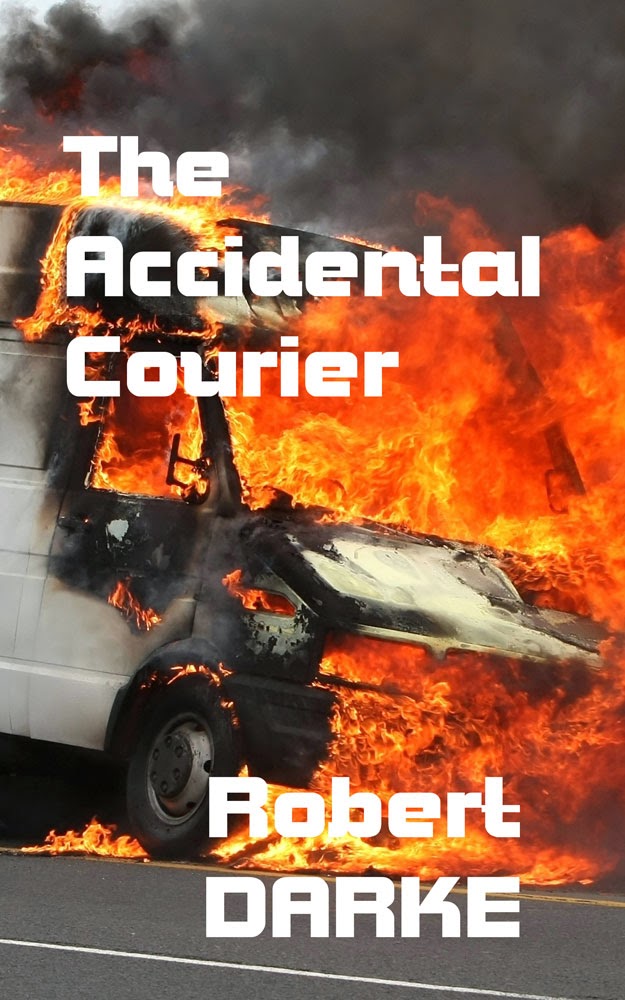
Guest Post: The Accidental Courier, by Robert Darke


The Accidental Courier available now as a paperback, or eBook, from Amazon US and Amazon UK

Short Stories

I was tidying my office the other day and found an old diary entry from 15 Jan 1984 that read, "This afternoon I started writing..." I must be one of the world's worst procrastinators because it took nearly 30 years to turn the dream into a reality. After my early attempts, I treated writing as a craft that had to be learned and attended all sorts of workshops and residential courses in the ensuing years.

Before embarking on a novel, for some reason, I needed to prove to myself that I was capable of writing to a 'publishable' standard. So I tried my hand at short stories and had loads of rejections before, finally, getting a twist-end story accepted by the national UK magazine, Best, who printed 'Sunday Love Songs' in their Autumn Special of 1999. It was great being in the Autumn Special because, unlike the weekly edition, it was on the shelves of every newsagent and supermarket in the land for a whole season! I thought I'd arrived but was soon brought back down to earth when my next few follow-up submissions were all rejected.

Well, I may be a procrastinator but I'm also tenacious and persistent! I convinced myself that if it happened once it could happen again - and it did. A couple of years later Best accepted another and then another and, suddenly, I was invited to by-pass the 'slush pile' and submit my stories directly to the editor via email. I'm eternally grateful to the then editor, Pat Richardson, who is now retired, for her faith in my work. I went on to have several short stories published in other nationals and small press 'literary' magazines as well as winning some competition prizes. So I told myself it was the right time to start the novel.

My First Novel

It took me 3 years to write my first novel. It was meant to be a thriller about smuggling and murder in Pembrokeshire (a county I love) and there was a bit of love interest too - just the sort of thing I enjoyed reading. I showed it to a few trusted friends and their feedback was that it was somewhere between a thriller, a romance and a travel guide but sadly didn't quite meet the full requirements of any of those genres. They said some kind things but all I heard was the criticism - and it hurt! But after retreating into my cave to lick my wounds I could see why they were right. I couldn't face rewriting it all over again and so I put it in my bottom drawer and started another novel ...but after a few chapters I got bored and figured the reader would be too.

So I took a break from writing and concentrated on my career.

NaNoWriMo Success
  
It wasn't until ill health forced me to take time off work that I stumbled across National Novel Writing Month (NaNoWriMo). It sounded like a bit of a gimmick but being thoroughly bored with daytime TV by then I decided to take the challenge. The aim was to write 50,000 words in the 30 days of November. Half way through that month, I was well enough to return to work but I ploughed on in my lunch hours because, as I said above, once I do eventually start something, I'm very determined. I hit the word count target but the novel still wasn't finished.

It didn't matter: I was back in the writing habit and thoroughly enjoying it. A couple of months later, the first draft of The Accidental Courier was finished. It took another 18 months of polishing, editing and rewriting before, finally, I felt confident enough to self-publish last October. Unlike my first attempt at a novel, this time the feedback has been 100% positive so far and, for me, that has been incredibly gratifying and made it all worthwhile. I'm now busy working on the next novel which takes as its central character, Detective Inspector Cannard who first appears in The Accidental Courier and it will also feature some of my other favourite characters from that book.

The Accidental Courier is available as a paperback, or eBook, from Amazon US and Amazon UK

# # #

About The Author

Robert Darke was born and raised in Cardiff but then moved around the UK with his job in HM Customs and Excise before eventually returning to settle back in his home town. He left Customs to provide IT Security and Audit services for several major organisations in the private and public sectors.  In 2013 he took early retirement from his job as Head of Corporate Communication for a large government agency to allow more time to concentrate on his writing. He is also a keen photographer, hospital radio presenter and proud new member of the Harley-Davidson Owners Group (HOG) Great Western Chapter.

For more information please visit:

28 June 2011

Guest Post: The Gift of Writing by Heather Hummel

Have you ever given yourself a birthday gift? One that no one else could give you, so you gave it to yourself? That’s what I did for my 40th birthday - I gave myself the gift of becoming a fulltime writer. This gift meant walking away from the high school classroom where I taught 9th and 10th grade English. It meant hearing, “You shouldn’t have quit your day job” ad nauseam.  Still, laptop in hand, I ventured out to my favourite coffee shop day after day and most evenings to write my first novel.
  That was the summer of 2005. I completed Whispers from the Heart that fall, staying close to the essence of being an English teacher. I created Madison Ragnar, a high school English teacher who teaches To Kill a Mockingbird. That is where the similarities between my personal life and that of Madison’s end and fiction began. One of Madison’s students commits suicide and his fellow students are left with a teacher and a theme from Harper Lee’s classic to deal with the shock and loss of their classmate.
  Madison’s students struggle to understand death and suicide while Madison is faced with healing and moving on from her past. A theme of self worth threads throughout the pages - both inside and outside of her classroom.
  When I set out to write Whispers from the Heart, I didn’t do character developments and outlines the way many authors do. Instead, I sat down and allowed my characters to invite themselves in. I allowed the storyline to direct itself. I welcomed Phil with surprise and wonderment when he suddenly showed up well into the book, but clearly played a pivotal role in Madison’s life. 
  The adventure that writing took on that summer was, for me, the realization that I gave myself the best gift possible…the gift of my creativity.
Since then I have published a nonfiction book, Gracefully: Looking and Being Your Best at Any Age, and Write from the Heart, the second novel in what is now the Unforgettable: Write Your Story series. Remember Me, God? will be the third in the series and is forthcoming this fall.
  In the six years since my 40th birthday, I have begun ghostwriting for celebrities and public figures. Many people have stories to share, but can’t find their written voice. That’s where I come in and am allowed to continue to use my creativity in writing books for others. It means showing up with no personal agenda or self-serving twist to their book. It means finding their voice and helping them put it down in a story. It’s one of the greatest and most rewarding challenges I’ve encountered.
  One of the greatest rewards came recently when I wrote a blog post that has made the biggest impact on me as a writer. I wrote a blog about two women who suffer from Chronic Fatigue Syndrome that has gone viral via Twitter and Facebook. The blog has resulted in record numbers of hits and, more importantly, has embraced a community that greatly appreciates the voice I’ve given them. Those who are suffering from CFS are reaching out to me to share their stories and with gratitude that I shed some light on an often misunderstood and unrecognized disease. I’ve been humbled by this experience and have realized that sometimes the less we write, such as a blog post versus an entire book, the more impact we can have. It has given the term re-gifting a whole new meaning to me.
Heather Hummel is a "photonovelist" who blends her love for photography with her award-winning career as an author. Her published works include: Gracefully: Looking and Being Your Best at Any Age (McGraw Hill, 2008), - Merit Award of the 2009 Mature Media Awards, Whispers from the Heart (PathBinder Publishing, 2008), - 1st Honorable Mention of the 2009 New York Book Festival, Write from the Heart (PathBinder Publishing, 2009)  Heather is a ghostwriter for celebrities and public figures and her books have appeared in newspapers such as: Publishers Weekly, USA Today and the Washington Post; and in magazines that include: Body & Soul, First, and Spry Living, a combined circulation of nearly 15 million.


Visit Heather’s website at http://www.heatherhummel.net/


Follow Heather on Twitter @HeatherHummel

Like Heather’s Fan Page on Facebook: http://www.Facebook.com/HeatherHummelFanPage

14 June 2011

Book Launch Guest Post: Vision by Beth Elisa Harris

Vision has been a concept for quite some time, since learning years ago about my ancestors from the Isle of Colonsay in Scotland. Those with vivid imaginations can concoct all sorts of drama when your father tells you, “We are descendents of the MacPhie clan, who were ostracized from the island by the MacDonald’s.” Regardless of the details, I had a springboard for a story. Now where, when, how to begin?

I often say I did not arrive at this place by walking a straight line. On the contrary, I have only recently returned to a less complicated frame of mind when dreams were as simple as one wanted them to be.  I arrived on planet earth as a writer.  That remained the purest of intentions until my warped perception of being a responsible adult slowly chiseled away pieces of my imagination. Before I knew what happened, I was writing business-i.e. things for others, such as articles, press releases, marketing materials, ghost projects and so forth.

To say something in me snapped a couple of years ago is an understatement.  Leaving out the details, let me just say I let the muse back in, spent the next year writing, editing and publishing Vision, started writing the two sequels and one other novel, all for young adults.

A voracious reader, I have a very open mind to different genres. Young adult or teen lit was just one of many types I sometimes enjoyed reading. But the more great YA books I read, the more I realized it was my writing genre. It takes more than remembering your early school years to write good YA, you have to love to read it too. The stories made sense, because the younger protagonists tend to be strong, brave, honest, slightly sarcastic and most of all, not whiney.  Sometimes ‘adult’ lit carries too much baggage, an over-abundance of skepticism about life weaving through the story, and it’s a turn off. Call me crazy, but I like triumph in some form. It’s the reason you flip pages to reach the end.  And yes, really liking young adults helps. I happen to adore teens and pre-teens.  Their voices are important. They have a lot to teach us.

I wrote Vision for what is considered upper young adult.  That is just how it came out.  There had to be some borderline adult situations to keep it real-I’m all about honesty, and my novels don’t contain too many netherworld creatures.  Instead my characters are real, diverse in all ways, passionate, vocal and inspiring.

And thankfully the readers agree! More than anything, I love getting comments about the unique flavor of the story, those that say ‘you’ve never read anything like this and I don’t know how to classify this book.’  With that said, those already waiting for the sequel should expect something out later this year.  I also hope to finish another YA novel Flyers appropriate for a slightly younger audience.

It’s all on my blog, so hop over for more information.  Residents of the UK should be able to currently purchase a Kindle version from Amazon UK and other e-books from Smashwords.

Beth Elisa Harris is a young adult author living in Southern California. Vision is her first published novel through eInteractive Media.

Beth Elisa Harris YA Author - Vision (series)
Published by: eInteractive Media
LCCN: 2011904385
BISAC: Juvenille Fiction/Science Fiction, Fantasy, Magic

Follow on Facebook as Beth Elisa Harris - Author
Follow on Twitter @Bethelisaharris   Goodreads Author Page 

BUY Vision at Amazon or on Amazon Kindle or Barnes and Noble NOOK and at Smashwords


9 June 2011

Guest Post by Tracy Sitchen: Making a Living Writing Online

There are many, many ways to make a living as a writer online. You can start your own blog, write e-books, work as a ghost writer (selling post or e-books for someone else's blog), or supply articles for content portals. With the changing face of the media industry, you can also write articles and editorials for online newspapers and magazines. However, working from home as a freelance writer requires a lot of discipline and determination if you are to become successful.

Create a Schedule

Working from home presents a number of temptations that can derail your productivity. Pretty soon, the flexible schedule that enticed you to work at home becomes so "flexible" that it is non-existent. Stay on track by creating a schedule, and stick to it the same way you would if you were punching a clock. Your schedule doesn't have to be from 9 to 5, nor does it have to be the same every day. Plan your weekly schedule according to the work you know you have to do and the personal commitments you expect.

Meet Deadlines

As a freelance writer, your reputation and credibility are key to your success. Ensure that you maintain a good reputation by delivering work on time. Keeping a schedule can help you meet deadlines. In addition, be sure that you don't over commit. It can be tempting to say yes to every offer that you get -- especially since the nature of freelance work is so erratic, and you never know when you will get your next job -- but don't accept work if you don't time in your schedule. Even if you're able to finish it on time, the quality of the work is likely to suffer, which will also hurt your reputation and your ability to get more jobs in the future.

Set Appropriate Rates

When you're just starting out, it can be tempting to set your rates very low so that you can get more work. Though you won't be able to start out charging $30 an hour, you should take a comprehensive look at your expenses and determine a reasonable rate -- both for you and your clients. Determine your living expenses and decide on a yearly salary. For example, if you want to make about $30,000 a year -- a modest salary -- you should divide that by 52 weeks, then divide that figure by 40 hours. Your rate would be just about $14.50 per hour. Keep in mind that as a self-employed writer, you are also responsible for paying your own taxes, purchasing your own health insurance, and saving for your own retirement plan. Keep all these things in mind as you set your rate. Over time, you will be able to raise it.

Always Look for Work

Even if you have a full schedule, always look for work. Many jobs that you find will be temporary in nature or will be on a project basis. You don't want to wait for those jobs to end before you start looking for new jobs. The availability of work is too erratic to count on finding a job as soon as your last one ends. Always be looking for new opportunities.

Do you work as a freelance writer, either full-time or part-time? What are some of your tips for success?

Tracy Sitchen is a veteran coupon clipper, stay at home Mom, and aspiring writer. While she loves shopping, she loves the chase of the deal even more! She’s recently been writing about City Museum coupons along with McDonalds coupons over at her blog where she shares deals and discounts to help every day people save money. 

6 June 2011

Poetry Guest Post by Sharon Skinner: In Case You Didn’t Hear Me the First Time


I have previously had poetry and short stories published in a number of magazines and a couple of anthologies, including The Wisdom of Our Mothers and, most recently, The Stories of Haven: I, as well as several other periodicals. However, I am very excited that Brick Cave Media, a local small press, recently published my new book, In Case You Didn’t Hear Me the First Time, a collection of poetry, essays and short stories written over a period of a dozen years.

The works in this collection reflect life’s journey through sadness, joy, love, loss, humor and hope. When asked what the book is about, I generally reply that it’s my personal take on our oh-so-human dance through “life, the universe and everything.”

I’ve intentionally included works that crack open the exterior shell and lay bare the tender interior where we truly live and love. The places where we curl up inside ourselves to cower, dream, recover, grow, and from where we can reach out and take a resolute stance against hardship. The places where we endure and from where we can celebrate our achievements and ourselves.

The poetry cuts deep, but cycles through to a place of self-affirmation. The essays about my time in the Navy are written with as much honesty as I could possibly muster (pun intended), exploring the dichotomies of the beauty and danger of the sea, the nobility and childishness of young service men and women, and the irony of military bureaucracy.

The inclusion of specific "Blog" entries as points in time, reflect specific moments in my life. Pointing openly to who I am and how I react to adversity, they act as a ribbon of truth, a sort of "Real life" or "Reality Writing" look behind the poetry, beneath the polish.

The reason I write is not just to express my personal emotions, but also to connect with others. I truly believe in the importance of transmitting a signal that does not simply radiate out into the atmosphere, but finds an appropriate receiver. And based on the reviews of my book posted on Amazon, my signal is currently being well received. This is not only gratifying and encouraging, but reaches deep into my interior, giving me yet another reason to celebrate.

In Case You Didn’t Hear Me the First Time is available on Amazon:


Sharon Skinner is an award-winning poet who received her B.A. in English from Ottawa University and her M.A. in Creative Writing from Prescott College.  She is a grant developer by day, currently serving as the National Board Secretary of the Grant Professionals Association. At heart she is a poet and fiction writer, having completed two Middle-Grade novels and one Young Adult Fantasy novel, The Healer’s Legacy, which is slated for release in Fall 2011. Sharon is currently hard at work on her current work-in-progress, a Young Adult Urban Fantasy about a teenage girl, who truly doesn’t fit inside her own skin.


Follow Sharon on Twitter @SharonSkinner56 
or at http://www.sharonskinner.com/

1 May 2011

Guest Post: Am I an Idiot? Working with a Freelance Editor by Rebecca Forster

Rebecca Forster
Spring. We begin anew. We slough off our baggage and leave the dreary months behind. Except when we don’t.  Which brings us to the topic of freelance editors.  have dragged mine into every spring, every new project, every new puddle of angst where I wallow secure in the knowledge that I will never write a decent book again.

I have done this for 26 years. I have faced each spring insecure and uncertain though I have published 23 novels, 2 indie published novels and one script in development.

My freelance editor’s name is Jenny Jensen*. To her credit, she does not roll her eyes as she takes me by the scruff of the neck, shakes off the muck and and points me back to the computer. I work with her because she is in my corner and that is important in publishing – to have someone in your corner. I work with her because I sell more often when I do.

That fact alone should be enough for me to never question my association with Jenny, yet I do. I want to know why, after all these years, can’t I edit myself? Haven’t I learned anything from her?  I had to know.  Am I an author idiot? Thankfully, the answer is no and Jenny had a couple of good reasons why:
  • Writing is a fast and furious process when it is going well. Grammar and spelling are not top of mind when an author is ‘in the zone’; words and ideas must flow freely.  Self-editing is prone to ‘blindness’. The author often sees no difference between her intent and the typed words.  
  • A good editor understands and respects the author’s words and voice while cleaning up the grammatical flaws that set the signals – signals that allow the reader to effortlessly navigate the story. Some writers see punctuation as a bother.  A well-punctuated manuscript will catch the eye of a publisher and so will one that is not punctuated well. Only one will sell.
  • Finally, some people are writers and others are editors. Like a writer with an instinct for story, an editor has an instinct for a pause, a rolling stop and when to quit. She knows when creativity and inspiration becomes awkward and interferes with story.  Knowing why I use a freelance editor usually leads to the question…
Can Only Rich Writers Afford a Freelance Editor?

Anyone who has been writing as long as I have can tell you that writing is not the road to riches. Most of us write while holding down other jobs and dealing with families. Some write for the pure love of it; most write in the hopes of making it their profession.

So, how can the expense of a freelance editor be justified?  First an author must understand that books are business. New York publishers have bottom lines to meet, independently published authors want to sell their books, online retailers want to turn a profit. The way to determine if it is worth spending money on a freelance editor is to first define your writing objective.

If you want to attract an agent, a New York publisher or stand out in the indie market then, in my opinion, an editorial eye is a necessity. Prices range from the ridiculously cheap to the astronomically expensive.  Some projects only need grammatical assistance and others continuity or story editing. Story editing is more expensive but, in my case, is critical. I write thrillers that rely on a trail of clues and red herrings and I cannot assess the effectiveness the webs I weave on my own.

In this roiling market, those who offer the cleanest, most professional product will be noticed. In the e-book market, those who present a flawed product will be called on the carpet instantly and very publicly. That is the worst kind of publicity and hard to recover from.

How Do I Work with a Freelance Editor? 

The same way you work with a New York editor attached to a publisher. You respect one another’s expertise and perspective. You have discussions, not confrontations.  You understand that while this is your book, her work is also held out to public scrutiny.

The Author:
  • Do not forward your first draft. Make it the best it can be before offering it for critique.
  • When the editor returns her comments/changes read them, set them aside and come back to them in 24 hours
  • Look at your edited work with an objective eye. The editor is the first reader. If she questions something so will the person who buys your book.
  • Pay your bills, say your thank yous. Even if you don’t like editorial suggestions, the work has been done. This is a small community- and getting smaller all the time considering the internet - and an author’s reputation is easily damaged.
  • Ask questions. If something doesn’t make sense, talk it out. Most freelance editors offer a certain number of follow-ups. Be succinct. Be focused.
  • Do not expect continuity editing if you have paid strictly for grammar/spelling edits.
The Editor:
  • Should be respectful of your work and have no genre preferences.
  • Should exhibit that she understands your ‘voice’. 
  • Should clearly state their fees up front and be specific about what the service entails.
  • Should have an acceptable turn around time.
Bottom line, if you can afford it, freelance editing makes all the difference in your final product. If you can’t spend the money find the next best thing: a middle school English teacher to help out, a wonderful book on grammar or a friend who will be read your manuscript and be honest. Rest assured, you are not an author idiot if you can’t self-edit. You are a writer. Other (wonderful) people are (thankfully) editors. Together, we make books that people want to read.

*Jenny resides at http://www.e-bookeditor.com. Note the wonderful example on her home page of what a difference punctuation can make.  


Rebecca Forster (follow on twitter @Rebecca_Forster) is a USA Today best selling author and a popular public speaker to writers' groups about publishing for Kindle, Nook and other e-readers. Rebecca also teaches on the UCLA Writers Program and at middle schools with The Young Writers Conference.  Visit Rebecca at http://www.rebeccaforster.com for writing tips, lots of pictures and a 'sneak peek' at her latest book.  

19 April 2011

Guest Post: A Self Publisher’s Tale by Elizabeth Currie

Elizabeth Currie
Firstly I would like to thank Tony for inviting me to contribute a guest blog to his website. After debating the relative virtues of a number of themes, we decided it might be topical and interesting for me to write about my recent journey to self publishing my first novel.

Like many journeys it has had its high points and low, its rocky and difficult places. But why self publish in the first place? That is probably the most important part of the whole process, the decision – not easily taken – to abandon (or perhaps not even look in the first place) the search for  the ‘conventional’ publishing route.

The journey for me has actually been a long one, taking easily the last five years, from when I completed my first novel (now titled ‘The Lady of Seville) and began the process of looking for a publisher.

From this vantage point I can now see how naive I really was. To me then, as an aspiring author of fiction (already with a well established pedigree in academic writing), it seemed all I had to do was my side of the ‘deal’ – come up with an interesting theme, research it well enough to make the plot and characters plausible, write it ‘engagingly’ (ie not like an academic article) and that pretty much would be that.  Well, yes, I realised that I probably wouldn’t exactly be ‘snapped up’ straight away, would have to prepare myself for a few rejections, but eventually, well ....

A depressing, disappointing and disillusioning experience  was in store for me. In those ‘days’ (we are talking about late 2006/2007 now) it was still (just about) possible to submit straight to publishers, so I tried a combination of locally-based publishers and agents. Time passed and one after the other the rejection slips came back.  I could easily write the rest of this blog detailing the subsequent weeks and months as they turned into years. I suppose in all I must have made some 25 or so submissions in total to agents/publishers for my first literary effort, an historical novel now entitled (but not then) ‘The Lady of Seville’.

Perhaps the book seemed slightly ‘specialist’, centring as it did upon a theme I knew a lot about and close to my heart, the period following the conquest of Peru by Spain in the 16th century. Although written as a dynamic adventure story and romance, with what I felt were interesting and credible characters, I could readily see that the book’s slow dreamlike beginning, and rather strange sounding story line might have caused it to be dumped straight into the slush pile.  I tried two main rounds of submissions and then withdrew the manuscript. Other life events took over and I have several other creative interests standing impatiently in the queue, awaiting their turn. So I turned my attention to painting pictures and developing my photographic portfolio for awhile instead.

Come 2009 I put all my goods back into storage again and once more took to the road – heading this time in the direction of India where I travelled alone for six weeks. I wanted to get ideas and inspiration for a completely different sort of book, one that might be more ‘mainstream’ and marketable, which is to say ‘women’s fiction’ (although not exactly ‘chick lit' – whatever that is).

I could write another whole blog upon this episode and related adventures, but in short, it produced my second novel: ‘An Indian Affair’ – a modern romance about half the length of the long historical adventure that had preceded it. No matter, however, exactly the same experience awaited me. This time I submitted directly to agents. I know you are supposed to submit to one at a time, but with an average eight week turn around period I did probably what many authors do, which is submit to around six at a time, all carefully selected from the ‘Writers and Artists Handbook’.

I made two and a half rounds of these: two at the beginning of the year (2010), about six in May; then another four or so later on in the autumn. One after another the standard rejections came back(pleasant, polite, but offering no feedback whatever). I know I am too sensitive; but I felt I simply couldn’t endure this process any more. I couldn’t see the point in carrying on banging my head against this impossible barrier as I was finding it. Something just wasn’t working. Clearly what I was writing didn’t sufficiently catch the readers’ attention to make them request a follow up.

At this point perhaps I should add that both manuscripts had been read by ‘trial readers’ and were well received; in particular the second romantic novel which had had good feedback from a selection of women well versed in the genre. By the end of the year I had finally developed my website and then made (for me) the unprecedented decision to enter the whole world of social networking (formerly so disparaged) and joined first Facebook and then Twitter. And, finally, I set up my own  personal blog (see ‘Wayward Lady’). Then I watched my world change from that erstwhile and hardly splendid isolation into something that slowly took shape as a writers’ network - and much-needed forum for exchange of advice and information.

By this time I had also joined a local writers group and slowly started to gain some of that vital insight and understanding I had lacked before.  In the mere three years since I had first looked into (then abandoned) the notion of self publishing it was clear just how much had changed. From being the old-style ‘Vanity’ press charging £100s for a mere three copies of your book and stigmatisation thereafter as a no hoper, the whole Indie, e-publishing and print-on-demand industry had taken off. New friends and advisers from the writers’ circle together with all the different links picked up from Twitter contacts allowed me to review my life and potential as a writer from a completely new perspective.

In the blog I had by then just started  I critiqued my own submissions according to the new sources I had just found.  In the ‘Slush Pile’ and ‘The Slush Pile Revisited’ posts I debated the merits of rewriting the opening pages to both my novels according to the arid formulaic criteria presented in such advice as ’25 reasons why your submission is rejected’; also with no guarantee of meeting with success.  As noted in the many web and blogging links I was now able to source, it became clear how rigid the formal publishing world had become.

I must admit it had, by then, achieved an almost revelationary quality. From feeling so blocked and thwarted, wondering if it was ever going to be worth writing another book, or whether the whole brave creative writing venture had to be written off(!) as a ‘failure,’ suddenly a way had magically opened up.  Certainly the whole process of taking your original manuscript and formatting it to make credible, professional and marketable end product (ie paperback) is a challenging one. Here I was helped by one of my new writing friends who had been through the process himself and advised me every stage of the way.

I was able to use a good original image to transform into a graphic for the cover of the book, and, a few storm-in-a-tea-cup style crises later, I had an ISBN and my first published novel. Certainly you learn en-route. There may be things I might change, or seek to improve for my new project underway (publishing the first written historical novel). Looking at the book there is nothing too startlingly out of place or dramatically ‘wrong’ to damn it as clearly ‘home made’.  It looks pretty much like any paperback book, but my own! (see An Indian Affair )

I would, however, advise anyone considering the same venture to give it all very careful consideration first.  I knew I had held out long in favour of conventional publishing, as still many people do. There are not an average of 300 weekly submissions to some, 800 per month to other Literary Agents for no reason. But increasingly it means that anything ‘unusual’, that deviates to any serious degree from standard submission ‘norms’ is unlikely to make it past the first stage.

As a further point I would also strongly recommend that any aspiring writer now have the all-necessary ‘platforms’: website, blog, Facebook pages, Twitter accounts and so on. This seems now to be an absolute ‘standard’. Approaching agents with an ‘unusual’ submission and no awareness of the way the world now ‘works’ can only damn you further. And, as a self-publisher, these certainly are a sine qua non.

Well, so what if what I write is not actually ‘good enough’ in the first place? Inevitably many people might think this.  Certainly we are given to understand that there is much in the ‘slush pile’ that genuinely lacks talent; is particularly well written. There must be much too which, whilst ‘OK’, is nevertheless still lacklustre. I believe in the quality of my work; others who have read it do so too. And now at least, the world ‘out there’ can find out for itself!

Elizabeth Currie has worked as an archaeologist and anthropologist of the Americas. She  recently changed the focus of her work towards the creative arts (fine art painting and photography) and most especially writing. Based in York in the UK she has a passion for travel that has inspired many of her creative undertakings. She said that 'Ultimately, it has all served the one end of allowing me to develop my philosophy of life and the person I am; and to express it'.  

Useful web sites:

www.elizabethcurrie.net
Blog site: ‘Wayward Lady’: http://elizabethjcurrie.blogspot.com/
Blog Posts documenting the decision to move into self publishing:

  • Thursday 10/02/11: ‘A Short Cut to the Slush Pile?’
  • Friday 11/02/11: ‘The Slush Pile Revisited’.
  • Wednesday 16/02/11: ‘The Raising of Spells.’

Poetry: ‘Poetry in Motion’: http://waywardladypoetry.blogspot.com/

Links to sites/blogs/advice Liz found helpful:

Follow Liz @elizajcurrie on twitter

14 April 2011

Guest Post by Catherine Schaff-Stump: So, you want to be a writer, do you?


Catherine Schaff-Stump
Let's talk about the quality that all writers must have before all things. Before tenacity. Before skill. Before work ethic. Let's talk about patience.  Where is the first place you will encounter a need for patience? With your manuscript. You will finish it, and you will want to send it away. Don't. Put it in a drawer for a couple of months, and then work on revising it. 

Get some feedback on it, and then, after a few times through it, send it out. I rework mine several times, and if it's not taken on somewhere, chances are good I will do substantial revisions on it sometime in the future. Creating a good work of art isn't quick. I'm getting the years perspective in my mind's eye, you betcha.  

After completing the work, the next place you'll need patience is when you submit your work. The urgency you will feel as you wait for the world to give you feedback will be in direct contrast to the size of the abyss you send your work into. Be mellow about it. Own your patience. Get on with your life. You can't sit by the computer refreshing your inbox and hoping. If you wander the Internet landscape, you'll hear about writers getting book deals years after they've submitted to slush. Or worse, rejections, years after. Give over the response to the universe, and do something else.  

It can take a long time after you've gotten an agent to sell a book to an editor. It can take a long time to get your career balanced where you want it. It can take a long time to get an acceptance from a box store market. If your work is accepted, you'll need patience continually. Waiting for the edits, waiting for the publication, waiting for the proofs, waiting for the check, waiting, waiting, waiting. 

This is the nature of publishing. I've heard that the cycle of a book going from accepted manuscript to published product is about two years at a minimum after you've done all the writing, revising, and shopping around. Writing taken from this perspective seems to be an occupation for the self-flagellating type A. You'd best become a type B mellow person in regard to your writing life. Given this information, I think if you're looking for a life of recognition and fame, petty crime is better. 

There's another piece to this, and that's what happens to the impatient. Some writers give up. I say you should, absolutely, if you can. Waiting is not satisfying. Some writers self-publish. I say if you do, make sure you want to be a PR person, an editor, and a sales force, in addition to writing books. Some writers publish in small press, or publish for free. I have done this, but if you do it, consider the implications for your career. Strangely enough, this doesn't work linearly, like it does in almost every other occupation. Consider the reputation of the venue, how much you'll be paid for your work, and the overall impact on your writing career. I'll just assume you're waiting for one of those. Here I am. Waiting. 

Current manuscripts given over to the cosmos. Writing the next project. Walking the walk. Talking the talk. Waiting for the next opportunity to revise. Waiting for the agent, the sale, the publishing. Waiting for one short story to come out. Waiting for the edits on another. Waiting for the rejections, the partials, the fulls, the revision requests. Waiting for chance and skill to combine together into opportunity. Not even chewing my fingernails. Nope. Because this is the writer's life. Writing, sending, waiting, rejecting, rewriting, sending, waiting. With the occasional acceptance to keep things interesting. I'm walking tall. I'm a writer. You? 

Do you have the patience and the guts to send your work out, and wait for your writing to be good enough to get you the results you're hoping for? And then the ability to wait some more while those pieces fall into place? I hear Solitaire passes the time when you're tired of writing the next thing. Me? I sew, talk long walks with my husband, and pet my cats.


Catherine Schaff-Stump is a writer, teacher, researcher and novelist based in Iowa. Catherine's blog can be found at Writer Tamago and she can be followed on twitter at @cathschaffstump 

8 March 2011

Guest Post by Laura Drake: A Million Ways Not to Write a Book


Laura Drake
This novel writing is very hard stuff.  Trying to learn craft while balancing plot, ideas, genre, and market. How anyone finishes a novel amazes me.  Sometimes it feels like I’m golfing and juggling . . . at the same time.

We all have our own ways not to write. You know what I mean – the conscious or unconscious things you do to avoid writing the damn book. Mine is the “I can’t write because I don’t know what happens next,” model.  It even sounds legitimate, until the quandary stretches out two weeks, and I’m forced to face the fact that I’m avoiding.
It wasn’t until I joined a writer’s group though, that I found that everyone has their own way of not writing a book. The below are a few of the categories I’ve noticed: 
  • Too busy; life is too disorganized. I’ll get back to it when . . . fill in the blank.
  • I’m blocked. 
  • I have to do more research. I need to take more classes. When I know more, then I can write.
  • I have so many ideas swimming around in my head that I can’t decide which one to write about.
  • I start a story, but when I get to the middle, it peters out, and I move on to a new idea.
  • I’ve completed the novel, but it’s not ready. Years of revision – it’s never ready.
  • I’ve finished the story and edited it, but I never get around to sending it out.
  • I’ve written the first six chapters, polished it, and entered every contest known to man. It’s even placed in contests. I just never finish the book.
  • I have this wonderful idea. No really, no one has ever thought to do a book on this fascinating subject. Why don’t you write it, and we’ll both share in the riches we’ll get from it?
  • I’m afraid the person (family member) I wrote about in a novel (and disguised) is going to recognize themselves. My family will implode.
  • I don’t understand the character well enough. I need to do character studies, interviews, horoscopes on them to be able to write.
  • And mine; how can I write on, when I don’t know what happens next?

I may have missed a few, but you get the idea. Please, don’t misunderstand me. I’m not being critical. I am right there in the mix, and I believe every author, from Plato to Stephen King, has their own way of not writing the book.

BUT. One of the most important things that separates the successful published author from one who never finished the book is that they plowed through the above. One of my favorite quotes is from Randy Pausch:

“Brick walls are there for a reason. The brick walls are not there to keep us out. The brick walls are there to show how badly we want something. Because the brick walls are there to stop the people who don’t want something badly enough. They are there to keep out the other people"

Those reasons are just roadblocks our brain throws up to cover up the fact that we’re scared. You can’t live with the thought that you’re too afraid of failure to reach for your dreams, so you use a perfectly legitimate excuse. I do it too.

But you know what I’ve found? When I ignore the fact that I don’t know what comes next, and sit down and type, something comes out. Sometimes what comes out is better than I imagined.

All the reasons above are perfectly legitimate.  They’re all true.  The question is: are you going to let them keep you from holding that published book in your hand, and opening it for the first time? From your dream of seeing someone in a coffee shop somewhere, reading your book? I’m not. I’m going now to write the next part, in spite of the fact that I don’t know what it is.

Laura Drake March 2011 

Laura has been writing romance and women’s fiction for over ten years and is currently editing her third novel. Based in Southern California, Laura is a corporate CFO during the day and a wife, grandmother, writer - and biker chick in the remaining waking hours!

AddToAny