Mastodon The Writing Desk

18 February 2015

Special Guest Post by Michael Schmicker, Author of The Witch of Napoli


Italy 1899: Fiery-tempered, seductive medium Alessandra Poverelli levitates a table at a Spiritualist séance in Naples. A reporter photographs the miracle, and wealthy, skeptical, Jewish psychiatrist Camillo Lombardi arrives in Naples to investigate. When she materializes the ghost of his dead mother, he risks his reputation and fortune to finance a tour of the Continent, challenging the scientific and academic elite of Europe to test Alessandra's mysterious powers. Meanwhile, the Vatican is quietly digging up her childhood secrets, desperate to discredit her supernatural powers; her abusive husband Pigotti is coming to kill her; and the tarot cards predict catastrophe. 

Available on Amazon US and Amazon UK

I have a confession to make –The Witch of Napoli started out as a 15-page film treatment. I had stars in my eyes. I studied documentary film production at New York University and at the British Film Institute before I became a journalist and book author, and knew the basics of the cinematic craft.  So when I stumbled across Italian Spiritualist medium Eusapia Palladino (1854-1918) while researching my first (non-fiction) book, Best Evidence, I decided she was my ticket to 20th Century Fox.

I’d write a film based on her life. The real-life Signora Palladino levitated tables and conjured up spirits of the dead in dimly-lit séance rooms all across Europe towards the end of the 19th century. Her psychic powers baffled Nobel Prize-winning scientists, captivated aristocracy from London to St. Petersburg, and annoyed the powerful Catholic Church, which suspected her paranormal feats were the work of Satan. Her meteoric rise to fame, her humiliating fall, and miraculous redemption made world headlines at the time – when she died, she earned an obit in a dozen national papers, including the New York Times.

I had visions of a biopic, or even better a Sony Pictures period drama starring Penelope Cruz or Salma Hayek. Forty-year old Eusapia was such a wild woman – fiery-tempered, amorous, vulgar, confident – in a Victorian age where respectable matrons were insipid saints on a pedestal, stunted socially, sexually, intellectually, economically.  She allowed strange men to sit with her in a darkened room holding her hands and knees and legs (“proper” women would have fainted, or throw themselves off a precipice, if caught in that situation).  She flirted and teased her male sitters, argued loudly, slapped an aristocrat who insulted her, flew at men who accused her of cheating (even when she did).  Yet she was also extremely kind and generous to anyone in trouble, loved animals, gave to beggars. Her heart was large. I thought she’d make a hell of a heroine. And there was that spooky paranormal twist to her life. I came up with a clever logline – the one sentence summary you use to pitch your film to super-busy Hollywood execs: “Downton Abbey meets the Exorcist.”

But the L.A. crowd told me selling a film treatment was a million-to-one shot.  I needed to write the novel first, then option the book.  I didn’t want to hear it. I’d never written fiction before. A novel is a nightmare for the amateur, and a challenge even for a pro. It requires playing with a Rubik’s cube of characters, plot, subplots, pacing, dialogue, style, emotional arc – pieces which the writer must move in a certain sequence, and introduce at the proper moment,  to propel the tale forward, hold the fickle reader’s attention, and arrive at a successful denouement. Historical fiction raises the complexity another level. Where do you find information on the cost of a plate of pasta in late 19th century Napoli?  Was the typewriter around? How many hours was the train ride to Rome? How do you weave the history in without slowing the story and boring readers? Frankly, I was scared stiff. But I finally took the leap. Now that The Witch is up on Amazon, I’m glad I jumped; somewhat surprised I survived; and extremely appreciative of the many positive reviews it has garnered.  Kirkus Reviews is featuring The Witch in its current issue (February 2015); it’s found an audience; and sales are climbing. If you’re a film buff, look carefully – you’ll even find multiple cinematic tricks buried in the structure of the novel.

Meanwhile, I’m still determined to see The Witch of Napoli on the silver screen – with Salma or Penelope. Know anybody at Sony Pictures?

Mike Schmicker
# # #

About the Author


Michael Schmicker is an investigative journalist and writer on scientific anomalies and the paranormal. He is the co-author of The Gift, ESP: The Extraordinary Experiences of Ordinary People (St. Martin's Press (USA); Rider/Random House (UK). His first book, Best Evidence, has emerged as a classic in the field of scientific anomalies reporting since its first publication in 2000. He is a contributor to EdgeScience magazine, a book reviewer for the Journal of Scientific Exploration, and his writings also appear in three anthologies, including The Universe Wants to Play (2006); First of the Year 2009 (2009); and Even the Smallest Crab Has Teeth (2011). Michael began his writing career as a crime reporter for a suburban Dow-Jones newspaper in Connecticut (USA), and worked as a freelance reporter in Southeast Asia for three years. He has also worked as a stringer for Forbes magazine, and Op-Ed contributor to The Wall Street Journal Asia. He lives in Honolulu, Hawaii. You can find Mike on Twitter @Schmicker

16 February 2015

Guest Post ~ The Rewards and Challenges of Writing a Story Inspired by a Relative By Carmela Cattuti, author of Between the Cracks


Join Angela Lanza as she confronts the ephemeral nature of life on this planet and navigates the wide cultural gaps between pre-World War II Italy and the booming prosperity of dynamic young America. Author, artist, and teacher Carmela Cattuti created Between the Cracks as an homage to her great-aunt, who survived the earthquake and eruption of Mt. Etna and bravely left Sicily to start a new life in America.

Available on Amazon US and Amazon UK

There are many questions one should ask oneself when writing a story based on a relative’s life. How closely should I base my character on his or her real-life characteristics and circumstances? What about the peripheral characters with whom the main character interacts? Sometimes we need to employ literary devices to highlight a point that completely changes the character’s circumstances.  I found writing a story about my great aunt, Angela Lanza Barone, a humbling experience on many levels.

Until I wrote Between the Cracks, I did not realize the depth of her influence on my life choices. I knew her quite well, in fact, she was my nanny of sorts. We lived in the same house with her and my uncle twenty five miles north of New York City. The house was a Queen Anne Victorian with four working fireplaces, large sliding French oak door, stained glass windows, and a grand staircase. It was a Grand Dame and one of the most elegant homes in town. She told me her life story over and over again until I could repeat it verbatim. Angela handed me my novel on a silver platter as she did most things. I could have written it exactly as she told me and still have come up with a solid piece of work.

Unfortunately, it is a work of fiction with all the pitfalls and challenges the art form presents. I had to embellish parts and cut certain characters and scenes that were part of her landscape. I had to ask myself the difficult question: what do I let go of and what do I keep? When you are writing about a relative answering this question becomes the ultimate challenge, so it is imperative you know what you want to accomplish by writing fiction. For myself, I wanted to integrate her qualities throughout the book so readers would ponder their choices in regard to religion, relationships, setting boundaries, taking risks, and expressing individuality.

I’ve been asked how my family felt about the book. It has been resoundingly positive. Even my ninety nine year old mother has nothing but praise for the novel and shows it off to her friends in her nursing home. I set out to honor my great aunt’s personal experience of immigration and assimilation into an evolving culture in the new world. My brother said, “You have done the family proud.” The positive feedback from my immediate family has aided me in continuing with the second book. In the next installment I am diving into Angela’s unfoldment in not only a changing America but a changing family and social structure. I think she was disappointed in how her life unfolded. She was cultural, creative, and spiritually aware at a time when Catholicism reigned supreme.

Many of my choices in life were based on her influence and her perception of me as a creative individual who should do exactly as she pleased. So, as I embark on the second book in my trilogy, I would support any writer to take on the challenge of writing about a relative. Self-awareness is the resulting gift.

Carmela Cattuti 

# # #


About the Author

Carmela Cattuti is a writer, visual artist, and teacher. She is the author of Between the Cracks, a novel based on her great aunt's inspirational journey from Sicily to the U.S. Carmela is a graduate of Boston College's masters program in literature. To find out more visit Carmela's blog. You can also find her on Facebook  and Twitter. 

11 February 2015

Blog Tour with Jane A. Hobden, Author of The Hartford Inheritance


As a child, Kitty Harmer had her world turned upside down when her twin sister, Sarah, was taken into care. Now aged 26 and struggling, she is contacted about the inheritance of a property she has never heard of miles away. Kitty seizes the opportunity and moves into Belford Hall, set on acres of land in Norfolk. Kitty is soon drawn to the charms of the Norfolk countryside, and a local farmer. As she settles into the primitive manor house, she discovers a book titled Hartford Place locked in a library drawer. Kitty soon learns of the stories surrounding the Hall, a curse made in the 1800s and a past she knew nothing about. Her Hartford ancestors mirror Kitty with their raven hair and emerald eyes and have all suffered tragedy, with veiled secrets buried deep.

Available on Amazon US  Amazon UK
Goodreads and Smashwords


Writing The Hartford Inheritance

Since I was a child, I have enjoyed literature and would spend countless hours after school tucked away in my bedroom reading and composing stories. My daughter, who is 11 years old, does exactly the same. She adores the process of story-telling and when we discussed what she wanted to be, she said without any hesitation an Author. It melted my heart. It’s where my passion has always been.

I thought of the conception for the book in 2011 and spent two months whilst I was between jobs writing the book.  Then I gave the first draft to two friends, one who I knew would be very honest with me and the other who would tell me it was fab whatever!!!!  I needed that balance!!!  Then I started the process of going into more depth with the characters and the plot. This took me quite some time as I was working full time and I would go for long periods not touching it!!  Then I started the editing process.  Again this took me some time because instead of editing, I would be looking to change the plot instead of what I was trying to achieve.

Throughout the processes I sent letters and chapters to over 30 literary agents without any success.  One of the publishers told me that they receive hundreds of samples of work each week and only take on one new author each year so I realised the odds weren't going to be great!!

I decided in 2014 that I really wanted to get the book published and I researched how to upload onto Kindle and other eBooks on the internet. I got in touch with a formatter named Stephen Baker from  EBooks by Design.  He was absolutely brilliant. He formatted the book into all ebook versions, got the ISBN numbers and uploaded it onto all eBook sites.

It’s hard to believe that after starting the process of writing my debut novel in 2011 I have finally published The Hartford Inheritance. intend to follow this book with a prequel and a sequel and hope very much that you enjoy my writing.

I have always lived in Hastings on the South East Coast of England, which I adore. I’ve been married for twelve years to a man who inspires me and with whom I am still very much in love. We have two children together, Harriet, now aged 11 years, and Toby, aged 6 years. 

My parents are my rocks and have taught me all my best qualities – to be fair and kind to everyone. They have always been there for me and they are very proud of me for achieving my goal of publishing my first book. This book is dedicated to all of my family, whom I love so very much.

Jane A. Hobden 

You can find out more about Jane's writing at her website and find her on Twitter @janenobbshobley  

10 February 2015

Guest Post ~ Alchemy and the Art of Writing Backwards, by Ailsa Abraham


A world without war? Professor Sawhele Fielding stumbles across an invention that would change the world; something so monumental, it could spell the end of environmental disaster and conflict. With the help of her father, a shadowy figure in the world of international banking, she begins to set into motion the biggest upheaval the planet has seen.  How could a Utopian dream of free fuel and peaceful co-existence turn into a nightmare? Iamo, a priest of the Mother Goddess and Riga, a Black Shaman assassin captain, are thrown together - reluctantly at first - to face a threat that nobody could have imagined before "The Changes". ALCHEMY is the prequel to Shaman's Drum which features the adventures of Iamo and Riga through their world in the near future, where the established religions of our own days had been banned. 

Available on Amazon UK and Amazon US


Thanks so much for inviting me over, Tony. How did I come to write Alchemy? Like most things in my life...back to front and inside out! I had already been published under the name of Cameron Lawton in gay romance /detective fiction which, in itself, is a bit of a mixture. MLR Press had taken three of my works and wanted a series.

Out of nowhere apart from my life-long interest in comparative religions, I was sitting in my back yard drinking tea when a scene flashed through my head. A crippled woman, dressed like a nun but obviously not a nun was rescued by a very handsome young man in monks' robes. It was just like the trailer for a movie which I very much wanted to continue watching but someone spoke to me.

That was it. I had to find out the back-story and what happened once he rescued her from the convent. That was how Shaman's Drum was written which was accepted immediately by Crooked Cat Publishing. The reaction was unbelievable. My two main characters, Riga the Black Shaman woman and Iamo the Priest of the Mother Goddess were immensely popular and all the readers wanted was MORE background.

Alchemy was commissioned straight away and took less time to complete. It includes many subjects close to my heart: the environment, the outrages of terrorism and inter-faith intolerance. I had my own experiences on which to draw for the different religions, including the old gods/New Age,  which come to predominance when the established ones were banned. I am, however, no scientist so I had to rely on my live-in nuclear engineer to help me with the “tricky bits”. In this novel I don't only show how the two lovers met and fell for each other, I look at the often-suggested solution of banning all religions to put an end to terrorism. Does it work? Read it and see!

Readers were delighted with the prequel too and asked for a third. I see – so the happy ending that was hinted at in Shaman's Drum doesn't work eh? (I am, of course, knocked-out by that reaction!) It is work in progress, only put on hold by a very nasty motorcycle accident I had last August which landed me in a coma for three weeks. My head is recovering but only slowly and writing for any length of time gives me demonic migraines. (Excuse me, there are a few demons in my books, too).

A fourth may follow as one of the important characters would now like his own book which he intimated to me while I was listening to a talk in Scotland by some Navajo Rangers on the paranormal investigations they sometimes carry out. I can't ignore a Black Shaman Blood Father for very long, can I?

Thanks again for this opportunity to share my work, Tony.

Ailsa Abraham
# # #

About the Author

Ailsa Abraham retired early from a string of jobs, ending up with teaching English to adults. She has lived in France since 1990 and is married with no children but six grandchildren. She copes with Bipolar Condition, a twisted spine and increasing deafness with her usual wry humour – “well if I didn't have all those, I'd have to work for a living, instead of writing, which is much more fun.”. Her ambition in life is to keep breathing and maybe move back to the UK. She has no intention of stopping writing. Her other passions are running an orphanage for homeless teddy bears plus knitting or crochet now that she has had to give up her beloved black Yamaha. Find out more at Ailsa's website http://ailsaabraham.com/ and follow her on Twitter @ailsaabraham 

9 February 2015

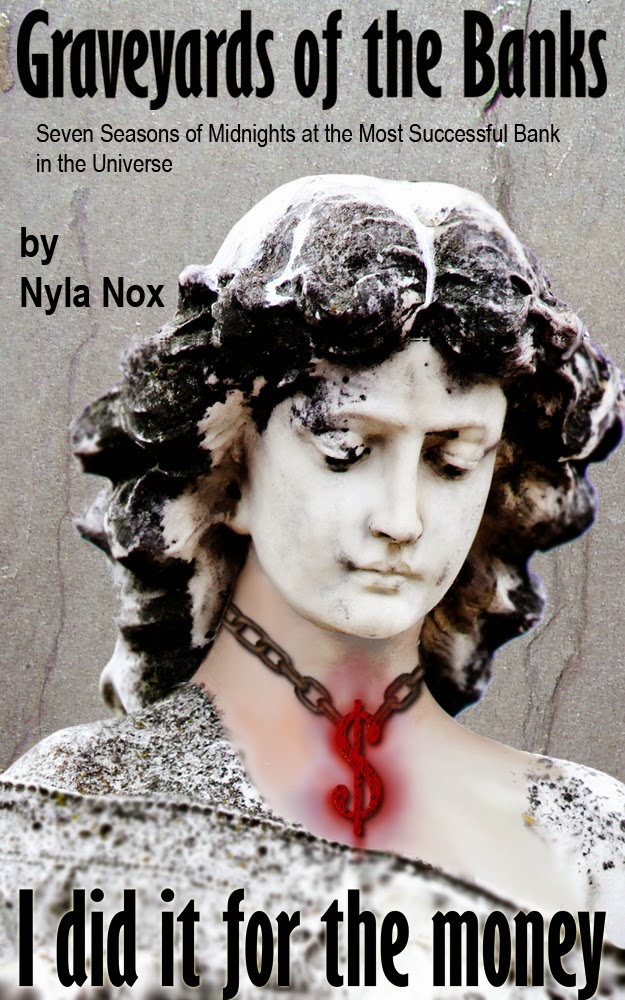
Guest Post ~ Graveyards of the Banks - I did it for the money, by Nyla Nox


A haunting trilogy about Nyla's journey through the gothic maze of the Most Successful Bank in the Universe in London. A group of jobless humanities graduates abandon all hope and enter the Third Basement for a life on the graveyard shift, a toxic bubble of bitches and bullies where the Bank conducts human experiments to select the Fittest to Rule. Nyla Nox worked on that night shift herself for seven years, treated by the Bank as the lowest of the low, hidden away in the Building Without A Name, right in the heart of one of the world's most powerful institutions in the City of London. Her voice is still unheard, the story of her hidden tribe is still untold. 

Available on Amazon US and Amazon UK


Long sleepless nights high above the London night, cowering in fear of bullies who had the power of instant dismissal, desperate for the money, not allowed to take toilet breaks – that was my life for seven years.  When I escaped in the morning, I wrote poetry and dreamed of a better world.

Oh, where was that?  No, it wasn’t the Prison of Askaban, although some called it that in whispers.  I worked on the graveyard shift at the Most Successful Bank in the Universe as a graphics operator, prey to the bankers who were ‘top dogs’ and the shift leaders who could do whatever they liked while our managers slept.

I am not the writer I always thought I would be.  From the age of six, I wrote fantastic stories, plays, poems and epic sagas. My trilogy ‘Graveyards of the Banks’, is a saga alright, but a saga about my life of hell at the Bank.  The experience was so traumatic and so pervasive, nothing else would come out of me before I had written this.  I didn’t want to.  I wanted to write about fantastic creatures and unknown galaxies, and sometimes I was able to escape into these, but only for shorter stories.

The ‘Graveyards of the Banks’ loomed over my mind like the ghosts of the medieval plague victims buried in the old graveyards around the Bank.  And so I wrote about them. This was a long and painful process. At first I didn’t really know how. My novel was set in the work place, although it was a very extreme workplace for sure, huge floors crammed with people, filthy kitchens, fleas in the carpets, and constant, constant anger fuelled shouting.  This was not the stuff of comedy.  It was more like a gothic tale of shadows and terror.

But there were not gothic tales of shadows set in the workplace. Why not?  I became intrigued by that question.  Why is the work place not portrayed with the same depth and width of artistic expression as our private lives?  Or history?

We spend so much time at work.  We have relationships, often very difficult group dynamics that nothing has prepared us for, and emotions run very high at work, particularly in high pressure places and, of course, on the night shift. I worked on the ‘Graveyards of the Banks’ for five years, two of them full time.  I financed those years partly with the money I made there.  Which is kind of ironic, I know…

Those five years also were my apprenticeship as a novelist.  Before, I had been a poet (and the London poetry scene was also a fairly vicious environment…), so I struggled with expanding the writing instead of condensing it.  I also struggled with the fact that, with a novel, you have to turn up day after day after day (or night, I had become so used to night work that I now mostly write after midnight).  A poem can be written in one or two sessions.

I discovered procrastination and self doubt beyond my wildest fears, and I also relived a lot of the scary experiences I was writing about.  Nobody could really relate to what I was going through – the Bank is a unique environment, as is the business of being a novelist.  The ‘normal’ people around me didn’t share either.  Who knows what they thought of me during those five years – I’m too afraid to ask…

Now that the trilogy is finished, I am very proud.  These books made me into a novelist.  So much so that I now work part time as a writing coach.  I also have developed my own way of writing about the work place, quite different from most other novels. 

Volume 1 is called ‘I did it for the money’.  I never thought a book of mine would have that title.  But the cover image shows a graveyard statue wearing a dollar sign reminiscent of the ‘Scarlet Letter A’.  There’s a hint of poetry in that… Maybe for my next book I can now return to writing sagas about places far away and tales of other suns. Or maybe the ‘Graveyards of the Banks’ are the strangest places I will ever write about.

Nyla Nox

# # #

About the Author

Nyla Nox lives an exciting double life, writing about finance and the workplace at mergersandinqusitions,
efinancialcareers and of course in her novel trilogy ‘The Graveyards of the Banks’.  Volume 1, ‘I did it for the money’, will be out on 6 March but is already available for pre-order. She also writes stories about fantastical creatures and her work has been included in collections by Cleis Press, Zharmae Press and Drollerie Press. Find out more at her website and follow Nyla on Twitter @NylaNox

7 February 2015

Guest Post ~ The long trail to Poison Bay, by Belinda Pollard


 “The Maori call this place Ata Whenua—Shadow Land.”

Television reporter Callie Brown likes safe places with good coffee. But she joins friends from the past on a trek into New Zealand’s most brutal wilderness, in the hope of healing a broken heart.
What she doesn’t know is that someone wants them all dead. Lost in every sense of the word, the hikers’ primal instincts erupt. Surrounded by people who have harbored secrets for a decade, Callie must choose the right ally if she doesn’t want to be the next to die...

“A breathtakingly fast-paced and original eco/wilderness thriller.” Karin Cox, Author

Available in ebook and paperback on Amazon US and Amazon UK
Kobo, BookDepository and all good online bookstores.


When I published my debut mystery/thriller Poison Bay just before Christmas, it was the culmination of many years of research, writing, editing and worrying.

The idea

The idea first began to fester in my head nearly 20 years ago, when I was travelling around New Zealand’s South Island on holiday. I was awestruck by the glacier-carved mountains, sharp and steep, that rose abruptly from ground level.

Locals boasted that it was one of the wettest places on earth, with that peculiar pride we humans have that says, “You think it’s hard to live where you come from? Beat THIS!”

I heard stories of narrow escapes in the wilderness… people being thrown bodily off hiking trails by the wind, becoming disorientated in sudden summer blizzards, or endangered by “tree avalanches” – after heavy rain, dense rainforest can slide down off the mountain leaving in its place hundreds of storeys of bare near-vertical granite.

As an aspiring mystery writer and all-round nice person, I thought, “This landscape would make a good murder weapon.”

I’d also been reading Agatha Christie’s And Then There Were None, about a group of people with past secrets who are assembled by invitation in a remote place and then begin to die one by one.

The two concepts merged in my head, and when I saw the name “Poison Bay” on a map, that settled it – I had to write this book!

The research

The manuscript remained one page long for a decade, partly because as a former journalist I found it hard to begin without facts to launch from. I decided there was nothing else for it but to undertake a research expedition, which would include hiking the Milford Track, a famous four-day trek through Fiordland National Park, far from any roads or towns.

I have bad knees and a fear of heights, plus I was recuperating from a chronic mosquito-borne virus at the time, so I found the whole escapade highly intimidating. This turned to my advantage as several of my characters are certainly not athletes, so I was able to understand and describe how they would feel. I took many photos and wrote a lot of notes.

After surviving the hike (just!), I spent ten days in the nearest town of Te Anau, reading local reference works in the library, interviewing police, search and rescue organisers and others. People were very willing to help me, and enjoyed teasing me about being “world famous in Te Anau” (population 2000).

The long haul

I wrote 11,000 words during my research expedition, but then a serious illness in the family shunted the book to the backburner for a while. Sometimes I wondered if I’d ever get back to it.

In 2010, I decided to get serious about my novel, and began entering the partial manuscript in various “development” competitions, to give myself concrete goals and deadlines. Each time I failed to make the shortlist, I would feel glum and lose momentum. But then I’d pick myself up again, write some more, and enter another competition.

I’ll never forget the feeling of seeing my name on the shortlist for a publisher fellowship through Varuna, The Writers House in the mountains west of Sydney, Australia. It was a turning point for me – a validation. Someone else thought my book might be worth writing! Even though I went on to win that particular award, strangely enough the memory of winning is secondary to the joy of making the shortlist.

There was much more work to do: sessions with a manuscript consultant; feedback from a wonderful group of beta readers; self-editing; rewriting. I realised I needed further expert input, and located specialists in NZ police procedures and Type 1 diabetes who generously checked my facts.

The sprint to the finish line

In early 2014 I decided to exit the agent-go-round and self-publish. Despite my resolve, perfectionism still held me back. A wise person once said to me, “You never really finish writing a book. You just stop.” In September 2014, I decided to “just stop”. I made the public declaration on my blog that I would publish by Christmas. Three months of insanity followed in which Poison Bay was finalised, edited, typeset for paperback, formatted for ebook, proofread and PUBLISHED.

Whew! The journey finally ends. But no – now I have the joy of connecting with readers, sharing my imagination with other imaginations. The journey is just beginning.

Belinda Pollard

# # #

About the Author

Belinda Pollard is an award-winning former journalist who loves mountain hiking despite bad knees and a fear of heights. She has been a professional writer and book editor for decades, and a contributor to the British Closer to God series since 1999. The words “Poison Bay” on a map of New Zealand triggered her journey to the sinister end of the bookshelf. Spooky and remote, it was a location just begging for a mystery. Poison Bay, her debut novel, was awarded a Varuna Publisher Fellowship in 2011. She blogs Real Life on a Beautiful Planet at www.belindapollard.com and writing & publishing themes at www.smallbluedog.com. As a speaker, she addresses audiences ranging from business people to writers on topics that are both practical and inspirational. Belinda lives in Brisbane, Australia where she undertakes ball-throwing duties for a dog named Rufus, and turns on the air-conditioning so she can dream of snow. You can find Belinda on Twitter @Belinda_Pollard

1 February 2015

Special Guest Post ~ Tantalus: the Sculptor’s Story by Jane Jazz


 When Sylvia sees something stir in the dark, shadowy corners of the studio where she paints, her world is changed forever. She finds herself staring straight through the neighbour's wall, and into the startled eyes of a young sculptor called Tom. What he doesn't realise is that she is not yet born; she is not due to be born for another fifty years. He would move mountains to get to her. He may have to. 

Available from Amazon UK and Amazon US


A trio of separate sparks ignited the idea for my novel.

i) We moved into an incredibly draughty, old Yorkshire vicarage that was semi-attached to the next building, and I discovered the houses were originally designed with adjacent studios for neighbouring  artists, in the late 1800s.  The house was seething with shadowy inspiration, and whenever I walked through the studio, insistent voices would whisper. Tom and Sylvia didn’t give me any peace until I had written their story.

ii) While unpacking, I came across my Greek mythology book, and realised Tom was suffering a similar fate to Tantalus, who was punished for displeasing the gods by being tethered in deep water under fruit trees. Whenever he tried to drink or eat, the waters and fruits would recede, so he was eternally hungry and thirsty.

I remembered that the family firm of John Betjeman had named their lockable decanter frame Tantalus, as the precious liquor would be enticingly visible but impossible for servants to taste. This further delayed unpacking, while I unearthed his verse autobiography, Summoned By Bells, to validate my memory with his report of ‘stockrooms heavy with the Tantalus / On which the family fortune had been made.’

iii) Some weeks later, I was spellbound by my first sight of glistening marble mountains in the Apuan Alps, when we stayed in a Tuscan villa and drove to Lucca for the day. It was high summer and the sun blazed in a fierce blue sky… yet these mountains seemed thickly carpeted with snow. We took a detour to investigate, and discovered the ancient marble town of Carrara, dominated by mountains where Michelangelo had found his perfect stone. This provided the spark that finally ignited Tantalus: the Sculptor’s Story.

Much of the novel centres around Tom’s life as a sculptor, both in Yorkshire and Tuscany, and I gathered inspiration and information  from several visits to Carrara, and my discussions with sculptors who trained and worked there. The food was pretty inspirational too!
‘After breakfast we’d go off for hours – roaming in olive groves, in orchards of hazelnut and walnut trees, through horse chestnut and beech woods, catching glimpses of deer and wild boar – and when we returned we ate simple feasts of beefy tomatoes, sun-warmed olives, ripe cheeses and thin slices of the local lardo: pig fat layered with garlic and rosemary, then cured in marble basins.’
A good deal of careful planning was necessary with this novel. Events from two different eras and timelines had to dovetail exactly, and this was complicated. I had a wallchart with long columns of dates, and these needed constant readjustment as the story progressed. It was important to be accurate, as Tantalus may fly to the edge of fantasy, but its feet are firmly planted in reality, with all dates and some events being taken from real life.

Tom and Sylvia happen to be separated by an impenetrable yet tantalisingly invisible wall of time, but this story explores the desperation of people who are forced apart; they could just as easily have been parted by barriers of race, place, creed or class, as they battle with unbreakable laws and unfulfillable yearnings. As both writer and reader, I find the slightly impossible rather irresistible.

Jane Jazz
 # # #
About the author

Jane Jazz has two daughters and is married to a keen fell runner, though she tends to just saunter. Having relocated from Yorkshire, they now live in rural Shropshire, where the view from her desk is best summed up by Ogden Nash: The cow is of the bovine ilk; one end is moo, the other milk. During her years as a commercial copywriter, press officer and journalist, Jane has written newspaper articles, magazine features, advertising copy, short stories, poetry and songs. She even wrote greetings card verses for a time, but (though ludicrously lucrative) it had to stop, as she was starting to think in rhyming couplets. For more information visit Jane’s website blog AuthorJaneJazz.  You can also connect with her on Twitter and on Goodreads.