Mastodon The Writing Desk

15 March 2021

Book Launch Spotlight: A Matter of Conscience: : Henry VIII, The Aragon Years, by Judith Arnopp


‘A king must have sons: strong, healthy sons to rule after him.’

On the unexpected death of Arthur Tudor, Prince of Wales his brother, Henry, becomes heir to the throne of England. The intensive education that follows offers Henry a model for future excellence; a model that he is doomed to fail.

On his accession, he chooses his brother’s widow, Caterina of Aragon, to be his queen. Together they plan to reinstate the glory of days of old and fill the royal nursery with boys.

But when their first-born son dies at just a few months old, and subsequent babies are born dead or perish in the womb, the king’s golden dreams are tarnished

Christendom mocks the virile prince. Caterina’s fertile years are ending yet all he has is one useless living daughter, and a baseborn son.

He needs a solution but stubborn to the end, Caterina refuses to step aside.

As their relationship founders his eye is caught by a woman newly arrived from the French court. Her name is Anne Boleyn.

A Matter of Conscience: The Aragon Years offers a unique first-person account of the ‘monster’ we love to hate and reveals a man on the edge; an amiable man made dangerous by his own impossible expectation.The story continues in A Matter of Faith: Book Two of The Henrician Chronicle.

# # #

About the Author

Judith Arnopp is the author of twelve books; three set in the Anglo-Saxon/early medieval period and nine set in and around the Tudor court. All books are available in Kindle and Paperback format, and The Beaufort Chronicle (three book series), The Kiss of the Concubine and A Song of Sixpence are on Audible. Find out more at Judith's website www.judithmarnopp.com/ and find her on Facebook and Twitter @JudithArnopp

14 March 2021

Special Guest Post by Mary K Tod, Author of Paris In Ruins


Available from Amazon UK, Amazon US

Paris 1870. Raised for a life of parties and servants, Camille and Mariele have much in common, but it takes the horrors of war to bring them together to fight for the city and people they love. The story of two women whose families were caught up in the defense of Paris is deeply moving and suspenseful ~~ Margaret George, author of Splendor Before the Dark: A Novel of the Emperor Nero

Louise Michel and the Paris Commune

My newest novel, Paris In Ruins, is set during the Prussian siege of Paris and the Paris Commune—nine months of devastation, death, and infamy. Research prompted many questions. Why did certain Parisians attempt a coup at the end of October 1870 when Prussian soldiers surrounded the city? 

Why did so many working-class citizens rise up to overthrow the government after enduring five months of siege that left many starving and destitute? Who were the leaders of this insurrection? When I came across Louise Michel, leader of the Montmartre Women’s Vigilance Committee who some referred to as the ‘Red Virgin’, I knew she had to be part of the story.

By the summer of 1870, Napoleon III, nephew of Napoleon I, had presided over France for twenty-two years, first as president and then as emperor. During that time, he expanded the French empire, modernized the economy, extended the railways and the merchant marine, and negotiated significant trade agreements with Britain and other European countries. He also dismantled and rebuilt large parts of Paris to create the boulevards and buildings that remain to this day and give the city its distinctive style.


Napoleon III (Wikimedia)

For some—the aristocrats, the Catholic Church, military and political leaders, and the upper middle class—life was good. However, the gap between rich and poor had widened. The working class merely scraped by and half the population lived in poverty and destitution. The people were restless. Protests bubbled beneath the surface, occasionally spilling over onto the streets in riots and demonstrations. According to one account, people assembled every night on the Boulevards, singing the Marseillaise, destroying property, their leaders inflaming the crowds with sedition.

In 1870, the revolutionary spirit from the revolution that occurred toward the end of the 18th century was still very much alive. People like Louise Michel, a feminist, a writer, and an anarchist were attracted to the ideals of socialism that spread under the influence of the International Association of Workers. Montmartre, the home of many working-class men and women, was a center of political and economic radicalism. 


Louise Michel (Wikimedia)

Political clubs were the places where discussions took place and demands for reform debated. Women set up their own clubs where they expressed their desires for change and their resentment of oppression. Louise Michel was one of the founders of the Society for the Rights of Women (La Société du Droit des Femmes). 

She believed passionately that women should have autonomy and equality. Michel and her co-leaders in the society called for the establishment of schools for girls, civil equality for married women, and equal working opportunities. Many denounced the Church and rejected the definition of women through their childbearing and nurturing capacities. 

Louise Michel wrote: “In the world, [woman] bends under mortification; in her home her burdens crush her. Man wants to keep her that way, to be sure she will never encroach upon his functions or his titles.”

Louise Michel led the Women’s Vigilance Committee of Montmartre with vigor and dedication calling on those who assembled to rise up for change, to support the Commune, and to take on all the tasks necessary to overthrow a social order she and others saw as repressive of workers’ rights and the rights of women. Just before the Commune seized control, Louise exhorted her followers to become ambulance workers, food workers, journalists, orators, barricade workers, educators, working class organizers, and to take up arms, if necessary, to fight for their rights.

In Live Working or Die Fighting, author Paul Mason writes: “A wiry, dark-haired woman runs screaming down the cobbled street that links Montmartre with the boulevard below. It is Louise Michel and she has a rifle hidden under her jacket. The word she’s screaming is ‘treason.’ She’s just seen government troops take possession of the guns lined up in the Montmartre cannon park. Drums are beaten in the alleyways and soon Michel returns, accompanied by her boyfriend Ferré and a motley column of armed citizens.”

Paul Mason shares Louise Michel’s memories of that day: “Montmartre arose . . . In the dawn, which was just breaking, you could hear the tocsin ringing; we went up at the speed of a charge, knowing that at the top there was an army in battle formation. We expected to die for liberty.”

This is the Louise Michel on whom my protagonist Camille Noisette spies so that those in government are informed of the plans of the radicals who threaten Paris and, should they succeed, all of France.

Mary K Tod

# # #

About the Author

M.K. (Mary) Tod writes and blogs about historical fiction. Her latest novel, PARIS IN RUINS  is available for pre-order on AmazonUS, AmazonCanada, Kobo and Barnes & Noble. Find out more from Mary's website www.mktod.com and find her on Facebook and Twitter @MKTodAuthor

12 March 2021

Special Guest Post by Lelita Baldock: The Inspiration behind Widow’s Lace


Available on Amazon UK and Amazon US

A hundred year old mystery, the widow left behind, a fallen soldier, the abandoned fiancée, an unnamed body and the young student determined to find the truth. In 1886 famous English poet Edward Barrington moves from Derbyshire, England to a farm on the Finniss River, in South Australia. Two years later he disappears.

My writing is always inspired by settings. I love to travel and experience new places and cultures. It is when I am out of my normal routine that the creative part of my mind becomes most active. So it will come as no surprise to hear that the inspiration for the story that would become Widow’s Lace came to me on a family holiday. I didn’t know it then, but such bursts of creativity would become the backbone of how I generate new ideas and plot lines.

The year was 2004, I was 22 years old and studying English Literature at the University of Adelaide, enjoying a course I was particularly drawn to: American Gothic. It was the first time I had really read any cannon Gothic Literature. I loved it. As a result I had begun my own private journey into gothic in general, reading Edgar Allen Poe, Mary Shelley and Robert Louis Stevenson. Overtime I ventured into Australian Gothic and more modern stories. I loved the concepts of isolation and oppressive space that recurred particularly strongly in Australian Gothic, think The Secret River by Kate Grenville, or The Dry by Jane Harper.

During a semester break my family and I went on a holiday to the town of Goolwa, some 50 miles out from Adelaide, the capital city of South Australia and my hometown. My father is a keen sailor, so we took a day trip along the Finniss River, a tributary river of the Murray River, which is part of one of the largest river systems in Australia, the Murray-Darling. 


Sailing on the Finniss River. (Photo Credit: Lelita Baldock)

It was there, bobbing on the quiet and remote waterway, surrounded by green rolling hills and gum trees, listening to the buzzing of insects as they searched for food amongst the reeds, that the first seeds of a story were planted.

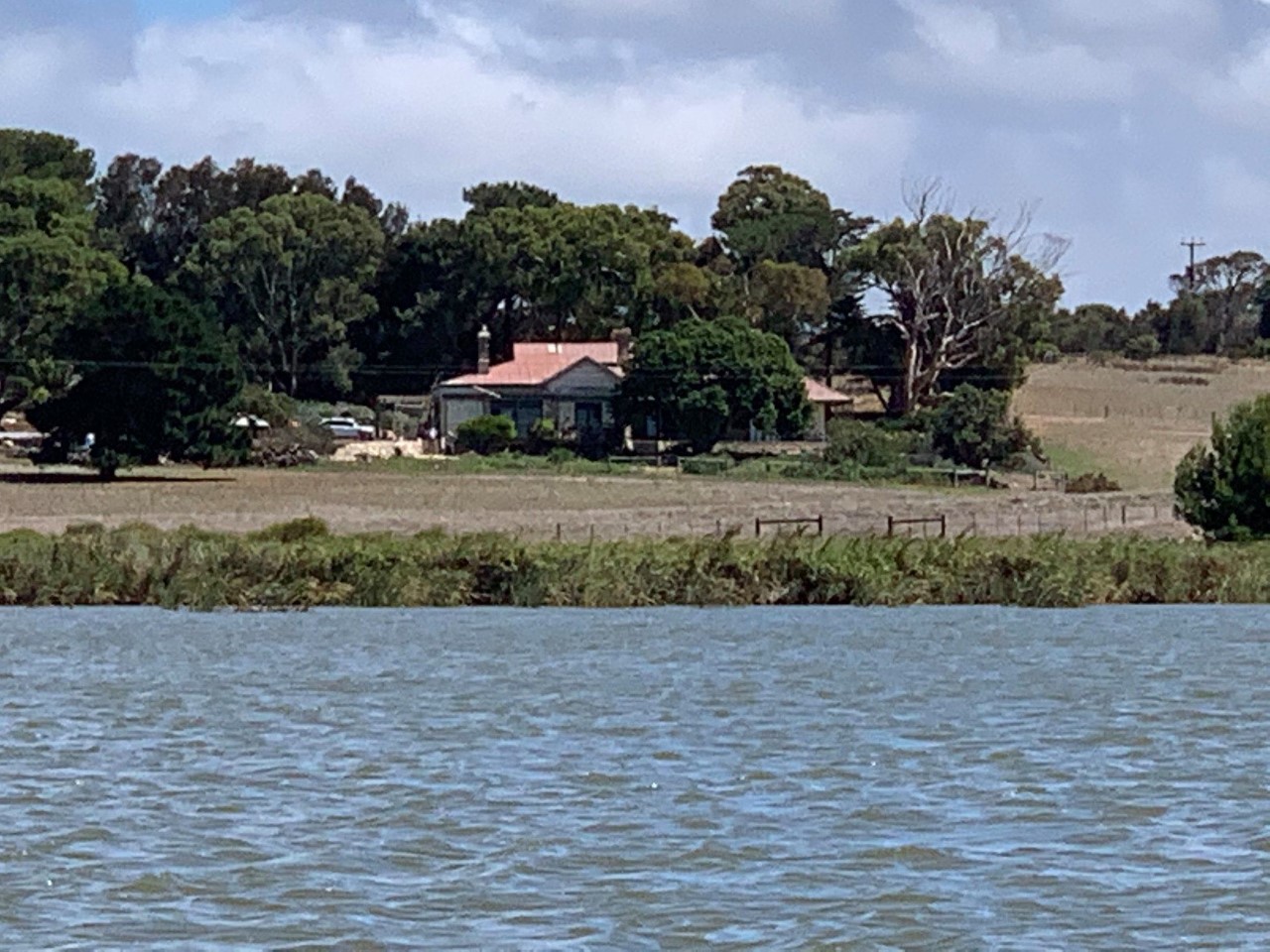
Watching the riverbank as we passed, I saw a small sandstone homestead, complete with outhouses and sheds. We judged the buildings to be from the late 1800s. The property was old and run down, but also majestic and wistful. I started wondering who would have lived out here so long ago, and why?

Homestead on the Finniss River. (Photo Credit: Lelita Baldock)

Likely inspired by the novels I was reading, I imagined a woman dressed in a flimsy, white dress standing alone on the bank, calling out, her voice echoing through the reeds. 

Over the next few months the image kept popping into my mind, and I found myself daydreaming, piecing together a series of events that would lead to a woman living alone on the banks of the Finniss River. And just like that, the basis for the novel that would become Widow’s Lace was born.

The novel itself took many years to write. It was my first attempt at writing, and while I had studied the works of others I had never written myself. But it was a journey I thoroughly enjoyed. By 2010 I had completed the first draft, but life happened, as it does, and the manuscript was put away for eight years while I moved to the United Kingdom with my husband Ryan and travelled through Europe. 

In hindsight, though unintentional, this break from the story was the best thing I could have done. During those eight years I learnt so much more about myself as a person and as a writer. I read widely and enjoyed composing short stories and poems as a way to practice using words effectively. I also experienced many more places and found locations that were perfect to enrich the backstory of my main characters, expanding the scope of Widow’s Lace.

In 2018 Ryan and I settled in Surrey, where we currently reside. We were both ready for a change in direction with our lives, wanting to get back into our passion-projects and feel like we were getting more out of life. So naturally, I picked up my manuscript again. Taking my original story of an English poet who moves to remote South Australia in 1886 and then disappears, I drew on the various parts of England I had explored in the intervening years and developed the linking characters who investigate his disappearance 130 years later. By mid-2019 my manuscript was ready, and Widow’s Lace was published in March 2020.

It was a long journey writing Widow’s Lace, but I think an essential one. I always believed in the basis of the story: a 100 year old mystery about a man who disappeared, and a body found by the Finniss River, but I needed time to find the threads that would pull it all together, and the locations that matched. 

Without a doubt, my writing is inspired by experiences, in travel and connections with people. Since completing Widow’s Lace I have mapped out a further four novel ideas, one of which, The Unsound Sister, has been published, and I am throughly enjoying developing these ideas and bringing them to life.

I still have much to learn. To be honest, I doubt you ever stop learning about writing. But that in itself excites me. I am loving the process of being creative and finding ways to make it a bigger part of my life. I look forward to many more adventures and discovering new ideas, characters and stories that I can shape into a novel and share with anyone who would like to read them.

Lelita Baldock

# # #

About the Author

Lelita Baldock was born and raised in Adelaide, Australia, and holds a Bachelor of Arts majoring in English and History from the University of Adelaide and a Bachelor of Education from The University of South Australia. During her twenties she worked as an English teacher in both Australia and the United Kingdom, working with the International Baccalaureate curriculum. Now Lelita and her husband run a web development business, and she makes time for writing after hours and on weekends. It can mean long days and late nights, but she doesn’t mind, stories are her passion. Lelita currently resides in the United Kingdom with her husband Ryan and beloved rescue-cat, Jasmine. Find out more at Lelita's website and find her on Facebook and Twitter @BaldockLelita


11 March 2021

Special Guest Interview with Cynthia Ripley Miller, Author of A Sword Among Ravens (The Long-Hair Saga Book 3)


Available on Amazon UK and Amazon US

AD 455. Arria Felix and her husband, Garic the Frank, have safely delivered a sacred relic to Emperor Marcian in Constantinople. But now, Arria and Garic will accept a new mission. The emperor has asked them to carry the sword of King David of Israel to the Church of the Holy Sepulchre in Jerusalem where Arria will dedicate it in her murdered father’s memory.

I'm pleased to welcome author Cynthia Ripley Miller to The Writing Desk:

Tell us about your latest book. 

A Sword Among Ravens is a romantic historical mystery/adventure set in the 5th century late Roman Empire in Jerusalem, and the third book in my series, The Long-Hair Saga. My heroine, Arria, is a Roman senator’s daughter known in Rome for her deductive abilities. Her husband, Garic, is a barbarian noble and First Counsel to his Frank tribe of warriors. They have accepted a mission given to them by Emperor Marcian, ruling the Eastern Roman Empire in Constantinople (modern-day Istanbul). They will carry an ancient relic, King David of Israel’s sword, to the Church of the Holy Sepulchre in Jerusalem. Along the way, they face many challenges and dangers. 

Their young daughter goes missing, a brutal killer stalks their path, and cold-blooded thieves are determined to steal the sword for their own gains. But when Arria is confronted over where the sword should truly rest, old friendships, loyalties, and her duty to the emperor are put to the test. Arria and Garic find themselves caught in a treacherous mission wrapped in murder, mystery, and the power of love and redemption.

What is your preferred writing routine? 

I’m definitely a ‘plotter’! I usually start with an idea, and then I move to the main characters I envision. I’ll describe their situation and characteristics on paper. I think about what they must have or attain, what they are willing to do, or how far they will go to achieve this goal. I try to define the central conflict and their ‘hero’s journey,’ individually and together. 

I like creating exciting connections between leading and supporting characters as well. At times, I let the muses lead me, and often it’s not where I intended to go! Practically, I use graphic web organizers (somewhat similar to a storyboard) or synopsis to help me plot my way through the book. I like twists, mystery, or intrigue to run through the storyline and a HEA (Happily Ever After). 

What advice do you have for aspiring writers? 

You may have many challenges in working your way to publication, but stay fearless. Pay attention to the industry’s demands, read, write, and participate in arenas that will help you grow, but at the same time, block out the noise. I decided to push through the market fads and write in a time that intrigued and excited me and at my own pace. A book takes me about two years to write. Years ago, while at a conference, some editors and agents advised against writing fiction set in WWII and early America and to publish several books a year. And yet, today, books set in WWI and WWII are quite popular. I decided—like the writers I admire—I would focus on quality over quantity, persevere, and enjoy myself. 

From my first word typed on paper to the day I signed a contract was almost nine years. In that time, I revised three drafts, researched, sent out queries, partials, and manuscripts, and attended conferences. I worked a full-time job and lived in a household with four kids and a dog, two cats, a few gerbils, and a goldfish!  

However, one of the ‘signs’ that kept me motivated (and sane) was that people who knew me never seemed to forget I was writing a novel. They would always ask me how it was going. I felt encouraged by this and determined. I made goals for myself, and I joined several writing groups and formed my own novelist group. I surrounded myself with other writers with the same goals—to become better writers and to work towards publication. There were more than a few times when I felt like quitting, but I couldn’t. Something wouldn’t let me. Then, one day, as I sat in my car in a library parking lot, I checked my email, and the offer was there. A London and New York publisher, Knox Robinson Publishing, wanted to publish my book. I cried happy tears.

The best advice I can offer anyone is the model for determination I used.  In the movie, The Shawshank Redemption, the character Andy, played by Tim Robbins, goes to prison for killing his wife and her lover, a crime he did not commit. For two decades, he picks away at the wall in his cell with a stolen rock hammer to create a hole large enough for him to escape from prison and finally find freedom. I loved the message in this story. If there is anything you really want—keep at it, pick away at it—and you may accomplish your goal. If you don’t reach your goal, your effort isn’t totally lost. It may lead you to a new purpose and maybe, an even better one. Think positively!

What have you found to be the best way to raise awareness of your books? 

I particularly like blog tours to raise awareness. I enjoy it when a reader reaches out to me because they’ve read about me, a review of one of my books, or a Q & A like this one. Author and library fairs also help raise awareness as well as social media platforms.

Tell us something unexpected you discovered during your research. 

In my third book, A Sword Among Ravens, I brought back a Jewish character from book one kidnapped as a young man from his home in Palestine. Part of this story takes place in Jerusalem. As I was researching 5th century Jerusalem, I discovered that in 324–25, Emperor Constantine reunited the empire after winning the Civil Wars of the Tetrarchy. 

Within a few months, the First Council of Nicaea (first worldwide Christian council) confirmed the status of Aelia Capitolina (the name given to Jerusalem by the emperor Hadrian in 130AD) as a patriarchate (offices). This was when a significant wave of Christian pilgrims and immigration to the city began. I was unaware that Jerusalem for a time had been given a Roman name. The city is believed to have been renamed Jerusalem in 324.

I also learned that in 325, the ban on Jews entering the city remained in force (first enforced by Emperor Hadrian after the Simon Bar Kokhba revolt). Still, they were allowed to enter once a year to pray at the Western Wall on ‘the ninth of Ab,’ a Jewish holy day. This revelation posed a dilemma for my Jewish character, Samuel. I needed him to be able to enter and move around the city. However, this historical obstacle forced me to create a new scenario, which in the end, added extra tension and drama to the story. 

What was the hardest scene you remember writing? 

I think the fight scene at the top of David’s Tower involving multiple people was the most complex scene to write. The weapons were not the problem. By book three, I was very familiar with the types of swords, knives, and axes of the era. It was describing several people paired against one another and fighting at the same time on a rooftop that seemed difficult. It’s much easier to watch swordfights on film, but creating it in words so the reader can visualize is a challenge—one that I jumped into eagerly but where research was necessary.

I enjoyed searching for and interacting with experts who write on swordsmanship, and I actually participated in a sword-fighting class at a conference I attended. Also, while researching the Hun composite bow for my first book, I found the world-leading bowyer for this weapon and contacted him. He graciously offered to read my scenes describing its construction. I was thrilled. It never hurts to ask for advice. Although the fight scene was challenging to write, I found it immensely rewarding when my Beta readers told me it worked.

What are you planning to write next? 

I’m actually toying with an idea I have for a fantasy book. It’s still germinating, but I have two main characters in mind and partially on paper.

Cynthia Ripley Miller

# # #

About the Author

Cynthia Ripley Miller is a first generation Italian-American writer with a love for history, languages, and books. She has lived in Europe and traveled world-wide, holds two degrees, and taught history and English. Her short fiction has appeared in the anthology Summer Tapestry, at Orchard Press Mysteries.com, and The Scriptor. She is a Chanticleer International Chatelaine Award finalist with awards from Circle of Books-Rings of Honor and The Coffee Pot Book Club. She has reviewed for UNRV Roman History, and blogs at Historical Happenings and Oddities: A Distant Focus. Cynthia lives outside of Chicago with her family, along with a cute but bossy cat. Find out more at her website, www.cynthiaripleymiller.com and find her on Facebook and Twitter @CRipleyMiller


8 March 2021

Guest Post by Alistair Forrest, Author of 'Libertas': Behind the Writing

Available on Amazon UK and Amazon US

SPAIN 45BC: Julius Caesar’s crack legions bear down on an obscure Spanish town, Munda, at the climax of Rome’s civil war. Against him are ranged the massed forces of Pompey the Great’s sons, Gnaeus and Sextus. To the victor, the spoils. Caught up in the conflict is an unlikely hero, Melqart. Near fatally wounded in the battle, his family is sold into slavery and his people oppressed by Arsay One-Eye,
a foe crueller than Caesar.

Capturing a Sense of Place, Part One: Julius Caesar marched through my garden

I have a journalist friend who, back in the day, would begin a catch-up call with the words: “I’m writing a book.” The response was always, “Neither am I”.

Well I did, and now the question is, “What took you so long?” In fact I’ve written several, but that first book (Libertas) was like falling in love for the first time. There were times when it wrote itself, leading me on, introducing each character as if they were standing right there in front of me, teasing me with how it would all end.

The key, I believe, is to immerse yourself in the location you are writing about, wrap yourself in the history and backstory, the culture and nature, and all of the tensions that have made that place what it is.

Not so easy if your story is set in Iran or Burma, but perfectly possible if you find yourself on the very spot where Julius Caesar stood 2,000+ years earlier to survey the forces arrayed against him before the last battle in his remarkable life.

My good fortune came about when I moved to Spain with a burning passion to write historical fiction, an enthusiasm that had dulled each evening under the weight of a very demanding day job as editor-in-chief of four magazines. The house my wife and I chose was surrounded by well-tended olive groves in an upland valley opposite Monda, a charming village in the Sierra de las Nieves Natural Park not far inland from Marbella. I knew that here I could find the freedom of thought to write a novel based on a character whose intelligence and engineering skills could influence the outcome of ancient warfare against the odds. It was a fairly loose idea that needed a home in those elusive historical facts.


Monda today

As we enjoyed a glass of Rioja on the terrace we looked across the valley to the whitewashed houses of Monda and its imposing castle, surrounded by breath-taking views of the mountains. We began to find out more – and discovered that Caesar had led eight crack legions right through the valley to Monda (then called Munda) to finally defeat the sons of Pompey. He probably stood in our garden, long before it was populated with palms, olives and almonds.

There was a small problem though. Many historians believe that the Battle of Munda took place near Osuna, which lies some 50 miles to the North West. But facts need corroborating, and the community of our Monda was adamant that it was here that Caesar’s Populares finally defeated the Pompeian Optimates. As the Spanish don’t deal in facts so much as raised voices, I took that as proof enough – if there is a difference of opinion, then I have the choice to opt for one or the other. Or put another way, never let the facts get in the way of a good story!

And so to research. This took two forms, walking and reading. There is a small section of Roman road leading towards Monda – enough of an historical site to halt the progress of a new road – and in the town there are ancient springs that never dry up and would have made this a logical ancient settlement. The town would also have been easily defended in a siege with ample water and a steep incline for an enemy to climb. A Moorish castle now stands on a steep hill above the town, and although local folklore says there was a fort there in ancient times, this cannot be proved. The remnants of the Optimates army took refuge behind the walls of Munda and were under siege for several weeks.


Roman road at Monda

The lie of the land matches an eyewitness account. Caesar’s own ‘official’ history of the campaign states: “The two camps were divided from one another by a plain about five miles in extent, so that Pompey, in consequence of the town's elevated position, and the nature of the country, enjoyed a double defence. Across this valley ran a rivulet, which rendered the approach to the mountain extremely difficult, because it formed a deep morass on the right.” 

Stretching North East from the town of Monda, towards modern day Coín (Lacibis in Roman times), is what could be termed a broad upland valley where family-owned olive groves clothe a series of low hillocks. In front of Monda there is a brook, dry in summer, with a marshy area to the right as you look from this valley. In 45BCE there would have been no olive trees as these have been planted in ordered rows over the past century or so – it would have resembled a plain amid the mountains – and on the town side of the brook is a steep incline, the ideal ground for Pompey’s sons to stand their ground and hope to draw Caesar on.

While the location threw up some difficulties, the battle itself did not. Though his work has been questioned by some historians, I trusted the account of Appian of Alexandria (c.95-c.165) who has a passage in which Caesar is goaded by Gnaeus Pompey. The young general accused Caesar of cowardice, prompting a degree of rage that ultimately led Caesar to personally thrust his way to the front line at Munda and exhort his troops to victory. Caesar was unusually brutal in his last battle. He believed he was right, his patience had run out and he had been called a coward.

Having researched the Battle of Munda, its causes and its effect on the politics of Rome, it was time to weave the story around the facts. Before the Romans came, the community was probably based on the simple things in life like hunting, animal husbandry, arable crops, baking bread and brewing. A lifestyle that remained unchanged in inland Andalucia until EC money built new roads for other Europeans to venture away from the Costas. That is the point – this happened in the 1st Century BC when the Celtiberian and Phoenician population came under the influence of the Romans, and towns like Munda became important satellite settlements in support of larger cities like Corduba (Cordoba) and Gades (Cadiz), often at the intersection of existing trade routes.

Rather than assume a collection of Pythonesque yokels whipping up rebellion and asking, “What have the Romans done for us?”, I chose instead to develop the theme of an indigenous people who were creative and inventive in their own right. They understood herbcraft and lacked nothing for a full, healthy life. The hero in Libertas is not a warrior but a thinker. Melqart is appalled at the horror that Rome brings to his home town, but instead of running away he uses his intelligence to make a difference.

The inevitable diaspora after the battle takes Sextus to Sicily where he begins to build his pirate nation, and Melqart across the seas in search of his enslaved family. By chance he is shipwrecked in Sicily on his way to Rome, where he helps Sextus with a series of ideas that Archimedes himself would have been proud of.

Spain and my travels in the Mediterranean, not to mention an upbringing in three Middle Eastern countries, have given me so much inspiration that it would be a crime not to combine this with my love of history and writing: feel the location and dig deep into what others know. We never stop learning. Or as Harry S. Truman put it: “It's what you learn after you know it all that counts.”

But I still have the novelist’s get out clause. We make stuff up and apologise later, usually to clever-clogs geeks. So to those who insist the Battle of Munda took place at Osuna rather than modern-day Monda, I say this: You’re wrong. I found an old Polaroid of Julius Caesar dressed in full battle regalia when I was digging in my garden.

In my next guest post at The Writing Desk I will explain the inspiration behind ‘Line In The Sand’, the story of David & Goliath as it might have been before the religious scribes got their hands on it.

Alistair Forrest

# # #

About the author

Alistair Forrest has worked as a journalist, editor and principal of a PR company in the UK. His books, published by Sharpe Books of London, include Libertas, Line in the Sand and the first two in a series of three novellas, Nest of Vipers and Viper Pit. The third novella is due out in the summer of 2021. He lives in Alderney in the Channel Islands with his wife Lynda, two large dogs and a rescued Spanish cat. Find him at www.alistairforrest.com, Facebook and Twitter @alistairforrest 

7 March 2021

Special Guest interview with Mary Kendall, Author of The Spinster's Fortune


Available from Amazon UK and Amazon US

Moonlit alleys, shadowy tunnels, and buried secrets… Summer of 1929. Of supposed unsound mind without a penny to her name, Blanche Magruder lies alone in a home for the aged and infirm. Meanwhile, her house, a crumbled ruin in the heart of Georgetown, Washington, D.C., 
is pillaged nightly by thieves looking for 
treasure rumored to be hidden there...

I'm pleased to welcome author Mary Kendall to The Writing Desk:

Tell us about your latest book 

The Spinster's Fortune is an historical mystery set in Washington, D.C. in 1929. It’s an intriguing tale of an elderly woman, Blanche, who, for unknown reasons, has hidden her family’s fortune in strange places throughout her decaying house in the neighborhood, Georgetown. 

It is up to her niece, Margaret, to figure out where these hiding spots are and, in the process, start to unravel mysteries about this aunt’s life. Along the way, Margaret begins to make discoveries about her own life and the changes that need to happen. The novel was inspired by real life events and one of the two main protagonists, Blanche, is based on a real person.

What is your preferred writing routine? 

In a perfect world, I would sit “butt in chair” right upon waking with some strong black coffee and write for a couple hours. I believe there is a thin veil between sleep and waking and tapping into that bit of the subconscious is the ideal time for me to write. This “ideal” routine rarely happens unfortunately. Instead, I fit my writing in when the rest of my life allows. 

It may be just a fifteen minute block of time or it may be several hours depending on my day. So, while not actively writing, the story is usually rolling around in my brain somewhere and I might even be scribbling notes here and there. Another important piece for me is to walk at least once a day where I can let my mind drift to figure things out. 

What advice do you have for aspiring writers? 

If you want to be a writer, the main thing you have to do is….write! Just dive in and start doing it. Also, this is a game for long haulers. Give up any illusions of best seller lists and over-night success. If that happens, great. But the real reason to keep writing? The love of writing.

What have you found to be the best way to raise awareness of your books? 

I am brand new to the social media writer’s thing but I have been working on developing all the usual channels: Twitter, Facebook, and Instagram, among others. I am still experimenting so I can’t tell you yet what the best way is. I can say that I am most drawn to and comfortable with using Instagram---right now anyway. All the platforms seem to be ever changing so there’s that as a factor.

Tell us something unexpected you discovered during your research 

In the United States, yellow taxis came into play in Chicago as a mode of transport in the early 1900s. I assumed they were ubiquitous around the country. But I discovered that in Washington, D.C., the setting of my novel, cabs were actually associated with the Black and White Taxi Company and were….black and white in color. Yellow cabs did not appear in D.C. until 1931 which is after my novel takes place. So I learned something unexpected and made that change to my novel accordingly.

What was the hardest scene you remember writing? 

One of the final scenes was difficult for me to write as I found it very poignant and touching because it is something we all must face eventually. (I do not want to give it away by saying any more.)

What are you planning to write next? 

My current work in progress is a change for me as it is not historical fiction. It is a present day mystery but revolves around a very strange real-life archeological find in the Williamsburg, Virginia area dating from the 1800s: a “witch bottle”. The story kind of springs up and around this bizarre find. So…not historical mystery per se but strongly rooted in history.

Mary Kendall 

# # #  

About the Author

Mary Kendall lived in old (and haunted) houses growing up which sparked a life-long interest in history and story-telling. She earned degrees in history related fields and worked as an historian for many years. Her fiction writing is heavily influenced by the past which she believes is never really dead and buried. Fueled by black coffee and a possible sprinkling of Celtic fairy dust, she tends to find inspiration in odd places and sometimes while kneading bread dough. The author resides in Maryland with her family (husband, three kids, barn cat and the occasional backyard hen) who put up with her mad scribbling at inconvenient hours. The Spinster’s Fortune, her debut novel, is twisty tale of family deception murky with gothic undertones with a release date of 6 April 2021. Find out more on Mary’s website at www.marykendallauthor.com Instagram, Facebook and Twitter @MaryLavin49

1 March 2021

Guest Post: Writing a Novel, by Saga Hillbom ~ Part Three: The Marketing Process


New from Amazon UK and Amazon US

1483, Westminster. The bells toll for the dead king, Edward IV, while his rivaling nobles grasp for power. His daughter Cecily can only watch as England is plunged into chaos, torn between her loyalties to her headstrong mother, Elizabeth Woodville, and her favourite uncle, Richard of Gloucester. When Elizabeth schemes to secure her own son on the throne that Richard lays claim to, Cecily and her siblings become pawns in a perilous game.


As mentioned in my guest post about the publishing process, my favourite thing to do is to write. The surrounding bits, such as publishing and marketing, were long uncharted territory for me. However, I have begun to put more effort into these aspects of being an author. In this post, I will go through a few tips for new writers, and talk about what I have done when marketing my upcoming historical novel Princess of Thorns. It is worth noting that while I am self-published, marketing is equally crucial for traditionally published authors.

Firstly, I would give a tip which is fairly obvious nowadays, namely to maintain an online presence. Aside from an author website, you need to be consistently active on some kind of social media. Pick 1-3 platforms that you can dedicate your time to. I have personally been a little lacking in my twitter presence, but post content on Instagram every day. Indeed, Instagram has been my main marketing tool for Princess of Thorns. 

It is where a lot of my target audience (mainly females above the age of 15, with an interest in history) spend their time. When I began marketing my latest novel, approximately six months before its release date, I also launched a series of Instagram posts. They are short, factual texts about everything related to the historical context of my book. I alternate them with aesthetically pleasing edits of period dramas. This is partly because movies and TV-shows are easy ways to attract people’s attention. Moreover, it provides variation.

My second tip would be to send free pre-release copies of your book to anyone who might be interested in writing a review. Of course, it is a bonus if the person has a large following on social media or is a fellow author, but each review counts. When raising awareness about Princess of Thorns, I acquainted myself with numerous experienced readers of historical fiction. Some of them were glad to collaborate with me. What I think is important to remember, though, is that no one owes you anything. Many will not respond to your messages, others will say ‘no thank you’, and still others will give bad reviews. That is entirely up to them.

Related to the practice of sending out pre-release copies, you should also contact bloggers and podcasters. It can be daunting when you are a new writer, but one never gets anything if one does not ask, as my grandmother once said. Reach out to people. This is an area in which I can definitely improve myself, but with Princess of Thorns, I have felt like a part of the writing community more than ever.

Lastly, there are paid book promotion sites and giveaways. Giveaways are quite self-explanatory. As for paid book promotion sites, they can be effective as long as you choose wisely. Also, if you pick a site that only promotes, for example, free ebooks, be certain that you run a Kindle promo simultaneously. Otherwise, your book will not actually be free to download. I know plenty of authors who consider it a pity to give away one’s book like this. Nonetheless, I am of the opinion that the more people who read my work, the happier I am, whether they pay for it or not. I should mention that I am not dependent on royalties for my upkeep.

When you begin marketing, writing all of a sudden becomes a business. That was a tough pill for me to swallow at first. I still do not measure my ‘success’ or ‘failure’ by how many copies of my book people buy or download. Instead, I look at the reviews, the lovely comments I receive, and at whether I am happy with the finished book itself. Most authors will never be bestsellers. In fact, most authors will never be able to make a living off their writing. 

While accepting this, I have still done my best to market Princess of Thorns, for the sake of practice if nothing else. I figure I might have 70 years of writing, publishing, and marketing ahead of me. Bearing that in mind, I hope to someday be as good at marketing as I am at writing rubbish first drafts. I also hope that this post about marketing tips and my experience so far has been helpful to someone.

Saga Hillbom

# # #

About the Author

Saga Hillbom is the self-published author of four historical novels, including Princess of Thorns, City of Bronze City of Silver, Today Dauphine Tomorrow Nothing, and A Generation of Poppies. She is currently studying history in Lund, Sweden, where she lives with her family. When not writing or reading, Saga enjoys painting, cooking, spending time outside, and watching old movies.. To find out more, visit her website sagahillbom.blog and follow Saga on Twitter @sagahillbom02

See Also: