Mastodon The Writing Desk

11 April 2022

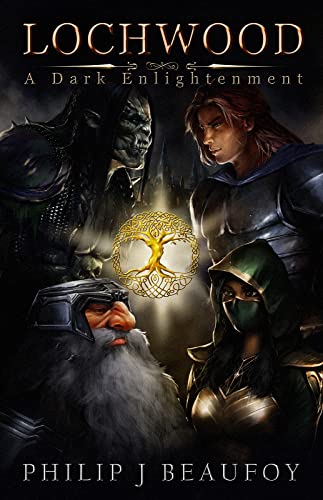
Special Guest Interview with Philip Beaufoy, Author of The Lochwood Series - A Dark Enlightenment


  Available from Amazon UK and Amazon US

The old races still live. They are hidden within us, more in some than others. The journey of a boy who must become more than he is, is a tale told a thousand times over, but it has never been told quite like this. 

I’m pleased to welcome author Philip Beaufoy to The Writing Desk:

Tell us about your latest book   

I have always been fascinated with the idea that many hominids roamed the earth at some point in ancient history. I wandered what it would have been like spying a tribe in the distance that was quite literally a different species. It is hard not to make parallels with the tales of giants, dwarves and elves that we all grew up loving and seem embedded into our culture. 

I was also taken with the idea of chaos as a scientific construct, in that given enough time all things will become dust, cold and empty and conversely the idea of life, a phenomenon that builds ever more complex structures the longer it is left to run. It was within this framework that I wanted to explore the moral norms of culture and how free choice is dependent on a person’s environment.  

Whenever I sit in an old English pub, next to a log fire sipping ale, I imagine I sit in a land far removed from the real world. I constructed the world where my story is set and the characters within long before the actual plot. These ideas gave be the basic construct for the Lochwood series. 

What is your preferred writing routine?   

I see scenes in my head. I play it like a film that I know has a good story if only I could find the correct words.  I know my characters and world. I have a map, currency, political system, weather patterns and cultures. After putting my first attempts on paper and outlining some initial ideas, I used Pro writing aid, to re-edit the whole book. As a beginner it helped me understand the methodology of writing as well as highlighting many dos and don’ts. 

I did not want my book to become overly formulaic. I welcomed the advice and guidance from a ‘bot’ but felt at times felt my style got lost in strict obedience to a set of rules. For this reason, every time I finished a chapter in pro writing aid, I dropped it back into word and did the final edit, which was torturous. It felt as though the excitement of the story exploded from me in a few weeks while refinement took three years. I am however very pleased with how I have developed from a total non-writer to someone who can express ideas in a way (some people at least) want to read. 

What advice do you have for new writers?   

Just write. Go back edit what you have written and write some more. Don’t be scared to put thoughts to paper they can be edited, refined, or deleted later. I spent hours agonising over a single sentence when I could have moved on and edited that sentence in context. Write, edit, repeat. Keep going until what you have, you like. Pass your draft to an honest friend or proof-reader and welcome any criticism. 

What have you found to be the best way to raise awareness of your books?   

There are many platforms for indie authors with some great tools for marketing and premotion, but the support of writers working through the same process is most helpful. I have gathered some of my best advice from friends on twitter. It is best to meaningfully engage with people, not only post memes for likes. Guest posts, such as this, can help reach new readers, and spread awareness as you as an author. 

Tell us something unexpected you discovered during your research   

While researching for my book I investigated ancient cultures, rituals, language, and the meaning of names. I found it interesting to base my own cultures and rituals on these, I use literal names from old languages to denote ancestry. In the battle scenes I have tried to make troupe movements, shield walls, light horse and archers deploy in ways similar to historical battles. 

The most fun was researching the megafauna that roamed the earth with prehistoric man. I discovered giant crocodiles and snakes, big cats and bore that hunted like wolves. I used this as the inspiration for the monsters and beasts that roam the far-flung jungles of my world. 

What are you planning to write next?   

A Dark Enlightenment is book one of The Lochwood Series. I plan to explore magic, science, social norms and structures. I want readers to think about new ideas, hate with a passion the evilness of my some characters and grow to love the eccentricities of others. I am looking forward to exploring the yet untouched lands and creating new adventures for Aelfheah to face. 

Philip Beaufoy

# # #

About the Author

Philip Beaufoy lives in Tamworth, UK, the ancient capital of Mercia. He has two children and a supportive wife who works as an illustrator and helped create the maps of Lochwood. He teaches science and maths at a school for students who have not been successful in a mainstream environment. Despite being dyslexic has always had a love of reading, writing and history. It is with this varied mix of interests he wrote the Lochwood series. Find out more at Philp’s website https://www.lochwoodseries.co.uk/ and find him on Twitter @PhilipJBeaufoy

10 April 2022

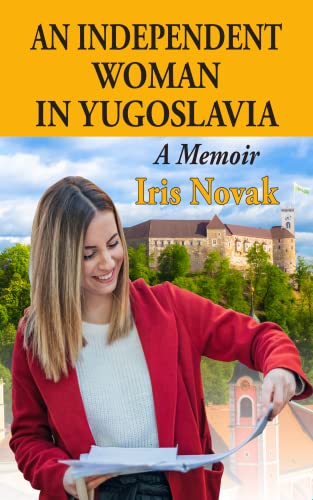
Guest Interview with Iris Novak, Author of An Independent Woman in Yugoslavia: A Memoir


Available from Amazon UK and Amazon US

The memoir of a woman named Iris who determined to succeed, although she was born as a poor and frightened country girl in what was then Yugoslavia. To achieve her goals, she used her abilities to gain knowledge from everything around her, and so triumphed against the odds and grew into a successful and independent business woman.

I'm pleased to welcome author Iris Novak to The Writing Desk:

Tell us about your latest book

My latest book is a memoir that describes the life of a woman in the ex-Yugoslavia. It speaks about my social background that did not offer me any support to succeed. Although I became the best pupil in a good Slovenian school, these years brought also bitter moments, because my father seemed determined to make our family unhappy, as he was himself. 

When my mother, my brother and I seemed to have been left without anything, we were accepted by my mother's family and started to live a normal life, without violence. I entered the secondary school and had to struggle again to become equal to my brilliant schoolmates. I fell in love, but soon found out that the young man did not deserve the love I felt for him. 

After some miserable months, I met another boy and thought that I finally found the love of my life. I graduated from the university, found a good job, got married and had three children. I was happy as a mother, but had to overcome struggles as a business woman in an environment in which business was the realm of men.

What is your preferred writing routine?

Up to now I used every free moment to write, but I wish that I would have enough time to write in the morning.

What advice do you have for new writers?

I think they should be honest and objective and read, read, read.

What have you found to be the best way to raise awareness of your books?

I first asked quite some friends to read my book and to tell what they thought about it. Only recently I discovered book blogs and I must say that I enjoy reading them. I intend to become a book reviewer for biographies.

What was the hardest scene you remember writing?

I had bitter feelings when I described domestic violence. But it somehow helped me to analyse it and leave it behind me.

What are you planning to write next?

I would like to write about life in Slovenia after it became an independent country and about European Union. One would expect that it would be much better and free than in the ex-Yugoslavia but it is not always so. I would also like describe my struggle to help my son recover from Crohn’s disease. And about my Camino de Santiago.

Iris Novak
# # #

About the Author

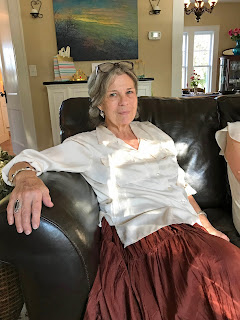
The author writes under the pseudonym Iris Novak. She was born in the second half of the twentieth century in Slovenia, the northern part of the then Yugoslavia. She graduated from English and German, acquired my MA in Management and PhD in Librarianship. She worked in the international business, in librarianship, was director of a school for foreign languages and finally established her own business: employment agency and college. She lives in Slovenia, is married and has three children.

9 April 2022

Special Guest Interview with K.S. Barton, Author of Raven Marked (Norse Family Saga)

>

Available from Amazon UK and Amazon US

A forgotten identity. A found family. Scars from the past. A young man comes of age in the turbulent, violent world of the Viking era. To survive, he must trust the ravens.

I'm pleased to welcome author K.S. Barton to The Writing Desk:

Tell us about your latest book

My latest book, Raven Marked, is the fourth book in my Norse Family Saga series. Raven Marked is a side story about the life of a character who appeared in the second book in the trilogy, Sword and Story. This young man, Helgi the Marked, strode into the lives of my main characters and from the moment he appeared in the story, I was captivated by him. It was one of those happy, magical moments in writing! 

This book is about a young man’s coming of age in the violent, turbulent time of the Viking age. To survive, he must trust the ravens he sees as a child escaping a desperate situation. Despite losing his identity as a child, he finds a family in a trading crew and travels with them until, as a young man, he arrives at the gates of Constantinople. 

What is your preferred writing routine?  

My writing routine is a constant iteration. It changes with the seasons and with my work schedule. Right now, I get up between 5:30-6am to write fiction and do that until 7:30. I find I can tap into my creativity really well first thing in the morning—it’s like I’m still in that dream space from sleep. I belong to an online sprint group that meets later in the morning and during that time, I’ll either write more fiction or work on other things, like a blog post, my newsletter, or other non-fiction. After that, I’ll check social media and then read for a while before lunch. Most of my intensive creative work is done in the morning—by mid-afternoon, I’m pretty much spent. 

What advice do you have for new writers?  

Find a community of other writers. Writing is a lonely pursuit. It’s hard work and our family and friends may be supportive but only other writers can understand what it’s really like. Sometimes we need other writers to share our joys and our disappointments. Other writers will understand the euphoric rush of a good review or a kind email from a reader, and they will be able to commiserate when you’re having one of those days when it seems like you can’t string together a coherent sentence. Whether it’s in person or online, a community of writers is a blessing. Just make sure to find one that fits with who you are. 

What have you found to be the best way to raise awareness of your books?

That is the hardest part of indie publishing! For me, the best luck I’ve had is with doing email promotions with services like Ereader News Today, Bargain Booksy, or The Fussy Librarian. These services get books in front of readers, and since the subscribers select what kinds of books they read, they only see what they are interested in. Another way is with newsletter swaps using Bookfunnel. Again, these are aimed at people who read certain genres, so that helps narrow it down to finding readers of your specific genre. I also try to create an engaging email newsletter.   

Tell us something unexpected you discovered during your research?  

When doing my early research on the Viking age, I read one of the most famous sagas, the saga of Egil Skallagrimsson. Egil was a skaldic poet, berserker, and Icelandic farmer who lived during the same time as the famous king Eirik Bloodaxe. Egil is an early example of an anti-hero—he was horrible and fascinating at the same time. When Egil was three years old, his father attended a party without him; Egil was so put out that he rode to the neighboring farmhouse on his own, strutted into the house of the other man and recited a skaldic poet. At three years old! At just seven, he killed his first man. 

What surprised me about Egil, and what inspired me for my own writing, was that he was a devoted father. Not only that, but Egil grieved the deaths of his sons so much that he locked himself in his bedcloset for three days with the hope that he would die too. His “beloved” daughter told him to create a poem for his grief. Egil did so and left his bed. The poem, Sonatorrek, which translates as “The Loss of Sons”, is a beautiful, tender, painful look into Egil’s grief at losing his sons. After reading it, I was intrigued by the idea that a man known for brutality could love his children so much that he’d wish for death instead of living without them. He is also angry with Odin, and that lashing out at the gods rang true for a man living in grief. I used Egil’s love of his children as an inspiration for one of my own characters. 

What was the hardest scene you remember writing?  

The hardest scene I ever wrote is something I ended up cutting from my second novel. In it, I had to kill a character I loved in a very sad way, so it was emotional for me. I’d grown quite attached to the character! I hated to kill them, but it was important for the story and for my main character to move on. I was emotionally wrecked for a while after writing it. The death still occurs but now it is off the page.   

What are you planning to write next?  

I’m in the revising stage of the second book in the Helgi the Marked duology. I plan to release this book, still untitled, in late 2022. I’ve decided to veer away from historical fiction for a little while to try my hand at historical fantasy. I’m currently working on a set of stories that are connected to my Norse Family Saga series as family legends; these are stories my character, Bjorn, tells to his children about his ancestors, who he believes are descended from a human and an elf-woman. What I’m writing now is told from the perspective of the female elf. We don’t know much about the elves of Norse mythology (or the alfar as they were called), so I’m having fun creating a world for them. I’m not sure yet if these will be full novels or novellas. Either way, they should come out in 2023.

K.S. Barton

# # #

About the Author 

K.S. Barton writes historical fiction and fantasy stories of love and adventure set in the Viking age. The author of several novels and short stories, she explores themes of family, honor, and strength all within the backdrop of Norse society. When doing research on Norse mythology for a teaching project, she discovered the Norse sagas and immediately knew that she wanted to write fiction about Vikings. She loves writing about family dynamics, love, loss, bravery, grief, community, complex moral dilemmas, and how the stories we tell can guide us through life and give us strength. Of course, no story of Vikings would be complete without male warriors and fighting, so there is plenty of that in her books, too!  Find out more ar her website https://ksbarton.com/ and find her on Facebook and Twitter @ks_barton

7 April 2022

Special Guest Post by Amanda Cockrell, Author of Shadow of the Eagle (The Borderlands Book 1)


New from Amazon US and Amazon UK 

Faustus Valerianus is the son of a Roman father and a British mother, a captive sold among the spoils after Claudius’s invasion. Now both parents have died within a month of each other, and so he sells the family farm and enlists, joining legendary general Agricola’s campaign to conquer the entirety of the British Isles culminating in a devastating battle amongst Caledonia's dark mountains.


Researching a Soldier’s Life in First Century Britain

I am always more interested in what it was like for an ordinary man or woman to live at a particular time than I am in the wealthy political and military leaders who ran things, and during the Roman Empire squabbled and fought and murdered their way to the Principate. Faustus, the hero of my newest novel, Shadow of the Eagle, is not one of these, but a junior centurion, entirely fictional, the son of a provincial Gaulish father and a British mother. He is haunted, occasionally literally, by the shade of his disapproving father. He falls inadvisably in love with a provincial girl. He finds that his mother’s roots in Britain go rather deeper than he had bargained for. He owns one slave and a horse.

However the generals he would have served were indeed real people and so must be characters on their own, if secondary characters. I’ve always liked Julius Agricola, governor of Britain from 77 or 78 CE (there is some dispute about this) until 85. How can you not like a general who was described by certain contemporaries as showing “an unhealthy interest in philosophy.” He appeared for a few chapters in the second of my Centurions series and I got quite fond of him. The hero of that book departed from Britain before the march north and I’ve always wanted to go on with that campaign, so Shadow of the Eagle gave me the chance. It’s the first in a series called The Borderlands, about the edges of the Roman Empire, and Agricola was the general who pushed those edges farther out than ever.

Almost everything we know about his campaign for Scotland comes from the historian Cornelius Tacitus. Tacitus was Agricola’s son-in-law, and so is suspect in his more extravagant praise of his wife’s father as well as his dislike of the Emperor Domitian, and maddeningly vague on the things that make later historians tear their hair out.

For instance, on the possible conquest of Ireland: “Agricola had given welcome to an Irish prince, who had been driven from home by a rebellion; nominally a friend, he might be used as a pawn in the game.” What was this prince’s name? Surely you might have mentioned that?

Or: “[Agricola] reached Mons Graupius, which he found occupied by the enemy.” What exactly is Mons Graupius? Does it have any other name? Where the hell is it?

Or: “One of the [Caledonians’] many leaders, named Calgacus, a man of outstanding valor and nobility, summoned the masses who were already thirsting for battle and addressed them...” What happened to Calgacus, defeated at Mons Graupius, wherever it was? Tacitus quotes Calgacus in a lengthy speech which was clearly made up by Tacitus, and never tells us what happened to him afterward. We are left to wonder whether he ever existed, or was merely a convenient mouthpiece for Tacitus to elaborate on what he thought was wrong with the Roman Empire’s thirst for expansion. If Calgacus had been captured, or killed, he would, like Vercingetorix or the head of Decebalus, no doubt have featured in some triumphal procession in Rome, of which there is no evidence.

Archaeology, the obsession of the historical novelist, fills a lot of gaps, although not those. Roman remains surface in Britain nearly every time someone puts a spade to his back garden or tries to build a shopping mall. If we don’t know where Mons Graupius is, we know what the soldiers who fought there wore, and ate for breakfast, and sacrificed to read the omens before a battle. We know what their forts looked like, and where they were, and their heating systems and plumbing. Unlike the book I was mad enough to set in Decebalus’s Dacia, which is now essentially Romania, this project had a wealth of research available, including guidebooks to the British sites, and books on native wildlife and topography and landscape. In English. Not to mention the wonderful British Ordnance Survey maps Ancient Britain and Roman Britain.

Someone had to lead the Caledones, however, so why not Calgacus? He appears in Shadow of the Eagle as Calgacos, not nearly as eloquent but I hope somewhat more human. And that exiled Irish prince? How can a novelist ignore him? There was an actual Irish prince, Tuathal Techtmar, whose father was deposed as high king of Ireland by a competitor, and whose mother fled with the infant Tuathal to her people in Britain. He eventually went back with an army and took the throne from the usurper. Historians put him anywhere from Vespasian to Hadrian, and there is speculation that he might have been Agricola’s prince, so I have adopted that theory because it is too good to waste. Agricola, despite telling Tacitus that Ireland could be taken with a single legion, never got the chance. So in the second book of The Borderlands Faustus will go haring off to Ireland with Tuathal to restore him to his throne, strictly unofficially.

Despite armies and generals and larger-than-life commanders, at the end it’s the small things that make a setting come alive. That kind of research has always been a joy to me. There was no way I was going to resist having Faustus buy his infant nephew a fascinus, that universal Roman good luck symbol of a phallus with wings. Or talk about the comparative efficacy and dangers of henbane and poppy tears as anesthetic in a military surgery. Or any of the peculiar festivals that dotted the Roman calendar, such as the Lemuria for dispelling insistent ghosts. Or the curse tablets of Bath, once Aquae Sulis. Curse tablets are not found only in Bath, but a particularly wonderful trove has surfaced from the sacred spring there. They were thin sheets of lead inscribed to order, rolled up like a scroll with a nail driven through the center to make the buyer’s point, and dropped into the spring for Sulis Minerva. Most had to do with the return of stolen items – the baths were notorious for light-fingered types hanging about the changing rooms — but others cursed faithless lovers or cheating business partners. Often they were ready made, with blanks to fill in the stolen item and/or the name of the curse’s target, with a promise of another sacrifice to the goddess if she gave the matter her attention.

My shelves of research books grow daily, because who can not order a title like Household Gods or Roman Dress Accessories or Roman Record Keeping and Communications? Books like that will tell you things you didn’t know you needed to know, something you may end up building a critical scene around. As Sir Arthur Conan Doyle said, “the little things are infinitely the most important.”

Amanda Cockrell

# # #

About the Author

Amanda Cockrell grew up in Ojai, California, a wonderful place where one could ride one’s horse down Main Street and there was a hitching post outside the library. It was a bedroom town for Hollywood, full of writers and actors and directors, so there was always something going on, and famous people’s discarded trousers tended to end up in the local thrift shop.  Her father was a screenwriter and her mother a screenwriter and novelist. Besides her Roman books, she is the author of three contemporary novels, two of them set in a fictional version of her beloved home town. She has a master’s degree in English and creative writing from Hollins University and is managing editor of that university’s literary journal, The Hollins Critic. She also had the privilege of teaching creative writing at Hollins for many years. She lives with her husband, Tony Neuron, and a substantial assortment of dogs and cats, in Roanoke, Virginia. Find out more at https://www.amandacockrell.com/ and find Amanda on Facebook and Twitter @CockrellAmanda1

6 April 2022

Special Guest Interview with Nancy Bilyeau, author of The Fugitive Colours (Genevieve Planché Book 2)


Available from Amazon UK and Amazon US

As Genevieve Sturbridge struggles to keep her silk design business afloat, she must face the fact that London in 1764 is very much a man’s world. Men control the arts and sciences, men control politics and law. And men definitely control women.

I'm pleased to welcome author Nancy Bilyeau back to The Writing Desk:

Tell us about your latest book

The Fugitive Colours is a story of suspense set in the intersecting worlds of art, science, and espionage in 1764 London, an exciting but dangerous time in the city’s history. It’s a follow-up to my fourth historical novel, The Blue. No one needs to have read The Blue first, although it could add to the experience. The main character of both books is Genevieve Planché, a Huguenot artist raised in Spitalfields. She longs to be a serious artist, but there are barriers for women that are very hard to surmount. 

When “The Fugitive Colours” begins, Genevieve runs a business from her Fournier Street house, designing flowers for the Huguenot silkweavers. She employs two temperamental young artists, and with her husband working as a low-paid science tutor far away and a young son to raise, she’s under a lot of pressure. 

To her shock, she receives an invitation to a gathering held at the Leicester Fields house of Joshua Reynolds, the most successful portrait painter in Britain. She can’t help but hope this is her entrée to the art world of London at last, but nothing is as it seems. In the novel she gets caught up in dangerous rivalries, espionage plots, and murder. 

As always, I sprinkle real people from history among my characters. In this book, you’ll find, along with Reynolds and George Romney, people like courtesan Kitty Fisher, Sir Francis Dashwood, founder of the Hellfire Club, and Sir John Fielding of the Bow Street Runners.

Kitty Fisher by Reynolds

What is your preferred writing routine?

I’ve always had day jobs, and usually they’re 40-hour-a-week jobs. So I try to write fiction early in the morning, research at night, and do both on weekends. But I also have a family at home, so it’s challenging to find time. I just keep going. I’m fortunate to not have a problem with writer’s block. Sometimes I hate what I write on a given day and it has to be 90 percent rewritten, but it does come. And I have a bunch of ideas for books always percolating.

What advice do you have for new writers?

Do not chase trends. I wrote a trilogy set in Tudor England, a novel set in early 20th century New York City, and two novels set in 18th century England and France. Each time I had the spark of an idea for a story taking place in a time I’m interested in, and I went from there. I just think there’s not enough money in writing fiction to make commercial success the driving factor. You’ll go crazy trying to predict trends. Let your love of history and storytelling guide you. Of course if your passion is to tell a story set in French Resistance World War II—one of the most popular book settings now--go with that. The key is: be authentic.

What have you found to be the best way to raise awareness of your books?

Facebook, Instagram, and Twitter help me spread the word, with Goodreads’ book giveaways and lists doing a great deal during the three months leading up to publication.

I try to encourage people to sign up for my author newsletter. That way I keep readers up to date on my books as well as any nonfiction articles or podcasts. I write about real people from history for blogs and for magazines. I’ve written about the murder of architect Stanford White and the Romanov-Windsor family’s last meeting for Town & Country. 

Tell us something unexpected you discovered during your research

The greatest English artists of the 18th century could be incredibly nasty—toward one another! When you hear names like “Joshua Reynolds,” you assume that such illustrious artists would behave with perfect decorum. But Reynolds, Hogarth, George Romney, and Thomas Gainsborough all had sharp elbows. None of these men came from wealthy families by a long shot, and they had to work extraordinarily hard to reach even the first stage of success. They were competitive and could be critical of each other and were not above undercutting and even sabotaging a rival.

What was the hardest scene you remember writing?

One with Genevieve’s husband, Thomas Sturbridge, a brilliant chemist, giving a lecture about Sir Isaac Newton to an audience of Huguenots interested in science. Thomas gets challenged by a stranger in the audience, and his reaction is odd. Lectures are not easy to make suspenseful and engaging. There’s a lot of context to what Thomas is saying when he talks about alchemy; this will direct the actions of some ominous characters in the book. It’s subtle but it can’t be too subtle. And since my book is written through the first-person point of view of Genevieve, it’s about her observation, reaction, and speculation. That’s not easy to pull off.

What are you planning to write next?

My publisher wants another Genevieve Planche book, I’m pleased to say. To get answers to a mystery that no one can solve, she goes deeper into espionage than ever before. In so doing, she faces the truth about herself.

First, though, I am writing another historical novel set in a different time period. The announcement on that one will be made soon. Until then, I have to keep my lips sealed 😊

Nancy Bilyeau

# # #

About the Author

Nancy Bilyeau studied History at the University of Michigan and has worked on the staffs of "InStyle," "Good Housekeeping," and "Rolling Stone." She is currently the deputy editor of the Center on Media, Crime and Justice at the Research Foundation of CUNY and a regular contributor to "Town & Country" and "The Vintage News." Nancy's mind is always in past centuries but she currently lives with her husband and two children in New York City. Find out more at Nancy's website www.nancybilyeau.com and find her on Facebook and Twitter @Tudorscribe

5 April 2022

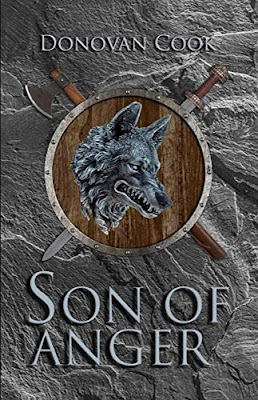
Historical Fiction Spotlight: Son of Anger (Ormstunga Saga, Book 1) By Donovan Cook


Available from Amazon UK and Amazon US


Ulf is like a storm, slowly building up its power, he grows more dangerous with each passing moment. And like all storms, he will eventually break. When he does, he will destroy everything in his path.

Ulf is one of a long line of famous Norse warriors. His ancestor Tyr was no ordinary man, but the Norse God of War. Ulf, however, knows nothing about being a warrior.

Everything changes when a stranger arrives on Ulf’s small farm in Vikenfjord. The only family he’s ever known are slaughtered and the one reminder of his father is stolen -- Ulf’s father’s sword, Ormstunga. Ulf’s destiny is decided.

Are the gods punishing him? All Ulf knows is that he has to avenge his family. He sets off on an adventure that will take him across oceans, into the eye of danger, on a quest to reclaim his family’s honour.

The gods are roused. One warrior can answer to them.
The Son of Anger.


# # #


About the Author


Donovan Cook loved reading stories about Vikings and other medieval warriors fighting to defend their homeland or raiding in distant lands. He now spends his time writing about them. His novels come from his fascination with the Viking world and Norse Mythology and he hopes that you will enjoy exploring this world as much as he did writing about it. Born in South Africa but raised in England, Donovan currently works as an English tutor and when he is not teaching or writing, he can be found reading, watching rugby, or working on DIY projects. Being born in South Africa, he is a massive Springboks fan and never misses a match. Find out more at Donovan's website https://www.donovancook.net/ and follow him on Facebook and Twitter @DonovanCook20

4 April 2022

Book Review: Harry of England: The History of Eight Kings, From Henry I to Henry VIII, by Teresa Cole


New from Amazon UK and Amazon US

In an inspired new book, historian and author Teresa Cole takes a fresh look at British history through the lives of eight kings named Henry. 

My recollection of childhood history lessons was skipping from the Norman invasion to the six wives of Henry VIII, so this informative and highly readable book is a useful way of filling in some of the gaps. I remember being intrigued by the news that Henry I died from a ‘surfeit of lampreys’, but did you know that he admitted to (and provided for) an amazing twenty-two illegitimate children?

As a youngest son, Henry had no idea he would become king, yet watched his brothers die one after the other. When his father, William the Conqueror, lay on his deathbed he granted his youngest son five thousand pounds of silver. With impressive zeal, Henry rushed off to have the silver weighed, and wasn’t seen again until his father’s funeral.

Henry II had little chance to learn from his grandfather, as he was only two years old when Henry I met his uncomfortable end. By the time he was crowned, with his queen, Eleanor of Aquitaine, at Westminster Abbey he was twenty-one, and had gained a good education. 

He was called Henry 'Curtmantle' when he was young because he was so short, and is probably best known for rashly commanding the murder of Archbishop Thomas a Becket at Canterbury cathedral. Henry II left the country in a much better state than he found it, but made many enemies as he curbed the powers of feudal lords.

Henry III didn’t have the best start, as the nine-year-old was crowned with the wrong crown, in the wrong place by the wrong person, but he did have the protection of William Marshall as regent. Henry III married the well-educated and well-connected Eleanor of Provence, untroubled by the fact she was only twelve years old, and they had five children. Described by Teresa Cole as ‘a decent but flawed man’, Henry III’s reign of fifty-six years was the longest in medieval English history.

A further hundred and twenty-five years passed before King Henry IV became the first English ruler since the Norman Conquest to speak English rather than French. The Britain he ruled was a very different place to that of his predecessor. After this we enter much more familiar territory with the remaining four ‘Henrys’ – but I can confirm that author Teresa Cole has brought her fresh perspective to the stories of their eventful lives.

This is a book you can dip in to at any page and find something interesting. Highly recommended.

Tony Riches

Disclosure: A review copy of this book was kindly provided by the publishers, Amberley.

# # #

About the Author

Teresa Cole was a teacher for many years before turning to writing. She is the author of Henry V: The Life of the Warrior King & the Battle of Agincourt 1415 (“Cole understands the importance of drama … a thorough account of Henry’s life” – History of War Magazine), and three books about the Normans – The Norman Conquest: William the Conqueror’s Subjugation of England, After the Conquest: The Divided Realm 1066-1135, and Anarchy: The Darkest Days of Medieval England. In a new departure.