Mastodon The Writing Desk

3 January 2022

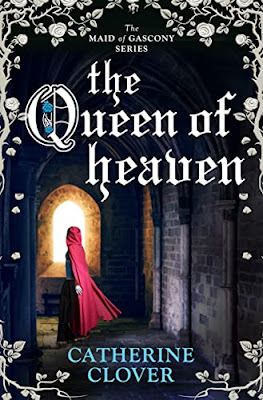
Special Guest Interview with Catherine Clover, Author of Queen of Heaven (Maid of Gascony Book 2)


Available from Amazon UK and Amazon US

The White Tower. A terrible vision. Her home invaded and precious documents stolen.

Lady Isabelle must flee her pursuers, posing as a young male scholar in the New College of St Mary in Oxford. But when she learns she is with child it won’t be long until she is discovered amongst their ranks. Can she bring herself to love an infant conceived in evil? And will she ever be reunited with her beloved Richard, or will Sir Henry Lormont’s dagger find him first?

I'm pleased to welcome author Catherine Clover to The Writing Desk:

Tell us about your latest book

Queen of Heaven is the second book in The Maid of Gascony Series. The story spans the years 1453 - 1457, and takes the reader on a series of adventures as the main character, Lady Isabelle - also known as Isa to her companions - travels across England to sail for Calais and take up the via Francigena en route to Rome. Upon her return to England by ship, she encounters historical figures who will later become known historically as members of the House of Tudor. Throughout the story readers will be reminded of characters and situations that arose in book one, The Templar’s Garden, but Queen of Heaven is written in a style that allows it to also be a stand-alone read.

The main character, Isabelle, is a mystic. She has the power of divine sight that alerts her to people and situations that can be perilous and destructive. In book one, her visions from God assure her that her love - not a physical, bodice-ripping love, but rather an attentive, Christ-like love or caritas - is necessary to help her chaplain survive his ever-deepening mental health illness, today what we would term the onset of bi-polar disorder. But in the Middle Ages it would have been known as a form of madness and it would have certainly caused him to lose his position in the Church and possibly be put to death.

In Queen of Heaven the reader will meet Isa as a young woman. She is no longer an adolescent as she was in The Templar’s Garden. Her voice and character have matured to be those of one who talks and behaves in a more serious and stoic manner. Her petulance and immaturity previously revealed in her statements about love and attraction have been replaced by her articulate, fearless and independent nature. This was not unheard of in this period; one only has to look at women such as Margery Kempe, Christine de Pisan and Joan of Arc for historical examples of women whose characteristics mirror those of Lady Isabelle.

The Templar’s Garden featured a soundtrack called Like as the Hart that I produced and that was recorded by the Choir of New College, Oxford. Queen of Heaven, too, has a soundtrack to accompany the text. Unfortunately, due to the pandemic, the recording of How Sweet the Rose in April 2020 had to be put on hold. I am hopeful that the recording will be made in the future so readers will have another way of further immersing themselves in the Marian themes that are found throughout the second book.

What is your preferred writing routine?

In non-pandemic times I would find myself carving out large chunks of time to do research which would help to focus my mind on the medieval period while listening to the recordings of the Choir of New College. I like to travel throughout England, Wales and the Continent to visit all the places I talk about in my stories. I find that pattern to be hugely inspiring and helpful. Doing so has then led to writing sessions where I incorporate what I have read and seen into the narrative (and sometimes even people I have met become characters!).

What advice do you have for aspiring writers?

My strongest advice is to follow your passion and keep writing as often as you can. But don’t get bogged down in the details. A good editor will help you to iron out your manuscript ahead of publication. And remember, just because you are thinking of something in your mind when writing a scene doesn’t mean your reader will understand it. Be clear. Don’t be afraid of how it will sound to others. It is better to put it down on the page than keep it in the safety of your imagination. As one of my favourite editors, Sally O-J, once advised me when I was shy about the material I was writing and it wasn’t clear to her what I was trying to express, “Get it out of your head and onto the page!” I still live by that mantra today.

What have you found to be the best way to raise awareness of your books?

Queen of Heaven had a blog tour, and I am grateful to those who read and reviewed it. I would love to have the opportunity to engage more with readers by doing virtual and in-person book events. I have a presence across all the socials and love meeting and connecting with other readers and authors on those platforms.

Tell us something unexpected you discovered during your research

In Queen of Heaven the reader learns that Margaret Beaufort gives birth to Henry VII at the very young age of 13, having become pregnant at age 12. While this may not be surprising to historical fiction readers given that it was common practice, especially for those of noble birth, it nevertheless sickened me, especially as at the time of writing Queen of Heaven my daughter was the same age as Lady Margaret in my story. I was constantly thinking of the #metoo movement and how wrong I feel it is to pardon these sexual predators from history simply for the sake of the circumstances being historical.

In my research what struck me was how physically tiny Margaret was. In fact, I was disgusted thinking about what Edmund Tudor did to her. Though it is not historically proven, it is possible that a reason she couldn’t conceive (or didn’t want to later) was because of what sexual intercourse with Edmund did to her mentally and physically, as well as what can only be assumed would have been an incredibly painful and risky birthing process. It made me loathe Edmund as a character, much of which came out in the scenes that involve him and his attitude towards Margaret.

What was the hardest scene you remember writing?

There were several parts of Queen of Heaven that were hard to write, but one of the early scenes that comes to mind is where Lady Isabelle is stripped naked by an angry mob in Lausanne and accused of sorcery. I wrote the entire book as I was faced with personal circumstances that were absolutely horrific. This influenced the nature of the dialogue in that scene, as well as the way in which I described Isa as she managed to keep her wits about her and not let the mob’s abuse destroy her psychologically. Above all, Isa’s faith carried her through the scene. This is one of many situations in Queen of Heaven where Isabelle’s belief in God helps elevate her to a point where she can withstand what is being carried out by others against and around her.

What are you planning to write next?

I have started writing book three in the series called The King’s Treasure. I have two other historical fiction works also in progress. One is set in 20th century Bangkok and involves a famous American silk merchant who mysteriously disappears, his remains never to be discovered and the circumstances of his disappearance thought to be tied to covert espionage, and the other is set in 19th century France and involves the life and loves of a highly successful female artist who worked alongside some of the most famous painters of the Realism movement. She was incredibly avant-garde in her day, never marrying and causing great speculation as she instead took up residence with her best friend, a woman whom she had known since childhood and whose wealth provided them both with financial stability. Their affection for one another helped create the nurturing circumstances for this artist to live and work in the unconventional manner as she did.

Catherine Clover

# # #

About the Author

Catherine’s interest in medieval history began at the age of eight when she was given her first book on medieval knights and castles. From that young age, she was keen to learn more about medieval buildings and the lives of those who lived in and around them. This passion led her to complete her doctoral degree from Trinity College, Oxford, on the fortifications of English Gascony at the end of the Hundred Years War, and subsequently gave root to the creation of The Maid of Gascony series of which The Templar’s Garden and Queen of Heaven are the first two books in the series. Catherine's stories are infused with theology and Divine love, offering readers a rare glimpse of medieval life through the eyes and experiences of a young female mystic. Catherine is also producing a series of choral music albums to feature as the soundtracks to her stories. Like as the Hart, recorded by the Choir of New College, Oxford, under the direction of Robert Quinney, was her first album and it remained in the specialist classical music charts in the UK for 13 weeks after its release. Catherine loves to engage with her readers across the socials. Find out more at Catherine's website www.catherineclover.com and find her on Facebook and Twitter @catherinealette


24 December 2021

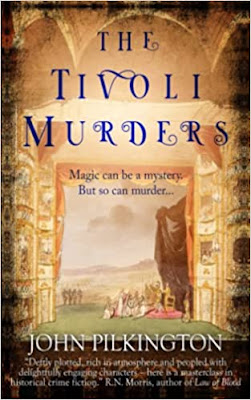
Historical Fiction Spotlight: The Tivoli Murders, by John Pilkington


Available from Amazon UK and Amazon US

London, 1891:It is three years since the notorious Ripper murders, and the last thing London needs is another killer on the streets. But this one targets the strangest of victims: popular Music Hall performers - two in quick succession, outside the famous Tivoli Theatre.

The Music Hall world is one of hard-nosed businessmen, impresarios, and big profits. Inspector Maskell of The Metropolitan Police is desperate for a lead in the case – and soon Sam Vasey, son and manager of Albert Vasey, better known as celebrated illusionist The Great Albertini, is drawn into the mystery.

A vicious campaign of sabotage is waged against the Albertini Company. Things reach a devastating climax at the Star Music Hall in Bermondsey, when Albert’s most spectacular illusion goes badly wrong before a sell-out crowd - resulting in the disappearance and murder of his onstage assistant Mirabel.

With the Albertini show grounded, Sam throws his energy into helping the police investigation. As the mystery deepens, Sam finds his own life in danger.

The hunt takes us from the bright lights of the West End to the gaslit, fogbound streets of London’s darker side – resulting in more than one illusion being shattered.

# # #

About the Author

John Pilkington has written plays for radio and theatre, television scripts for the BBC and now concentrates on historical fiction, reflecting his passion for the Tudor and Stuart periods. A writer for over thirty years, he has published around twenty books including the Thomas the Falconer Mysteries (republished by Sharpe Books), the Marbeck spy series (Severn House) and two Restoration-era mysteries featuring actress-turned-sleuth Betsy Brand (to be republished by Joffe Books). He is also the author of a children’s series, the Elizabethan Mysteries (Usborne). Born in the north-west of England, he now lives in a quiet Devon village with his partner, and has a son who is a musician and composer. Find out more at his website, www.johnpilkington.co.uk, and find John on Twitter @_JohnPilkington.

23 December 2021

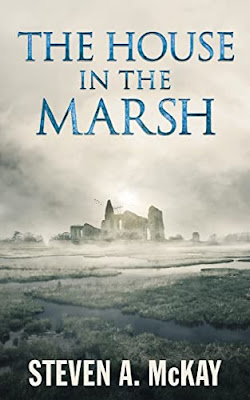
Historical Fiction Spotlight: The House in the Marsh: A medieval Christmas mystery with a ghostly twist (The Forest Lord) by Steven A. McKay


Available for pre-order from

For generations, stories have been told about the ruined old house in the marsh outside Wakefield. Stories of hidden treasure, sinister night-time cries, and ghostly figures doomed to haunt the lonely estate for all eternity as punishment for some terrible crime. This Christmas, it seems the old tales might just turn out to be true…


England, AD 1330: John Little, a bailiff living in Yorkshire, has little interest in ghost stories, having seen enough horrors among the living to bother much about the dead. The strange accounts from his fellow villagers have everyone talking though, and it’s not long before he’s asked to accompany a group of curious locals on nocturnal visits to the house in the marsh.

There are more worrying concerns in northern England however, as autumn gives way to winter and rumours of rogue bailiffs attacking, and even murdering people in their own homes, begin to circulate.

Along with his friends - ill-tempered Will Scaflock and the renowned friar, Robert Stafford - John is drawn inexorably into a dangerous adventure that will leave yet more people dead and only add to the eerie legends which will pass into English folklore for centuries to come.

Can John and his companions uncover the truth about the house in the marsh and its terrible secrets? And will they be able to forever exorcise the ghost haunting Wakefield, or will this Christmas be anything but merry?

# # #


About the Author

Steven A. McKay was born in Scotland in 1977. He says, 'I enjoyed studying history – well, the interesting bits, not so much what they taught us in school. I decided to write my Forest Lord series after seeing a house called “Sherwood” when I was out at work one day. I’d been thinking about maybe writing a novel but couldn’t come up with a subject or a hero so, to see that house, well…It felt like a message from the gods and my rebooted Robin Hood was born. My current Warrior Druid of Britain series was similarly inspired, although this time it was the 80’s TV show “Knightmare”, and their version of Merlin that got my ideas flowing. Of course, the bearded old wizard had been done to death in fiction, so I decided to make my hero a giant young warrior-druid living in post-Roman Britain and he’s been a great character to write. I was once in a heavy metal band although I tend to just play guitar in my study these days. I’m sure the neighbours absolutely love me.' Find out more at his website https://stevenamckay.com/ and find him on Twitter @SA_McKay.

21 December 2021

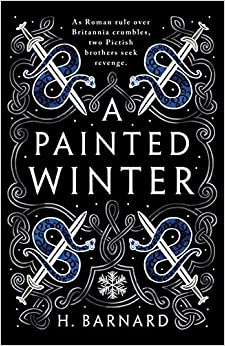
Special Guest Interview with Helena Barnard, Author of A Painted Winter (Book 1 of the Pictish Conspiracy)


Available from Amazon UK and Amazon US

In the misty highlands of fourth century Scotland, two Pictish brothers conspire with the Ancient People from beyond the Great Wall to attack the Romans.

I'm pleased to welcome author Helena Barnard to The Writing Desk:

Tell us about your latest book

A Painted Winter is book one of the four-part Pictish Conspiracy series. Set in early medieval Scotland and Roman Britain, it tells the story of the ‘barbarian conspiracy’ which was a fourth century conflict in Britain when the Picts allegedly conspired with other ‘barbarians’ like the Saxons against the Romans. It is a fascinating, little known about moment in history that was influential in ending the Roman occupation of Britain. The novel is predominately historical fiction with some Celtic mythology / fantasy elements.

A few years ago, I was travelling around Scotland and I started to engage closely with the history and archaeology of Scotland more broadly, but in particular in relation to the Picts. I found it fascinating, especially the early period involving the conflicts with the Romans who tried to conquer their lands.

Unfortunately, the Picts did not record their own history in writing, so the historical records that we have are from the Roman, “enemy perspective”. I thought it would be interesting to show these conflicts from the Pictish perspective. To show what they thought about the conflicts with the Romans and also how they thought about themselves. “Scotland” at the time was made up of many different tribes or Kingdoms and it is interesting to learn that not all of them saw Rome as an enemy. 

Their relationships with each other and with Rome was complicated. Even the people living in what we now know as “England” (who had been occupied for hundreds of years by the Romans at that time) did not necessarily identify as “Roman”and many held onto their old Celtic religion, practices and language. I really wanted to draw out these issues around identity in complex political and economic situations in my book. These themes have never been more relevant given the often polarising state of cultural and political issues in modern times.

What is your preferred writing routine?

I’m very much a planner and after years working as a lawyer, I prefer a structured day. I need a lot of time to research and mull things over. I’ll usually do research and planning during the day, 10 to 5. But for writing, I like those dark, quiet times. So I write late at night and early in the morning.

What advice do you have for aspiring writers?

No matter how old you are, or what career path you’ve had; if you have a story to tell, you should tell it. I was inspired by Sharon Kay Penman who had worked as a lawyer before becoming a historical fiction writer.

What have you found to be the best way to raise awareness of your books?

This is my debut novel, and it is being released on 21 December 2021 so I don’t have a lot of experience with publicity. But I’d say that Instagram and Twitter are very useful platforms in sharing information about upcoming releases. However, it is really important to try and genuinely connect with people on these platforms. The reading community is very positive and is great to connect with like-minded people who love reading and writing. The novel is also part of an Instagram book tour, which has been great in getting the book in the hands of people who are passionate about books.

Tell us something unexpected you discovered during your research

Despite being surrounded by oceans and rivers, the Picts likely did not eat fish. We know this from the absence of fish in archaeological deposits and also human skeletal analysis. Salmon and other sea-beasts feature on the Pictish symbol stones, so they knew they existed. It is unclear, but it may be the case that fish were considered so special by the Picts that they avoided their consumption.

What was the hardest scene you remember writing?

I don’t find writing that difficult, but going through the editing process with my editor and publisher and accepting that certain scenes or even just a line or two needs to be deleted or re-written was hard. Very hard. One scene in particular, involving Druwydds (Druids) in an ancient Oak grove comes to mind. I felt very attached to it. I’d done a lot of research into Celtic mythology and it is probably the scene I am most proud of. Any change that had to be made to that by my editor I found painful!

What are you planning to write next?

I’m finishing off the second book in the Pictish Conspiracy series called The Saxon Spring. It focuses a lot more on the pre-migration Saxons and their involvement in the barbarian conspiracy. I am really excited about the new elements to the story and the action continues to build as the series progresses.

Helena Barnard

# # #

About the Author

Helena Barnard (Pen name H. Barnard) is a historical fiction author, and formerly a lawyer. Born in Australia, Helena now resides in northern England, at the foot of Hadrian’s Wall. A Painted Winter is her debut novel and is book one of the four-part Pictish Conspiracy series. Helena has a passion for history and archaeology, particularly in relation to iron age and medieval Britain. As a historical fiction writer, she focuses on shining a light on lesser-known fascinating moments in history and bringing these moments to life for readers. You can find out more here: https://linktr.ee/Helenareadsandwrites and follow Helena on Twitter @HelenaBwrites


20 December 2021

Special Guest Post by Boshra Rasti, Author of Surrogate Colony


Available from Amazon UK and Amazon US

In MicroScrep, a post-pandemic world, one politician, Arthur Mills, brings all scientists and engineers together to create a vaccine and rebuild a world where harmony ensues.

Dystopian Education

I wrote Surrogate Colony because I am in the business of education. I hate that phrase “business of education”, but believe me, after 15 years teaching, and a Master’s degree in Educational Leadership, there is a definite point when the fog clears and you see it for what it is - a capitalist venture. People think capitalism is about money - it isn’t; it’s about capital, a game of monopoly.

Monopolizing the way you think isn’t the most concerning consequence in this day and age, the most worrying is the way leadership is carved and molded, how human resources are divided, how something as human as learning is broken down, branded, and lorded over vast numbers of vulnerable children. The datafication (which is equal to exploitation - just ask Facebook) of the most basic human yearning, to know and be known, is terrifying.

Even if the bottom line isn’t physical money, there are other currencies at play my dear reader. That’s the thing about systems. Go figure that out for yourselves. I am not trying to convert you. I just want you to question. Actually, the only way to truly be a teacher is to demand that students question. That’s until they ask teachers to stop teaching critical thinking. 

And that’s the exact moment when teachers all over the world, in classrooms or not, should start creating music, art, novels, poems, whatever. Let creation resist the forces of monopoly in the world and clarify that you can datafy, track and control all sorts of nonsense at schools, but you cannot break human wonder, curiosity and creativity.

Adriana, the main character in Surrogate Colony, at a very early age notices this deficiency in education. She remembers early on in the novel:

Mother’s voice rings in my ear, “curiosity killed the cat.” But my favorite teacher, the late Ms. Bonito, said something to me on the eve of her untimely death that I won’t ever forget. “Adriana, it is true that curiosity killed the cat, but satisfaction brought it back.” Her eyes twitched with emotion as she said that to me. On her way home from school, she was killed in a car crash.

Writing that Pierces

Writing must pierce. Being a writer is like sitting on the table for your first tattoo, or earring, or nose ring. The searing needle burning into your skin, the drop of blood a symbol of what you’ve done. Your body is forever altered.

And the way the world sees you has also changed. You’ve made an impression on it; on every passerby that briefly or profoundly stares at you. The gaze depends on the beholder. For some it’s the spectacle of a freak. For others, an attractive impression burned into their mind. It doesn’t matter what the reader sees; it matters that the writer has become vulnerable to the gaze of others.

That’s what scares me about a world without creative spectacle; without a needle and body. That world may very well be dystopian. Ruled by seemingly harmonious rules and order, but that cut the body’s nose in spite of its face.

Writing and art push the boundaries, creating the I am and You are that is so essential to the disgusting or adoring gaze of the other. It is from that place that society can learn tolerance, understanding, and progress.

Without creativity we are doomed to our own banality and flattening. In my novel, Surrogate Colony, people are given X-ray vision to protect themselves from viruses and bacteria. However, X-ray vision in Microscrep isn’t meant to create the piercing reality that society needs to be vulnerable, or creative. It is used to collectively control chaos. However, as the main character, Adriana learns, without chaos we cannot have creativity or desire.

Ties that Bind

“Just because our world is wrong doesn’t mean people don’t enjoy the binds which are holding them in. At least their binds are safe.”

― Rebecca Crunden, A Touch of Death

There is a sickening dysfunction in complacency and silence. That’s why writer’s write, artist’s paint or draw, musicians sing loudly; crescendoing the music despite the complicity and collusion of our tuned out world. They thrive on the edge of normalcy.

It’s scary stuff being different. Having a story to tell; a muse that won’t leave you alone. Maybe that’s why Charles Buckowski’s advice to young writers was to “Drink, f*** and smoke plenty of cigarettes.” I don’t think he was trying to be crass, (okay maybe he was, but I am trying to make a point), he was explaining that writers need to experience life and this might mean that they will not be bound. This means that they must be given space to explore.

In my novel, Surrogate Colony, the problem with society, Microscrep, is when there is no freedom to explore. The majority in Microscrep are the kind of people that “enjoy the binds which are holding them in,” because, “at least their binds are safe”.

The moral of Surrogate Colony is that we should never collectively get to that stage where we are so riddled with fear that we are happier with absolute control. We should never barter our freedom for a prison cell of seeming safety.

Boshra Rasti

# # #

About the Author

Boshra Rasti is an Iranian-Canadian expatriate, writer and educator. She currently lives in Qatar as a teacher. She is the author of several published poems, “Connection in the City”, a poem about the city of Surrey, BC, Canada, as well as the author of “In the Chrysalis”, a poem about the COVID-19 pandemic, published in Together...Apart, an anthology of creative works published by HBKU Press. Her short stories have been published by Grattan Street Press, Literally Stories, and South Florida Poetry Journal.
Boshra draws inspiration from the teenage mind, one she may not have fully outgrown. She also is an avid runner who enjoys the self-torture of running in Qatar. She has other eclectic interests such as making vegan ice-cream. She may or may not use a pen name in the future to prevent a life-long tendency that people have of butchering her name. She hopes to someday make her home somewhere that doesn’t include burning up due to the consequences of global warming. You can find her works on her website: www.boshrawrites.com 

19 December 2021

Book Review: Philippa of Hainault: Mother of the English Nation, by Kathryn Warner


Available from Amazon UK and Amazon US

This is the first full-length biography of Philippa of Hainault since 1910, and explains how fourteen-year-old Philippa who successfully turned an arranged marriage to her fifteen-year-old second cousin Edward III in 1326 into a successful partnership which changed the course of British History.

Philippa was pregnant with her first child, Edward of Woodstock, (later known as 'The Black Prince') when she was crowned at Westminster in 1330, and it seems she was never far from the side of the king, and took an active interest in the politics of the time.  

I particularly like the little details, such as how Philippa's accounts show the cost of repairing a bedspread which had been chewed by her dogs, and that she owned four crowns, studded with jewels.

Philippa acted as regent of England during the king's absence  in 1346, and sent an army against an attempted invasion by the Scots at the Battle of Neville's Cross, rallying the troops on horseback.

Philippa and Edward III had thirteen children, including five sons who survived into adulthood, although three of their children died of the Black Death in 1348. 

Kathryn Warner's insightful research and thought-provoking analysis brings the world of Philippa to life, and this is a book i'm happy to recommend.

Tony Riches

# # # 

About the Author

Kathryn Warner grew up in the Lake District in the north-west of England, and gained a BA and an MA with Distinction in medieval history and literature from the University of Manchester. She is a specialist in the history of the fourteenth century and has been researching and writing about Edward II's reign since 2004, and have run a blog about him since December 2005.  Find out more at Kathryn's blog and find her on Twitter @RoyneAlianore

See Also:

Blood Roses: The Houses of Lancaster and York before the Wars of the Roses, by Kathryn Warner

Richard II: A True King's Fall, by Kathryn Warner  

10 December 2021

Special Guest Interview with Charles Edward Williams Author of The Aelian Crescent


Available from Amazon UK and Amazon US


A new emperor rises and steadily withdraws from the conquered eastern borders. A sinister and treasonous plot is unveiled amongst the elite members of the Senate with dire consequences. The restless emperor disciplines the border legions of Germania and Brittania and erects formidable barriers . Legate Cletus suffers a devastating personal loss.

I'm pleased to welcome author Charles Edward Williams to The Writing Desk:

Tell us about your latest book

My third novel - The Aelian Crescent - in the Vialegio Series follows on from the previous two novels - The Dacian Enigma and The Arc of Dacicus. The first two books covered the ruthless and resolute expansionary eastern frontier and Mesopotamian campaigns of Emperor Trajan. 

During this epoch, this formidable soldier Emperor expanded the Roman Empire to its greatest extent. The Aelian Crescent- focuses on the subsequent succession of his ward Emperor Hadrian- an entirely different creature - who withdrew back from the conquered frontiers and wisely adopted a far reaching commonwealth type political strategy. The story further explores the vicious rivalries against his adoption by members of the Senate, and the capricious jealousies and hellenisation of the Empire by the new forceful and ambitious Emperor.

What is your preferred writing routine?

Mornings mostly, sitting comfortably in my favourite armchair pecking away like a chicken with one finger on my IPad and using the Pages application. Some days the flow is really strong with the words
seemingly streaming out. Other days, when the words struggle to come, I use the slow time to collect my thoughts and to self edit in order to shape and further scope out the storyline.

What advice do you have for aspiring writers?

If a story presses within you to begin writing- then don’t ignore the innate urging of your thoughts. Commit them to writing, even if only a few paragraphs. The efforts of writing your thoughts out will lead to that wonderful moment when the dam bursts, and your story flows forth from your mind.

What have you found to be the best way to raise awareness of your books?

Getting a local bookstore to stock and display the novel was an initial help, as was advertising in the local newspaper. In addition, listing the new book in the National Society of Authors ‘new books’ newsletter provided a wider reach and exposure. Social media appears to assist with broader readership exposure, and to date I’ve used Twitter which has many successful authors exchanging useful and helpful information. The novels are currently listed on Amazon Kindle and on Smashwords.

Tell us something unexpected you discovered during your research

In Emperor Trajan’s case - what struck me was the unseen yet powerful role played by his wife, the dutiful Pompeia Plotina in his rule. Blessed with humility and compassion, she guided many wise decisions made by the imposing soldier Emperor for the overall well being of the population. Due to her wide ranging social works she was adored by the citizens, and her grace and eminence buttressed the popularity of the Imperial couple. 

As regards Hadrian, I was truly surprised to discover that his custodian father Trajan harboured serious doubts about him. Trajan, who was an astute judge of character seemed to dislike Hadrian.Perhaps he thought his ward Hadrian was over influenced by Greek culture. It may well have been that Trajan saw through his capricious nature early on and was wary of him. It remains a mystery, forever lost in the mists of time, as to whether Trajan named Hadrian as his successor or whether it was a subterfuge by Plotina.

What was the hardest scene you remember writing?

The death scenes are always hard. Admirable and worthy soldiers cut down in the heat of battle. Generals that command intense loyalty from their legions falling out of favour with Emperors. Death in childbirth was probably the most harrowing of all- I literally trembled with remorse as the words tumbled out.

What are you planning to write next?

The fourth book which will bookend the Vialegio Series will cover the darkening years of Hadrian’s rule. Included will be the strange and mysterious interplay between the powerful ruler and his adored youthful companion, as well as the savage prophecy unearthed in Egypt that warns of the cracks in the vast Empire.

Charles Edward Williams.

# # #

About the Author  

Charles Edward Williams lives in Dunedin, a coastal University city in the South Island of New Zealand.
Walking past the imposing Arch of Titus and down the large and uneven flagstones leading to the Forum, the author sensed the unheard voices and the untold tales of the soldiers that gave their lives in honour of the hallowed ground. An abiding interest in the first two centuries CE of the early Roman Empire led to the author to relate a soldiers tale. The authors aim is to provide the reader with an enjoyable holiday read and to enable them to share the thoughts and dreams of this remarkable period through the eyes and thoughts of a soldier serving in the Legion. Find out more at his website www.vialegio.com
and find him on Twitter: @LegioVia