Mastodon The Writing Desk

7 November 2022

Special Guest Post by Maggie Phillips and Sarah Clement, Authors of Heart of Pompeii


Available from Amazon UK and Amazon US

The year is 70CE in Pompeii, Italy, and highborn Quintus Vistorius is about to break his family's heart when he runs away from home to escape society's obligations that he marry and have children. At the same time, Valens, a sheep farmer from the country, brings his new wife to start a life in the city. Already, his life is inexorably wound to Quintus' whose disappearance has sent shockwaves through the city. When they do meet three years later, it's in the Lupanar, Pompeii's most notorious brothel where Quintus is now a sex worker going by the name of Ignis. For Val, it's love at first sight. For Ignis, it takes a little longer as loving Val threatens the modicum of freedom he has found 
within the brothel's walls.

Heart of Pompeii is a historical fiction novel featuring LGBTQ+ characters set in, as the title suggests; Pompeii. The story follows the lives of two men; a minor government worker called Valens, newly come to Pompeii with his just as new bride, and Ignis, a native of the city who lives and works in the most popular of Pompeii’s brothels. Even before they meet, their lives are bound together in ways they can’t imagine but meeting transforms them in ways neither of them are prepared for. It’s a story about their lives and about the city they both love. Through their eyes, readers are able to see what life could have been like in one of Ancient Rome’s most famous cities. 

When Maggie and I met, neither of us were expecting to become best friends let alone embark on a publishing adventure that has led us to launch our debut novel; Heart of Pompeii, but here we are. When we announced that we were collaborating on a novel, the number one question was ‘how?’. Maggie lives in Portland, Oregon, and I live in Swansea, Wales which puts us in vastly different time zones where I live my life eight hours ahead of Maggie. Fortunately, Maggie is an early riser. Thus our days began at 7am/2pm and from the very start of the collaboration, we were both aware of the importance of committing hours to writing that we would have to any other job. 

Initially, we hadn’t intended to write the book we did. We hadn’t even planned to work together the way we would go on to. We were both playing with the idea of writing a novel. Both of us had very clear ideas about what we wanted the purposes of our book to be which was how it ultimately became so easy to collaborate. We both wanted to tell queer stories that have been traditionally erased from history and we wanted to root those stories in the human experience. History progresses, times change, but the human experience largely remains the same. This is exemplified in the earliest examples of graffiti which even thousands of years ago relate to the sexual prowess of the writer or the writer’s mother. Some things never change. 

While working on another project, Maggie decided that she wanted to write historical fiction and given that I spend my free time blogging about the history in historical fiction, it seemed natural for me to take on the role of researcher. The setting, Pompeii, had been established before either of us even knew we were going to write anything at all, separately or together.

It’s an interest we both share and it provided a great opportunity for the characters to meet with tragedy which is one of Maggie’s favourite things to write and something she does exceptionally well. One time, she rewrote a scene because she didn’t feel I was crying hard enough. That was a good day. Our main source of inspiration were the casts of ‘two maidens’ found in a garden in Pompeii. Initially thought to be two young women, it was revealed through various tests that the ‘two maidens’ were actually two unrelated men found to be embracing in their final moments. 

As we researched, the scope of the project became bigger and along the way we became co-writers. At the time, I was working on a project that Maggie was heavily involved in. Ultimately, I asked her to write it alongside me and we decided to take a character each and write chapters from alternate points of view. It worked great and that project became the practice run for our main event; the Heart of Pompeii. 

We had our story and characters were starting to take shape within it. We had dual protagonists and alternating points of view which meant we could easily divide the main characters. We chose one each to write from which ensured a consistent voice for each of them throughout the novel. We filled notebooks with planning and character ideas, ensuring that we were agreed on motivation, traits, relationships, and anything else we could think of so that the story remained coherent despite having two authors. 

Writing the story was actually the easy part. Making two styles of writing work as one was much harder. Maggie prefers to write through dialogue whereas I will avoid dialogue at all costs, choosing instead to write in long, meandering, flowery language with mostly unnecessary words. The two of us would spend entire editing sessions trying to make the pacing match which would see me telling Maggie that she really did have to add some environmental detail, while she would delete entire sections where I’d described the air temperature for two paragraphs. One of the most common exchanges would be me completely freezing on how to write a conversation while Maggie pointed out that as a human being, I had, on occasion, been known to have a conversation. 

Communication was vital and not just for the sake of the novel. If there were days when one of us was feeling particularly vulnerable or fragile about a section or a scene then the other would have to be gentler in their criticism. Throughout it all, we never lost sight of the fact that we were trying to help each other be the best writers we could be and nothing was being criticised out of spite. We were also quick to reassure each other that just because our styles are different, it didn’t mean that one was worse than the other. It was conversations like these that hammered home to me how I couldn’t have collaborated with just anyone else. 

The distance offered up another issue that neither of us had considered; the language barrier. When we first started writing anything together, we decided whether to write in British English or American English but neither of us appreciated just how different the language we speak is. We both speak English but we would frequently be using words or phrases that simply did not translate into the other’s cultures.

Words that mean something in Britain might mean something entirely different in America and vice versa. The issue of spelling consistently seemed to be the most minor of considerations when we would frequently stop and question each other just what the hell we were talking about, while the other shouted back that it was a perfectly normal phrase. Arguments would inevitably ensue and for the most part, they were hilarious. 

For me, the hardest scene to write were the closing chapters set during the eruption of Vesuvius. I wept. And Maggie decided that we needed a particularly emotional soundtrack to those scenes which only made me weep harder. It’s hard to type when you can’t see through your own tears. Maggie, on the other hand, was in her element. Far harder for her was when we came to write one of the birthday events, a scene which marked a turning point in the story for character motivations and development. It struck a little close to home given that we were writing during the covid years and largely isolated from anyone who wasn’t on the end of our laptops. 

With the book written, edited, edited again, and edited some more, we decided to attempt the traditional route of publishing via an agent. A benefit of collaboration was that whenever we received the inevitable rejection letters, we could face it together. Some hurt more than others and we never did discover whether it was better to market ourselves as a single writer under a penname than a collaboration. After almost a year of trying, we decided to go the self-publishing route and here we are! 

Having gone through the many, many, many highs and lows of self-publishing we feel pretty well prepared for our next project. Our ethos remains the same; to tell queer stories throughout history. The stories don’t have to be grandiose or groundbreaking, they’re just showing that queer people existed. They lived. Regardless of the time period, we’ve always been here. 

We’ve entertained a few ideas for our next work but we’re leaning towards something set during the Roman Conquest of Britain, focusing on the Demetae tribe of South-West Wales. Despite overwhelming odds, they resisted Roman occupation and maintained their identity. They would go on to found Ceredigion and Dyfed, from which generations upon generations of my family have sprung from, including myself. We’ve also considered solo works but have enjoyed collaborating so much, we’re in no hurry to leave it. 

Maggie Phillips and Sarah Clement 

# # #

About the Authors


Maggie Phillips is debuting as an author, mixing her love of history and writing for the first time professionally as a full-time writer. She lives for writing and bringing queer stories out to the front of history where they belong. She lives in Oregon, United States with her husband. 
Sarah Clement loves writing about history and is finally taking the leap from her historical blog of many years to the world of printed historical fiction. She lives with her daughter in Swansea, Wales.  You can also find Maggie and Sarah on Instragram @wenglishwrites

3 November 2022

Historical Fiction Spotlight: Squire's Hazard, by Carolyn Hughes


Available from Amazon UK and Amazon US

How do you overcome the loathing, lust and bitterness threatening you and your family’s honour?

It’s 1363, and in Steyning Castle, Sussex, Dickon de Bohun is enjoying life as a squire in the household of Earl Raoul de Fougère. Or he would be, if it weren’t for Edwin de Courtenay, who’s making his life a misery with his bullying, threatening to expose the truth about Dickon’s birth.

At home in Meonbridge for Christmas, Dickon notices how grown-up his childhood playmate, Libby Fletcher, has become since he last saw her and feels the stirrings of desire. Libby, seeing how different he is too, falls instantly in love. But as a servant to Dickon’s grandmother, Lady Margaret de Bohun, she could never be his wife.

Margery Tyler, Libby’s aunt, meeting her niece by chance, learns of her passion for young Dickon. Their conversation rekindles Margery’s long-held rancour against the de Bohuns, whom she blames for all the ills that befell her family, including her own servitude. For years she’s hidden her hunger for retribution, but she can no longer keep her hostility in check.

As the future Lord of Meonbridge, Dickon knows he must rise above de Courtenay’s loathing and intimidation, and get the better of him. And, surely, he must master his lust for Libby, so his own mother’s shocking history is not repeated? Of Margery’s bitterness, however, he has yet to learn…

Beset by the hazards these powerful and dangerous emotions bring, can young Dickon summon up the courage and resolve to overcome them?

Secrets, hatred and betrayal, but also love and courage 
Squire’s Hazard, the fifth 
MEONBRIDGE CHRONICLE.

# # #

About the Author

Carolyn Hughes has lived most of her life in Hampshire. With a first degree in Classics and English, she started working life as a computer programmer, then a very new profession. But it was technical authoring that later proved her vocation, as she wrote and edited material, some fascinating, some dull, for an array of different clients, including banks, an international hotel group and medical instruments manufacturers.Having written creatively for most of her adult life, it was not until her children flew the nest several years ago that writing historical fiction took centre stage, alongside gaining a Master’s degree in Creative Writing from Portsmouth University and a PhD from the University of Southampton.
Find out more at Carolyns website www.carolynhughesauthor.com and find her on Facebook: CarolynHughesAuthor and Twitter: @writingcalliope

2 November 2022

Special Guest Post by Jenni Keer, Author of The Legacy of Halesham Hall


Available from Amazon UK and Amazon US

1890. One summer evening changes everything for Sidney and Leonard Bellingham when their beloved mother disappears from the family home, Halesham Hall. Left with their bitter father, they are taught to trust no one but themselves, with brother pitted against brother to see who is worthy of inheriting the Bellingham Board Games company. But the series of twisted games they are forced to play will have far reaching consequences. 1920. Phoebe Bellingham arrives at Halesham Hall determined to solve the puzzles that will allow her to claim back the Bellingham inheritance. But this legacy involves more than one secret, and soon Phoebe realises that the stakes are higher than she ever could have imagined.

Thanks for having me on to talk about my latest book, The Legacy of Halesham Hall, a gothic romance with plenty of twists and turns. It’s perfect timing as the book is currently on a Kindle Monthly Deal for November and can be purchased for JUST 99p/99c in the UK, US and Canada, so if you fancy a slow-burn romance scattered with puzzles and plot twists, set in a creepy old house, now is the time …

Writing this book is a real departure for me as it’s my first purely historical work. There are two timelines: one follows the tumultuous summer of 1899 for adolescent Sidney Bellingham, and the other is the arrival at Halesham Hall of a young woman in 1920, trying to get to the bottom of a decades-old family rift. 

Because the Bellingham family own a board games company, I had great fun designing both their fictional games and the weird house with puzzles embedded in its very fabric. It is slightly darker than my previous books, but I always write a happy ever after, so ultimately it is an uplifting read.

Writing novels set in the past has been a real challenge. Everything my characters do, say or even think has to be historically accurate, which means plenty of research around clothes, settings and events, but also speech and concepts. For example, in Halesham Hall I couldn’t use the words weekend or teenager (which was interesting because the thrust of Sidney’s story is very much about how teenage he is, and how adolescent behaviour hasn’t changed much in a hundred years!). 

Every time I use a well-known phrase I check it isn’t anachronistic, and I permanently have an online etymological dictionary open. All of that, alongside the usual fact-checking, such as ensuring flowers are blooming at the right time, the timeline is consistent, and so on, takes time. And still I managed to miss that collared doves didn’t come to the UK until the 1950s. *groan*

Because I’m rubbish at plotting, the book involved plenty of rewriting when ideas, plot twists and even character traits occurred to me during the writing process. I am full of admiration for authors who are able to plan their novels in advance, but I have learned that we all have a different process, and as long as we all get there in the end, it doesn’t matter how we get there. 

Going forward, I am sticking with historicals, and my current work-in-progress is set in 1927. The roaring twenties have been fascinating decade to research and I look forward to sharing this book with my readers next year.

Jenni Keer

# # #

About the Author

Jenni Keer is a history graduate who embarked on a career in contract flooring before falling in love and moving to the Suffolk countryside. Her lifelong passion for reading became a passion for writing, and she was delighted when her debut novel, The Hopes and Dreams of Lucy Baker, was shortlisted for two awards. Her first two books were contemporary romance but she has now embraced her love of the past to write twisty, turny historicals. Living with four grown up children and three cats (but just the one husband) she is frustrated by their inability to appreciate that when she's staring into space, she's actually working, and that watching television counts as research. Much younger in her head than she is on paper, she adores any excuse for fancy-dress and is part of a disco formation dance team. Find out more at Jenni's website https://jennikeer.co.uk/ and follow her on Facebook and Twitter @jennikeer

1 November 2022

Historical Fiction Spotlight: Dark Waters Rising (An Abbess of Meaux mystery Book 12) by Cassandra Clark


Available from Amazon UK and Amazon US

A storm is coming . . . Can nun sleuth Hildegard solve the murder of a lay sister before the rising flood waters trap her with a cunning killer?

Autumn, 1394. All is not well at Swyne Priory. Dissension has arisen amongst the nuns. The new novices whisper in corners, spreading malicious rumours and sharing dark secrets.

The Prioress gives Hildegard an order: search out the cause of this unrest, and put a stop to it. But before Hildegard can investigate, she's forced to deal with a new problem: the arrival of a mysterious stranger in the middle of the night, claiming his life is in danger.

Hildegard isn't sure whether to believe him, but when a body is discovered near the priory, she's soon plunged into a dark and dangerous puzzle where nothing is as it seems. All she knows for certain is that a storm is coming, threatening to cut the priory off from the outside world and trap them with a killer . . .

Medieval mystery at its finest - and a great pick for readers who love sleuthing monks and nuns like Peter Tremayne's Sister Fidelma, Ellis Peters' Brother Cadfael and Cora Harrison's Reverend Mother.

# # #

About the Author

Cassandra Clark has an M.A. from the University of East Anglia and taught for the Open University on the Humanities Foundation course in subjects as diverse as history, philosophy, music and religion. Since then she has written many plays and contemporary romances as well as the libretti for several chamber operas.  Find out about Cassandra's other books on her website at www.cassandraclark.co.uk and follow her on Twitter @nunsleuth

28 October 2022

Special Guest Post by Richard Lamb, Author of Things That Wait in the Dark: Should Authors Create Their Own Book Covers?


Available from Amazon UK and Amazon US

Things That Wait in the Dark brings you 20 vintage tales from that golden age. Tales of horrors both natural and supernatural. This brand new collection was compiled from the archives of the late Hugh Lamb, one of the world’s leading anthologists of vintage horror, and from discoveries made by his son, Richard. You’ll find a host of lesser known stories as well as some not seen in an anthology 
since their original publication.

The rise of self-publishing transformed the industry. As an author today, you have full control over your books, inside and out. With all the software and apps available, you can even create your own book cover. But should you?

It’s no wonder that, in your excitement to get your book out to the world, you may question the need for a professional cover artist. You think to yourself, how hard can it be? With a bit of technical experience, you can handle the job. But back away from your laptop for just a moment and let’s discuss.

As a serious writer, you’ve studied the craft and practiced newfound techniques, all in the quest to perfect your writing. You’ve written drafts, rewritten, edited, and proofread your manuscript. Maybe you even workshopped it in a writing group or hired a professional editor. Have you invested the same effort to master graphic design?

If not, you may be on your way to creating a cover that includes a couple of Googled images with a title pasted over them in a poorly chosen font with no appreciation of layout, design principles, or current industry trends. Your book deserves better than that. Its jacket should do justice to the effort and creativity contained within.

A book cover has a lot of work to do. It must catch the eye, engage the reader, but also depict the tone, genre, period, and setting of the story with the goal of selling the book to the appropriate reader. Moreover, it has to juggle all these demands while mainly existing as a tiny thumbnail in a sea of competitors. That’s a big ask for a single image and a couple of fonts. But it can be done. Just not necessarily by the writer of the book. 

Be honest with yourself: Do you have the knowledge and expertise to pull this off? After all, a cover is the face of your book. It’s the first thing people will see, before they’ve even read the synopsis. Indeed, if that cover is unattractive or misleading to your intended audience, they may not get to the synopsis at all. And let’s not forget that each time someone shares a post about your new book on social media, the cover will be put before dozens, hundreds, maybe even thousands of discerning eyes and potential readers. 

As a cover artist, designer and published anthologist, there’s something so pleasing about a well conceived, brilliantly executed book cover. Conversely, I find myself disheartened when I see the wasted opportunity for something special on a book that could be absolutely fantastic on the inside. 

My father, Hugh Lamb, was a rather well known writer and anthologist of Victorian ghost stories (the anthologies I now publish started as my way of memorializing him after he passed away in 2019). I came to understand the publishing business from an early age. I remember his excitement with the publication of each book and with each new cover design that came for his approval. 

I went on to attend art school and began designing and illustrating the covers for some of his books from the end of the 90s (with old-fashioned pen and ink rather than my now preferred Photoshop). I also illustrated books by other genre authors, including Ramsey Campbell. Unsurprisingly, I developed a love for the horror genre but I also learned the power of a good book cover. 

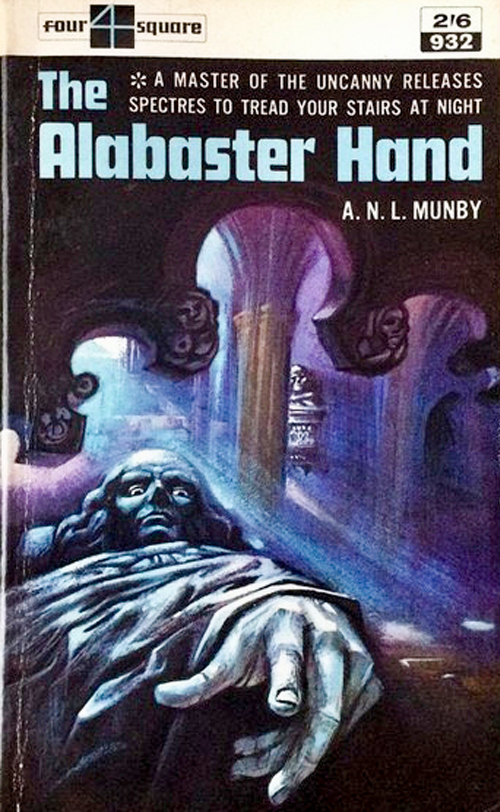
My father had a huge collection of books. One of my enduring childhood memories is creeping into my dad’s office with my brother to scare ourselves with some of the spookier covers in his collection. The ones I particularly remember are Tales of the Uncanny and Supernatural by Algernon Blackwood, 

The Alabaster Hand by A. N. L. Munby, and also some of my father’s own covers (the paperback editions of Victorian Tales of Terror and The Taste of Fear spring to mind). These images, and the style in which they were done, burned themselves into my consciousness and no doubt inform the covers I produce today, both for my own books and for other authors. 

We should never forget that the cover is there solely in the service of the book. But great books stay with us forever, and I see no reason why a great book cover can’t do the same. Design is art, and your cover design should be a piece of art worthy of the work you put into that book. That is what we cover designers strive for—a cover that does its job well and would not look out of place hanging on a wall either. 

So my advice to you, dear author, as you embark on the wonderful experience of releasing your book into the wild, is make sure you hire someone to do the cover that it deserves if you are not experienced enough to do it yourself. But for those who decide that they will be doing their own cover after all, here are 5 basic pointers to help you out:

1. Design often works in trends. Look at the covers of other books in your genre. Don’t be afraid of putting your own spin on a layout you have seen and like (and that means a spin, not a direct copy). 

2. Keep it simple. Composite images are not necessarily a bad thing (I use them myself), but if you don’t understand how to compose them, you may end up with a disjointed and distracting soup. 

3. Check the ownership and licensing of the images you are using. Stock image sites can be ruthless when they discover you have used their property without purchasing the license. 

4. Typefaces/fonts matter. They speak and have utility beyond being read. Make sure you pick a typeface for your title that suits the book’s genre and tone. Look at what other books in your genre use and select something similar. A flowery script typeface on the cover of a thriller (I’ve seen it) just doesn’t work. 

5. Once you have put your elements together, look at the cover in thumbnail size. Does it catch your eye? Can you read it? Is it identifiable? If it does not work as a thumbnail, it is next to useless.

Good luck! 

Richard Lamb

# # #

About the Author

Richard Lamb is the owner of Inspired Lamb Design, a creative agency specializing in web sites and cover art for authors. He is also a writer and anthologist. Richard’s newly released anthology THINGS THAT WAIT IN THE DARK was just featured in The Washington Post. Feel free to reach out to him at richard@inspiredlambdesign.com, visit his website at https://websites-for-authors.inspiredlambdesign.com and find him on Twitter @IldWebdesign

26 October 2022

New Historical Fiction Spotlight: The Winter Garden, by Nicola Cornick


New from Amazon UK and Amazon US

Remember, remember, the fifth of November…

1605: Anne Catesby fears for her family. Her son, the darkly charismatic Robert, is secretly plotting to kill the King, placing his wife and child in grave danger. Anne must make a terrible choice: betray her only child, or risk her family’s future.

Present day: When her dreams of becoming a musician are shattered, Lucy takes refuge in her family’s ancestral home in Oxfordshire. Everyone knows it was originally home to Robert Catesby, the gunpowder plotter. As Lucy spends more time in the beautiful winter garden that Robert had made, she starts to
have strange visions of a woman in Tudor dress, terrified and facing a heartbreaking dilemma.

As Lucy and Anne’s stories converge, a shared secret that has echoed through the centuries separating them, will change Lucy’s life forever…

Sweeping generations from the 1600s to the present day, with the enthralling Gunpowder Plot at its heart, Nicola Cornick’s utterly enchanting new timeslip novel will sweep you off your feet. Perfect for fans of Lucinda Riley, Barbara Erskine and Kate Morton.

‘A completely wonderful read. Set during the Wars of the Roses and the present day, it’s historically rich, emotional and magical. I was intrigued and immersed throughout’ TRACY REES

‘Well, Nicola has done it again! A cracking tale that wouldn’t let me put it down or turn out the light. I absolutely loved it’ KATIE FFORDE

‘Atmospheric and beautifully crafted, I guarantee this suspenseful time-slip story will have you up all night to finish’ RACHEL HORE

‘A treasure trove of historical insight, casting a new light on a compelling mystery that binds the present to the distant past’ FIONA VALPY

‘I was utterly immersed, forgetting everything but the story and the characters. Nicola’s writing is so vivid and beautiful and perfectly pitched, her plotting addictive’ JENNY ASHCROFT

‘Well researched and stylish, full of emotion from past and present, this is an engrossing mystery to keep the reader turning the pages’ ANNE O’BRIEN, author of The Queen’s Rival

‘An engaging, beautifully crafted romance that weaves together several intriguing mysteries, both ancient and modern, and questions the very essence of time itself’ ALISON WEIR, author of Six Tudor Queens

# # #
About the Author

Nicola Cornick grew up in Yorkshire and studied History at the University of London and at Ruskin College Oxford where she was awarded a Distinction for her Maters dissertation on heroes and hero myths. She worked in academia for a number of years before becoming a full-time writer. She is the author of acclaimed dual-time mysteries as well as of award-winning historical romance. When she isn’t writing, Nicola volunteers as a guide and researcher for the National Trust at the 17th century hunting lodge Ashdown House. She has given talks and chaired panels for a number of festivals and conferences including the London Book Fair, the Historical Novel Society and the Sharjah Festival of Literature.  Nicola also gives talks on public and local history topics to WIs, history societies and other interested groups. She is a former Chair of the Romantic Novelists Association and is the current RNA archivist, and a trustee of the Friends of Lydiard Park. In her spare time Nicola is a puppy walker for the Guide Dogs charity. Find out more at Nicola's website www.nicolacornick.co.uk and follow her on Twitter @NicolaCornick

25 October 2022

Historical Fiction Spotlight: The Godmother’s Secret, by Elizabeth St.John


Available from Amazon UK and Amazon US

What if you knew what happened to the Princes in the Tower. Would you tell? Or would you forever keep the secret?

November, 1470: Westminster Abbey. Lady Elysabeth Scrope faces a perilous royal duty when ordered into sanctuary with Elizabeth Woodville–witness the birth of Edward IV’s Yorkist son. Margaret Beaufort, Elysabeth’s sister, is desperately seeking a pardon for her exiled son Henry Tudor. 

Strategically, she coerces Lancastrian Elysabeth to be appointed godmother to Prince Edward, embedding her in the heart of the Plantagenets and uniting them in a destiny of impossible choices and heartbreaking conflict.

Bound by blood and torn by honour, when the king dies and Elysabeth delivers her young godson into the Tower of London to prepare for his coronation, she is engulfed in political turmoil. Within months, the prince and his brother have disappeared, Richard III is declared king, and Margaret conspires with Henry Tudor to invade England and claim the throne. 

Desperate to protect her godson, Elysabeth battles the intrigue, betrayal and power of the last medieval court, defying her husband and her sister under her godmother’s sacred oath to keep Prince Edward safe.

Were the princes murdered by their uncle, Richard III? Was the rebel Duke of Buckingham to blame? Or did Margaret Beaufort mastermind their disappearance to usher in the Tudor dynasty? Of anyone at the royal court, Elysabeth has the most to lose–and the most to gain–by keeping secret the fate of the Princes in the Tower.
 
Inspired by England’s most enduring historical mystery, Elizabeth St.John, best-selling author of The Lydiard Chronicles, blends her own family history with known facts and centuries of speculation to create an intriguing alternative story illuminating the disappearance of the Princes in the Tower.

The enduring mystery of the princes in the tower just got an exhilarating new twist. An exquisite novel—I couldn't put it down. Amy Maroney, Author of The Miramonde Series and The Sea and Stone Chronicles

 The Godmother's Secret is beautifully written with a careful balance of fiction and fact made possible thanks to Elizabeth St. John's meticulous research. The descriptions are breathtaking and well-placed. The blend of action, introspection, and drama is perfect. I loved that I did not always agree with Elysabeth. It made her character more human with independent decisions and thoughts and not simply the lovable storyteller. The other characters are also carefully fleshed out and masterfully imagined from the past. St. John has carefully added individual characteristics and behavior that breathes life into every person along the road and it made for a marvelous read. St. John's experience as a brilliant novelist shines through in this flawless story that took me on a magical journey into the past. The only complaint I have is that it ended too soon. I can't wait to get my hands on St. John's other work, The Lydiard Chronicles. Five Stars, Readers' Favorite

# # #

About the Author

Elizabeth St.John was brought up in England, lives in California, and spends most of her time in the 17th Century. To inspire her writing, she has tracked down family papers and residences from Nottingham Castle, Lydiard Park, and Castle Fonmon to the Tower of London. Although the family sold a few castles and country homes along the way (it's hard to keep a good castle going these days), Elizabeth's family still occupy them - in the form of portraits, memoirs, and gardens that carry their imprint. And the occasional ghost. But that's a different story... Find out more at Elizabeth's website http://www.elizabethjstjohn.com/ and follow her on Facebook and Twitter @ElizStJohn